Wei Collection, Lower Volume
Radical: Meat (ròu)
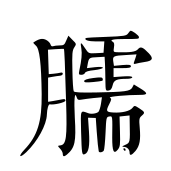
臑
Kangxi stroke count: 20
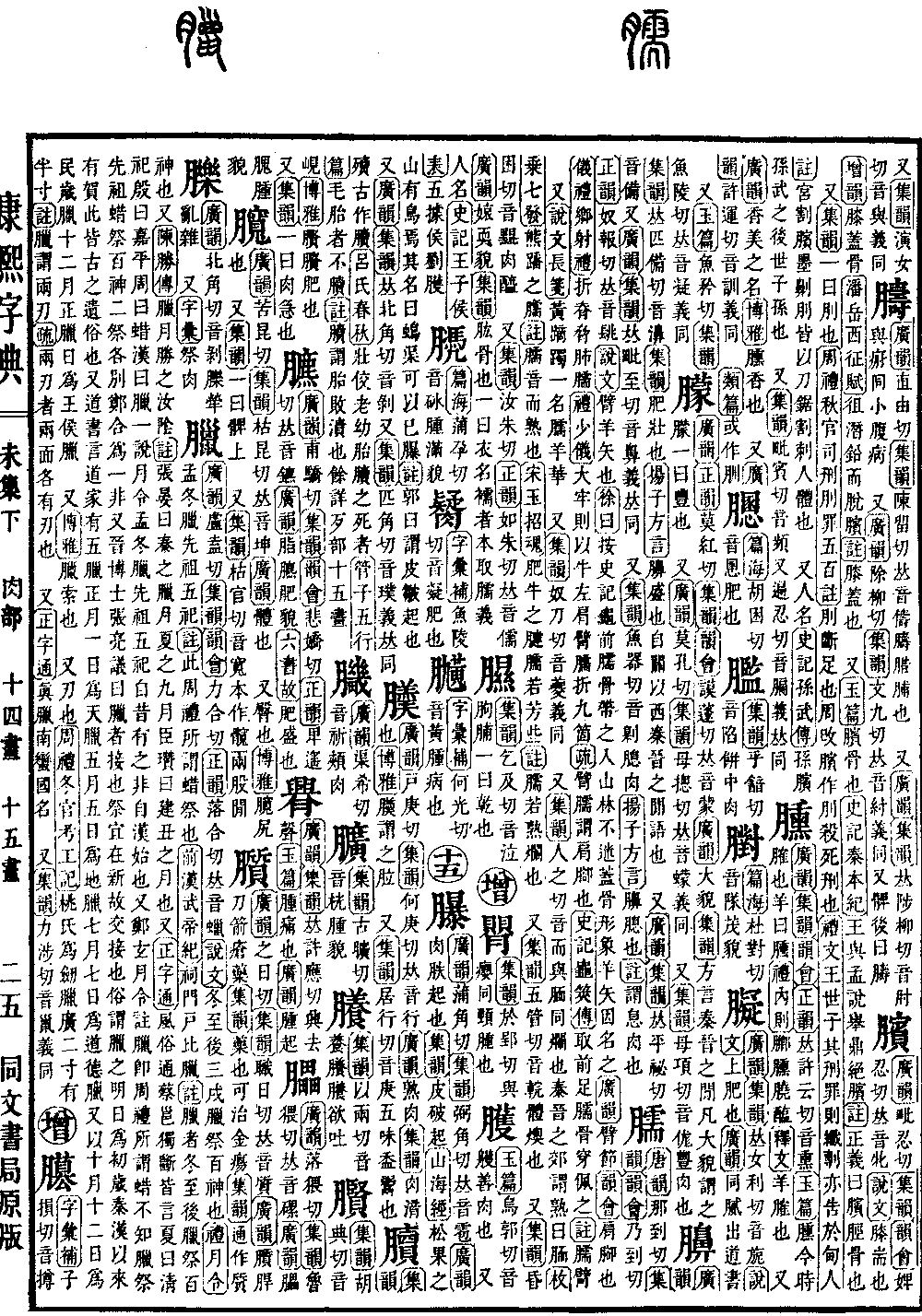
Page 997, Entry 10
Pronounced nào.
According to the Shuowen Jiezi (Shuowen), it refers to the bone in a sheep's leg. Xu comments that in the Records of the Grand Historian (Shiji), it is mentioned that the front leg bone of a tortoise, when carried into mountains and forests, prevents one from becoming lost. Because the bone resembles a sheep's dropping, it is named accordingly.
Guangyun defines it as the joint of the arm. Yunhui defines it as the shoulder or leg.
In the Book of Etiquette and Ceremonial (Yili), it mentions breaking the spine, ribs, lungs, and shoulder. In the Book of Rites (Liji), it states that for a great sacrifice, use nine pieces of the left shoulder and leg of the ox. The commentary explains that the shoulder leg is referred to as the arm-shoulder.
In the Records of the Grand Historian (Shiji), the Turtle Divination Biography states to take the front leg bone and wear it. The commentary notes that it refers to the arm bone.
Additionally, according to the Shuowen Changjian, the yellow azalea is also known as the sheep-shoulder flower.
Pronounced kuí. The meaning is the same.
Pronounced ér. Equivalent to the character ér (meaning to be cooked/well-done). In the regions of Qin and Jin, being cooked is called ér. In the Seven Stimuli (Qi Fa) by Mei Sheng, it refers to bear paws that are well-cooked. The commentary states it is pronounced ér, meaning cooked and soft. In Song Yu's Summons of the Soul (Zhao Hun), it describes the tender fat of a cow as soft and fragrant. The commentary notes that it means cooked and tender.
Pronounced wǎn. Refers to bodily warmth.
Pronounced hùn. Refers to a minced meat condiment.
Pronounced rú. Guangyun defines it as a soft appearance. Jiyun defines it as the humerus bone. Another definition describes it as a type of garment, noting that the word for a short jacket (rú) originates from the meaning of this character.