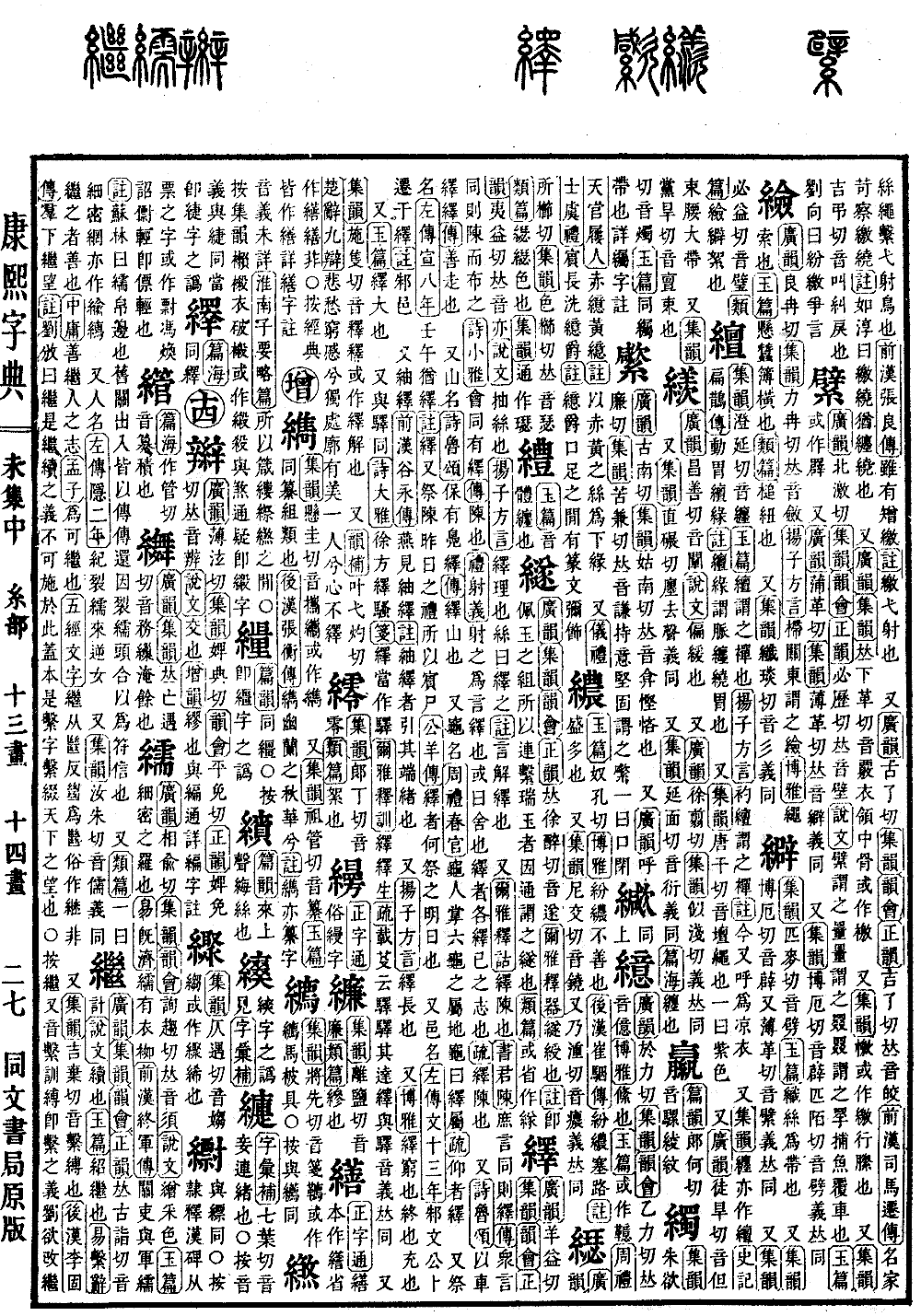
Wei Collection, Middle Volume
Radical: Silk (mì)
Kangxi Strokes: 19
Page 941, Entry 06
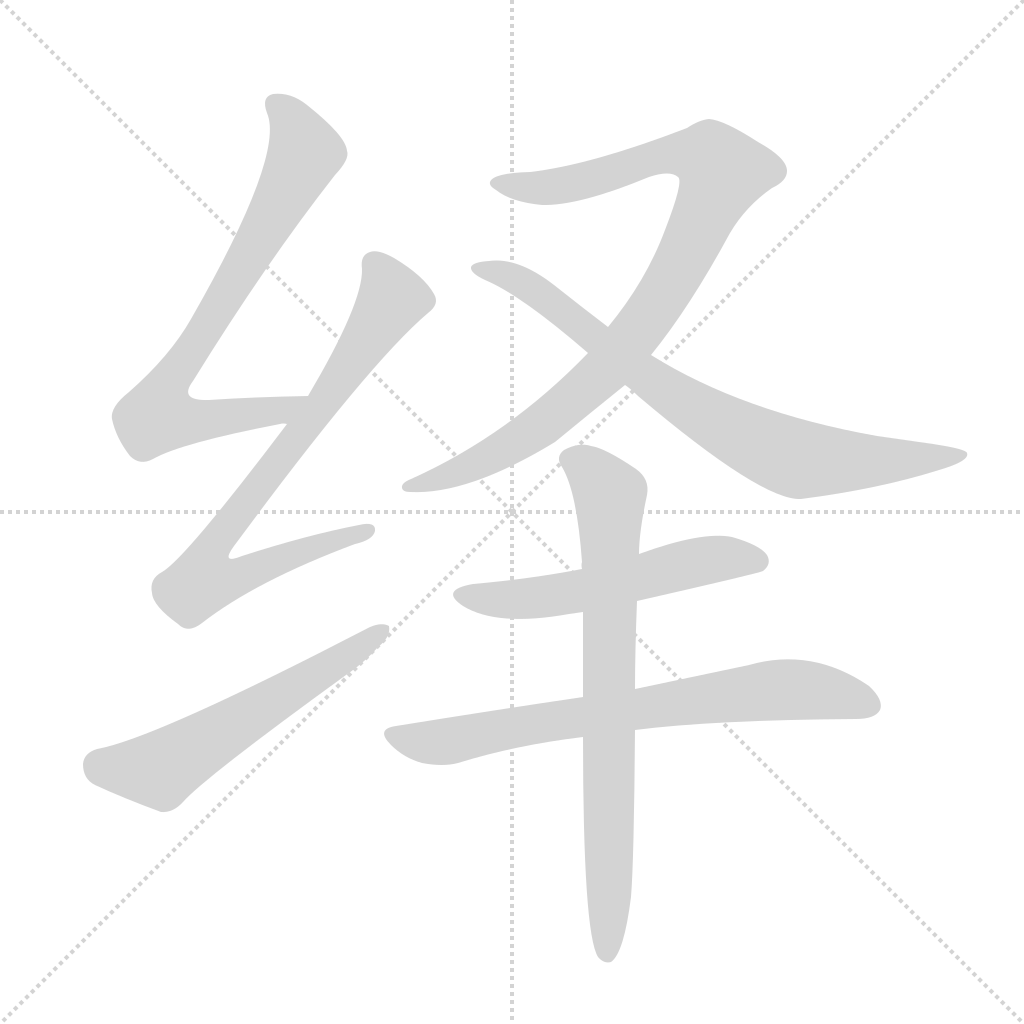
Pronounced yi (falling tone).
According to the Analytical Dictionary of Characters (Shuowen Jiezi), it means to draw out silk.
According to the Regional Speech (Fangyan) by Yang Xiong, yi means to organize or manage; when referring to silk, it is called yi. The commentary notes that this means to untangle or explain.
Also, in the Approaching Elegance (Erya), entry Explaining Ancient Terms, yi means to display or set forth.
In the Book of Documents (Shujing), chapter Jun Chen, it is written: when the words of the masses are in accord, then they are set forth. The commentary explains that when the words of the multitude are in harmony, they are displayed and distributed.
In the Book of Odes (Shijing), Lesser Odes, it is written: meetings and gatherings are held in orderly fashion. The commentary explains this as to display.
In the Book of Rites (Liji), chapter Meaning of Archery, it is written: the term archery implies a setting forth; or it is said to mean to release; it means that each person displays their own intent. The commentary clarifies that yi means to display.
Also, in the Book of Odes (Shijing), Lu Odes, it is written: with chariots moving swiftly. The commentary interprets this as moving well.
Also, the name of a mountain. In the Book of Odes (Shijing), Lu Odes, it is written: possessing the Fu and Yi mountains. The commentary identifies Yi as a mountain.
Also, a type of turtle. In the Rites of Zhou (Zhouli), Ministry of Spring, the Turtle Master manages the six classes of turtles; the earth turtle is of the Yi class. The commentary notes that those with an upturned shell are of the Yi type.
Also, a type of ritual. In the Zuo Tradition (Zuozhuan), eighth year of Duke Xuan, it is written: on the ren-wu day, the yi ritual was performed. The commentary notes that yi is an auxiliary sacrifice, intended to set forth the rituals of the previous day and to entertain the sacrificial representative. In the Gongyang Tradition (Gongyangzhuan), it asks what the yi ritual is, and answers that it is the day following a sacrifice.
Also, the name of a city. In the Zuo Tradition (Zuozhuan), thirteenth year of Duke Wen, it is written: Duke Wen of Zhu divined to move the capital to Yi. The commentary notes this was a city of the Zhu state.
Also, to disentangle or analyze. In the History of the Former Han (Qian Hanshu), biography of Gu Yong, it is written: he was received in private audience and analyzed the matters. The commentary explains that this means to pull at the threads of a situation.
Also, according to the Regional Speech (Fangyan), yi means to be long.
Also, according to the Extensive Dictionary (Boya), yi means to be exhausted, to end, or to be filled.
Also, according to the Jade Compendium (Yupian), yi means to be great.
Also, identical to the character for relay station (yi). In the Book of Odes (Shijing), Greater Odes, it is written: the Xu tribes are in a state of turmoil. The annotation suggests that yi should be written as the character for relay station. In the Approaching Elegance (Erya), entry Explaining Teachings, it says yi-yi means to grow. The commentary cites the poem Zai Shan which uses the relay station character to describe vigorous growth, noting that the sounds and meanings of the two characters are the same.
Also, according to the Compilation of Rhymes (Jiyun), pronounced shi (falling tone). The character for release is sometimes written as yi, meaning to loosen.
Also, according to the Rhyme Supplement (Yunbu), rhyming with the sound yi (entering tone). In the Songs of Chu (Chuci), Nine Arguments, it is written: deeply sorrowful and lonely I dwell in the vastness, there is one beautiful person whose heart is not comforted.
Textual Note: In the Approaching Elegance (Erya), entry Explaining Teachings, the phrase yi-yi means to grow. In accordance with the original text, the character for meaning has been added after the word grow.