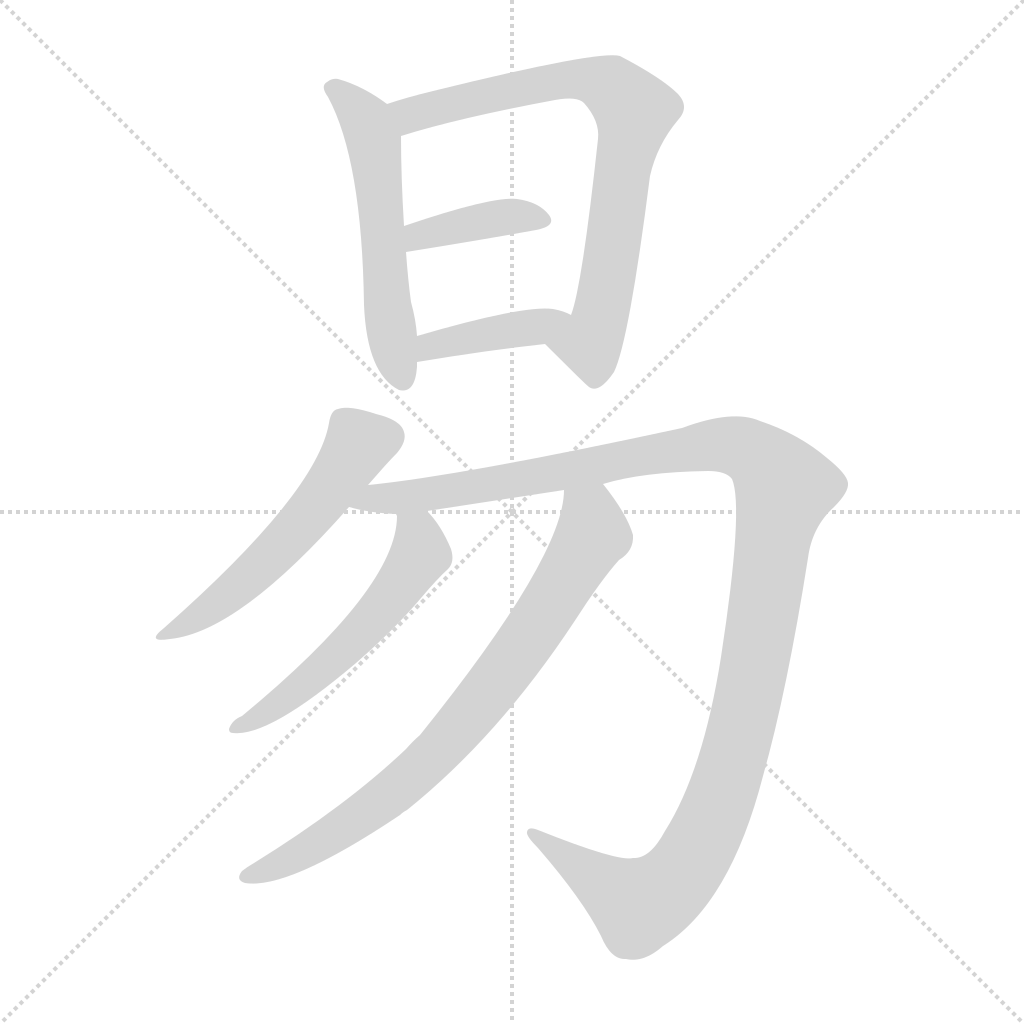
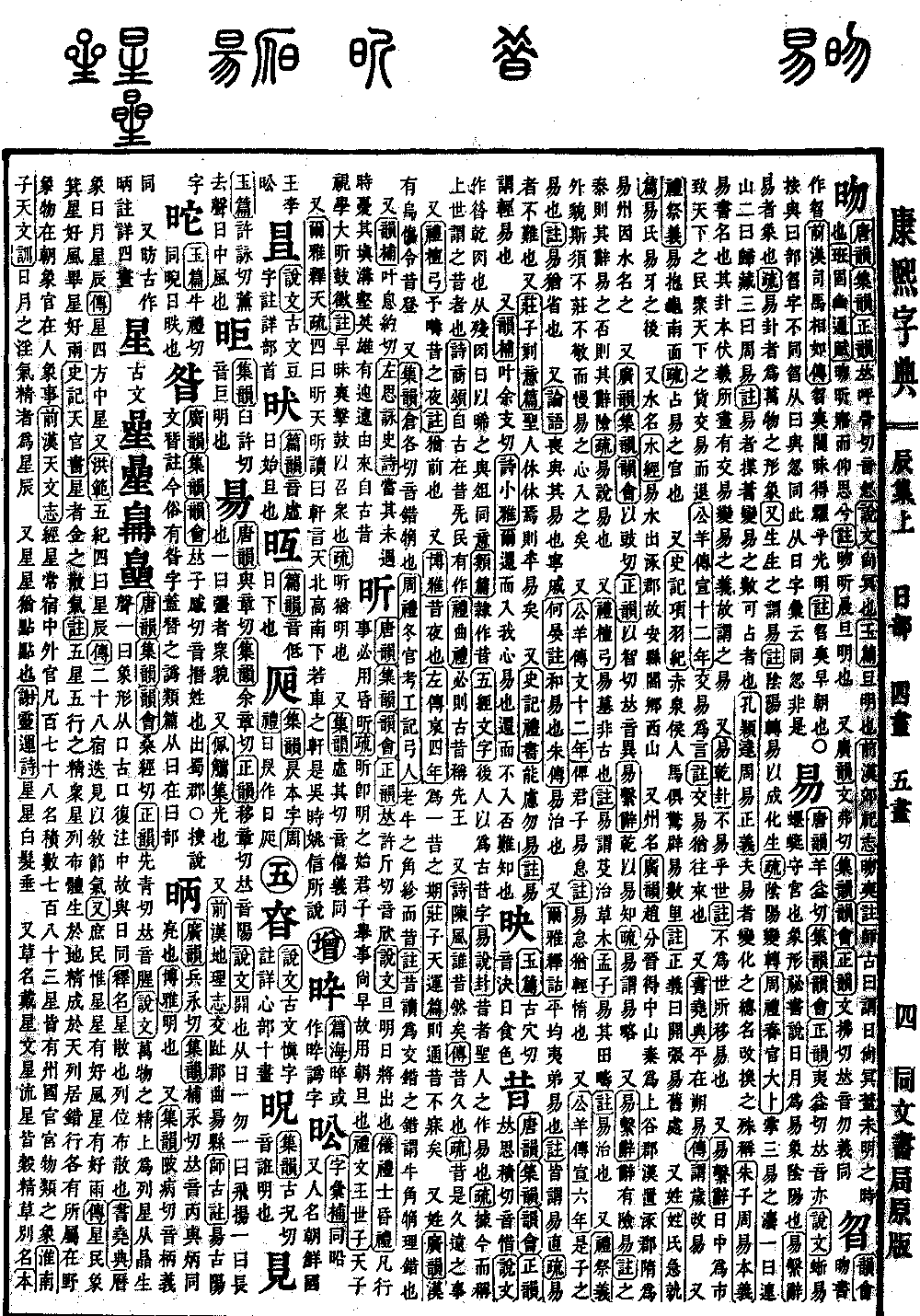
Chen Collection, Upper Volume
Radical: Sun (rì)
Kangxi Strokes: 8
Page 492, Entry 03
Tang Rhymes (Tangyun) pronounces it yi.
Collected Rhymes (Jiyun), Rhyme Compendium (Yunhui), and Orthodox Rhymes (Zhengyun) pronounce it yi, sounding the same as yi.
Explained in Explaining Graphs and Analyzing Characters (Shuowen Jiezi) as a lizard, specifically the chameleon or the gecko. This is a pictographic character. Other secret records state: the combination of sun and moon forms yi, symbolizing yin and yang.
Book of Changes (Yi), Appended Statements (Xici): The Book of Changes (Yi) speaks of symbols.
Commentary (Shu): The hexagram symbols of the Book of Changes (Yi) are the manifestations of the forms of all things.
Also: Unceasing generation is called yi.
Note (Zhu): Yin and yang mutually transform, thereby creating and nurturing all things.
Commentary (Shu): Refers to the change and transformation of yin and yang.
Book of Rites (Zhouli), Spring Officials (Chunguan), Grand Diviner (Dabu): In charge of the three methods of divination of the Book of Changes (Yi): the first is called Continuous Mountains (Lianshan), the second is called Return to the Storehouse (Guizang), and the third is called Changes of Zhou (Zhouyi).
Note (Zhu): Yi refers to calculating the changes of numbers by arranging milfoil stalks, which can be used for divination.
Kong Yingda, Correct Meaning of the Changes of Zhou (Zhouyi Zhengyi): What is called yi is a general term for change, another way of saying replacement.
Zhu Xi, Original Meaning of the Changes of Zhou (Zhouyi Benyi): Yi is the name of a book. Its hexagrams were originally drawn by Fuxi and contain the meanings of exchange and change, hence it is called yi.
Also, Book of Changes (Yi), Qian Hexagram: Not changing because of worldly customs.
Note (Zhu): Not shifted or changed by the trends of the world.
Also, Book of Changes (Yi), Appended Statements (Xici): At high noon, they established a market, summoned the people of the world, gathered the goods of the world, and after trading, they returned to their homes.
Gongyang Commentary (Gongyang Zhuan), 12th Year of Duke Xuan: The meaning of the term exchange.
Note (Zhu): Exchange is like coming and going.
Also, Book of Documents (Shujing), Canon of Yao (Yaodian): Distinguish and observe the rotation of the seasons and years.
Commentary (Zhuan): Refers to the replacement of the years.
Also, Book of Rites (Liji), Meaning of Sacrifice (Jiyi): The official in charge of divination holds the tortoise shell and faces south.
Commentary (Shu): This is the official responsible for divination.
Also, Records of the Grand Historian (Shiji), Chronicle of Xiang Yu: The Marquis of Chiquan, along with his horse, were both startled and retreated several miles.
Note (Zhu): The Correct Meaning (Zhengyi) says: It means to leave and change one's original position.
Also, a surname.
Collection of Surnames for Rapid Learning (Xingshi Jijie Pian): Those with the surname Yi are descendants of Yi Ya.
Also, a river name.
Classic of Waterways (Shuijing): The Yi River originates at the western mountains of Yan Township, Gu'an County, Zhuo Commandery.
Also, a prefecture name.
General Rhymes (Guangyun): Zhao State divided from Jin State to obtain Zhongshan; the Qin Dynasty established it as Shanggu Commandery; the Han Dynasty established Zhuo Commandery; the Sui Dynasty changed it to Yi Prefecture, named after the river.
Also, General Rhymes (Guangyun), Collected Rhymes (Jiyun), and Rhyme Compendium (Yunhui) pronounce it yi. Orthodox Rhymes (Zhengyun) pronounces it yi, sounding the same as yi.
Book of Changes (Yi), Appended Statements (Xici): The Qian Hexagram is manifested through its ease and wisdom.
Commentary (Shu): The yi here refers to the general outline of the Book of Changes (Yi).
Also, Book of Changes (Yi), Appended Statements (Xici): The hexagram and line statements have distinctions between difficulty and ease.
Note (Zhu): When tending toward peace, the statements are easy; when tending toward blockage, they are difficult.
Commentary (Shu): Yi means ease and harmony.
Also, Book of Rites (Liji), Tan Gong: Cultivating and managing graves is not an ancient system.
Note (Zhu): Yi refers to clearing and tidying away grass and trees.
Mencius (Mengzi): Manage their fields well.
Note (Zhu): Yi means to manage.
Also, Book of Rites (Liji), Meaning of Sacrifice (Jiyi): If one's appearance and demeanor are not solemn and respectful for even a moment, then thoughts of negligence and disrespect will enter the heart.
Also, Gongyang Commentary (Gongyang Zhuan), 12th Year of Duke Wen: Causes the gentleman to develop a heart of negligence and laziness.
Note (Zhu): Yi-dai is like negligence and laziness.
Also, Gongyang Commentary (Gongyang Zhuan), 6th Year of Duke Xuan: This is your simplification (or negligence).
Note (Zhu): Yi is like simplification.
Also, Analects of Confucius (Lunyu): In funeral rites, rather than being elaborate, it is better to be truly sorrowful in heart.
He Yan's Note (Zhu): Refers to harmonious ritual texts and elaborate ceremonies.
Zhu's Commentary (Zhu Zhuan): Yi means to govern or manage.
Also, Erya, Explanation of Words (Shigu): Even, yi, and di (respectful), all have the meaning of yi.
Note (Zhu): All refer to ease, fairness, and uprightness.
Commentary (Shu): Yi means not difficult.
Also, Zhuangzi, Outer Chapters: The sage is at leisure and content, so his state of mind is peaceful and simple.
Also, Records of the Grand Historian (Shiji), Book of Rites (Lishu): Able to think without being rash.
Note (Zhu): Yi refers to being rash or careless.
Also, Rhyme Supplement (Yunbu): Rhymes with the sound of yu.
Book of Odes (Shijing), Minor Odes (Xiaoya): You return and enter your home, and my heart is at ease. You return but do not enter, and it is hard to predict whether it is good or bad.