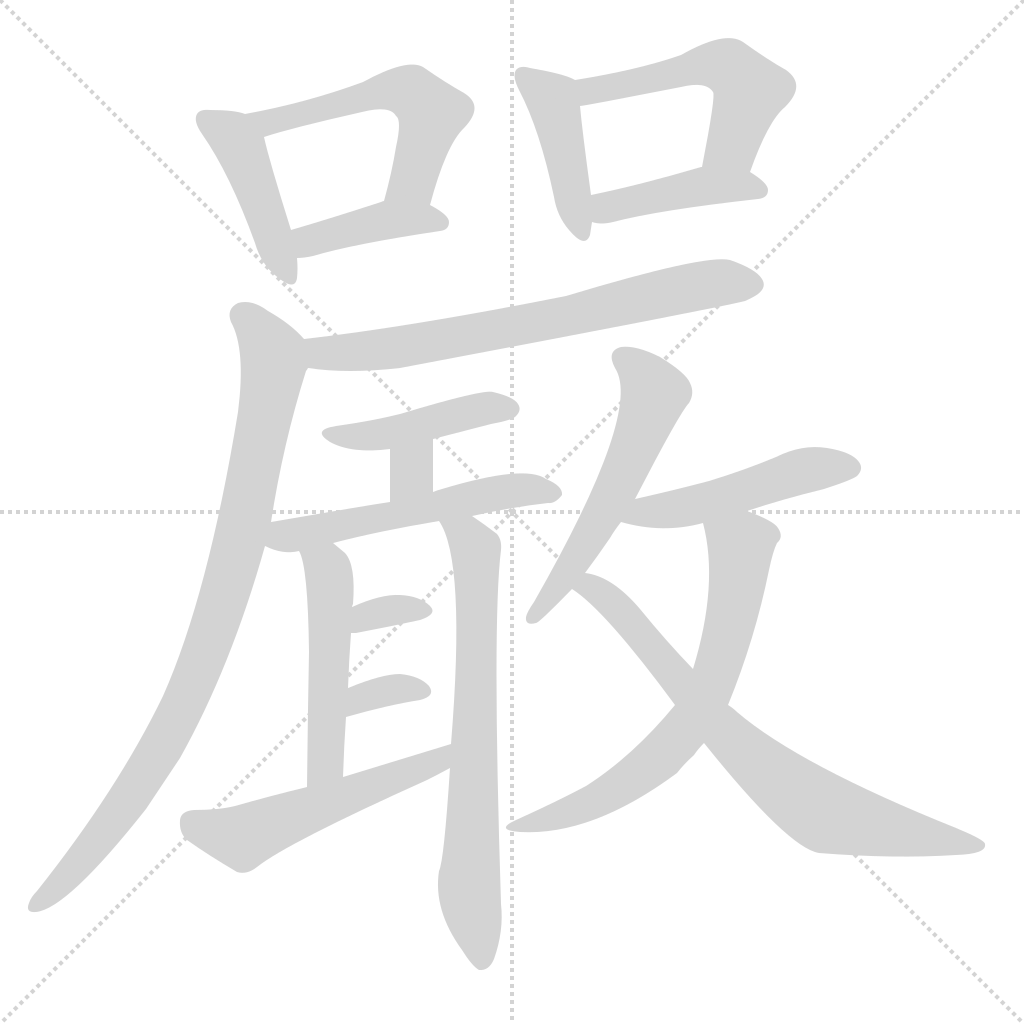
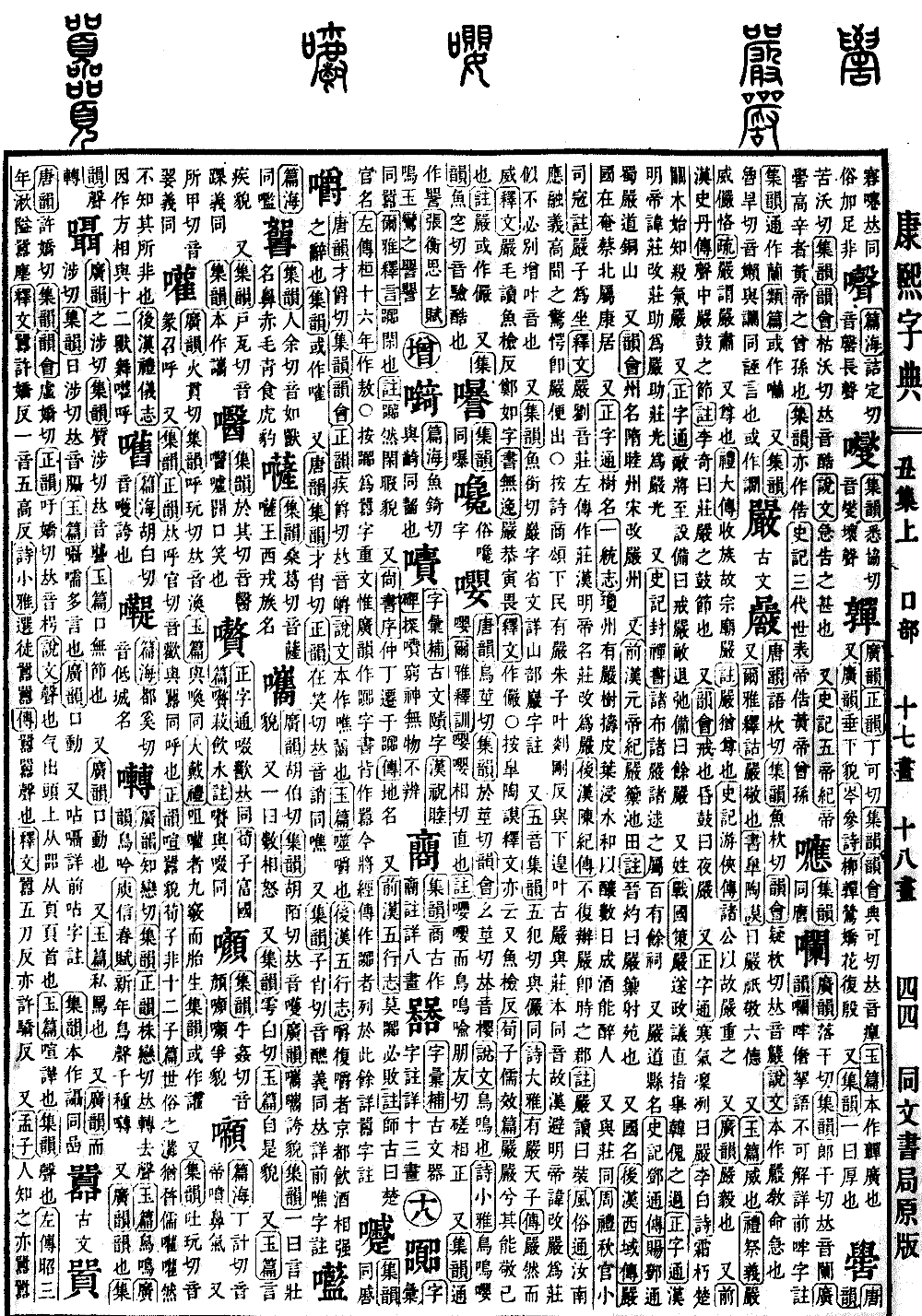
Chou Collection, Upper Volume
Radical: Mouth (kǒu)
Kangxi strokes: 20
Page 214, Entry 07
Ancient form. According to Tang Rhymes (Tangyun), pronounced yan; according to Collected Rhymes (Jiyun), pronounced yan; according to Rhyme Compendium (Yunhui), pronounced yi, with the sound yan.
In Explaining Graphs and Analyzing Characters (Shuowen), it is the original form of the character. It means urgent instructions or commands.
Also, in Er Ya (Erya, Explaining Glosses), it means respect. In the Book of Documents (Shujing, Gaoyao Mo), it says: maintain the six virtues with daily respect and reverence.
Also, in Jade Chapters (Yupian), it means majesty. In the Book of Rites (Liji, Jiyi), it says: majestic dignity and respectful solemnity. The commentary explains: strict and solemn.
Also, it means honorable. In the Book of Rites (Liji, Daduan), it says: to gather the clan, the ancestral temple must be honorable. The commentary explains: honorable is equivalent to respected. In the Records of the Grand Historian (Shiji, Biographies of Wandering Knights), it says: for this reason, the gentlemen treated him with serious respect.
Also, in Extensive Rhymes (Guangyun), it means resolute or determined.
Also, in the History of the Former Han (Qianhan Shu, Biography of Shi Dan), it says: the sound followed the rhythm of the strict drum. The commentary by Li Qi says: this refers to the solemn drum rhythm.
Also, in Rhyme Compendium (Yunhui), it means to warn or guard. The evening drum is called the night guard.
Also, in Correct Meaning Guide (Zhengzitong), cold and biting weather is called yan. In a poem by Li Bai, it says: frost withers the wood at the Chu Pass, only then do I realize the killing frost is severe.
Also, in Correct Meaning Guide (Zhengzitong), when the enemy is about to arrive, defensive preparations are called jie yan (martial law). When the enemy retreats, relaxing preparations is called jie yan (lifting martial law).
Also, a surname. In Strategies of the Warring States (Zhanguo Ce), Yan Sui discussed directness and exposed the faults of Han Kui. In Correct Meaning Guide (Zhengzitong), because Emperor Ming of Han had the personal name Zhuang, the names Zhuang Zhu and Zhuang Guang were changed to Yan Zhu and Yan Guang.
Also, in Records of the Grand Historian (Shiji, Treatise on the Feng and Shan Sacrifices), it mentions the various Zbu, Yan, and Qiu categories, totaling over one hundred shrines.
Also, Yan Dao, a county name. In Records of the Grand Historian (Shiji, Biography of Deng Tong), it mentions the copper mountains of Yan Dao in Shu, given to Deng Tong.
Also, in Rhyme Compendium (Yunhui), a prefecture name. During the Sui dynasty, it was Mu Prefecture; during the Song dynasty, it was renamed Yan Prefecture.
Also, in the History of the Former Han (Qianhan Shu, Annals of Emperor Yuan), it mentions the Yan Yu pond and fields. The commentary by Jin Zhuo says: Yan Yu refers to an imperial archery park.
Also, a country name. In the History of the Later Han (Houhan Shu, Records of the Western Regions), it states the country of Yan is located north of Yancai and is a dependency of Kangju.
Also, in Correct Meaning Guide (Zhengzitong), a tree name. In the Unified Geography of the Ming Dynasty (Yitongzhi), it is recorded that Qiongzhou has a tree called yan. Its bark and leaves are pounded, soaked in water, and used for brewing; after several days it becomes wine that can intoxicate people.
Also, the same as zhuang. In the Book of Rites (Zhouli, Autumn Official, Minor Minister of Justice), the commentary says: Zhen Yanzhao was used for the seat. The Pronunciation Notes (Shiwen) says: Yan, pronounced zhuang by Liu; in Zuo Tradition (Zuo Zhuan), it is written as zhuang. Because of the naming taboo of Emperor Ming of Han, it was changed to yan. In the History of the Later Han (Houhan Shu, Biographies), it says: not yet ready to set out immediately to the commandery. The commentary says: yan is read as zhuang. In Customary Manners (Fengsu Tong), it says: Ying Rong from Runan, hearing of this, was shocked and immediately packed and left. According to the Book of Odes (Shijing, Shang Song), the common people have a solemn demeanor. Zhu Xi notes the rhyme with shan and gang; it rhymes with huang in the following line. In ancient times, yan and zhuang shared the same pronunciation, so during the Han dynasty, they avoided the Emperor's name and changed yan to zhuang; it seems unnecessary to add a separate rhyming pronunciation.
Also, in Collected Rhymes (Jiyun), pronounced yan. A simplified form of the character yan. See the notes under the radical for mountain (shān).
Also, in Five Sound Collected Rhymes (Wuyin Jiyun), pronounced yan. The same as yan. In the Book of Odes (Shijing, Daya), it says: the majestic Emperor. The commentary says: majestic and awe-inspiring. The Pronunciation Notes (Shiwen) says: Yan, read as yan by Mao, and as is by Zheng. In the Book of Documents (Shujing, Wu Yi), it says: be solemn, respectful, and fearful. The Pronunciation Notes (Shiwen) says it is written as yan. According to the Pronunciation Notes for Gaoyao Mo, it is also read as yan. In the Xunzi, Confucian Effectiveness, it says: solemn and respectful of oneself. The commentary says: yan is sometimes written as yan.
Also, in Collected Rhymes (Jiyun), pronounced yan. Means cruel or harsh.