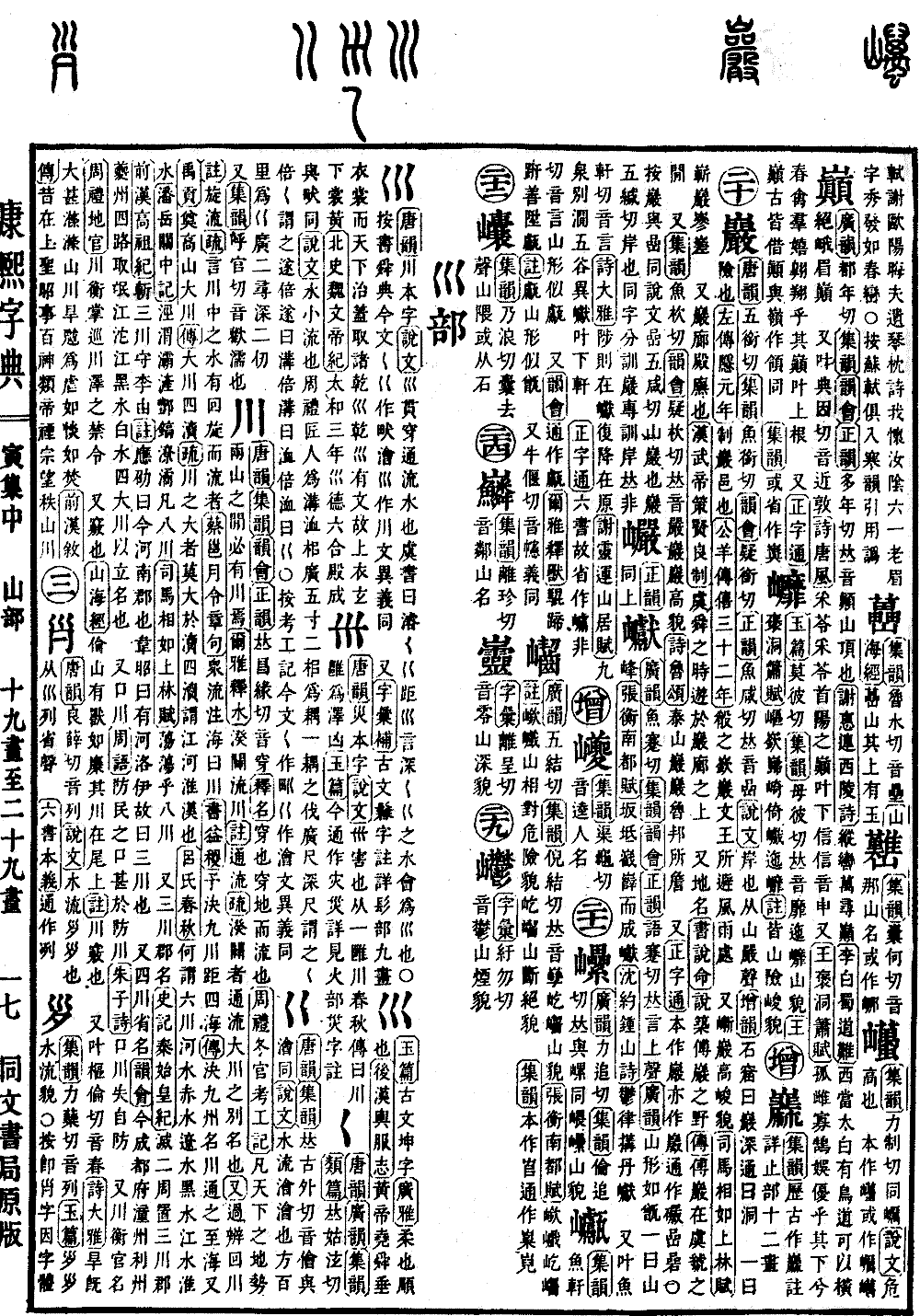
Yin Collection, Middle Volume
Radical: Mountain (shān)
Character: Yan
Kangxi stroke count: 23
Page 323, Entry 07
Pronounced yan
Shuowen Jiezi (Explanation of Graphs and Analysis of Characters) defines it as a cliff. It is formed from the mountain radical with a phonetic component. Zeng Yun (Expanded Rhymes) states that a stone cave is called yan, and a deep passage is called a cavern. Another definition is a precipice.
Zuo Zhuan (Chronicle of Zuo), first year of Duke Yin: To establish a fortified city.
Gongyang Zhuan (Gongyang Commentary), thirty-third year of Duke Xi: The precipitous heights of Mount Xiao, where King Wen took shelter from wind and rain.
Also, chan-yan describes a high and steep appearance.
Sima Xiangru, Shanglin Fu (Rhapsody on the Shanglin Park): Towering and uneven.
Also, yan-lang refers to the halls and corridors of a palace.
Emperor Wu of Han, Edict on Worthies: In the time of Emperor Shun, he walked in the palace corridors.
Also, a place name.
Classic of History (Shangshu), Charge to Yue: Yue built a wall in the wilderness of Fu Yan.
Commentary: Fu Yan is located between the states of Yu and Guo.
Pronounced yan. Yan-yan describes a high appearance.
Book of Odes (Shijing), Eulogies of Lu: Mount Tai is high and imposing, looked up to by the state of Lu.
Zhengzitong (Comprehensive Dictionary of Characters) notes: Originally written as yan. Also written as yan. Commonly used interchangeably with other variants. The character yan and the character yan are the same. Shuowen Jiezi states the character yan is pronounced yan and refers to a mountain cliff, while the character yan is pronounced yan and refers to a bank. To distinguish them as separate characters is incorrect. The characters are variations of the same root.
Correction: Gongyang Zhuan, thirty-third year of Duke Xi, replaces thirty-second year in the original text. The word place is replaced by the word also.