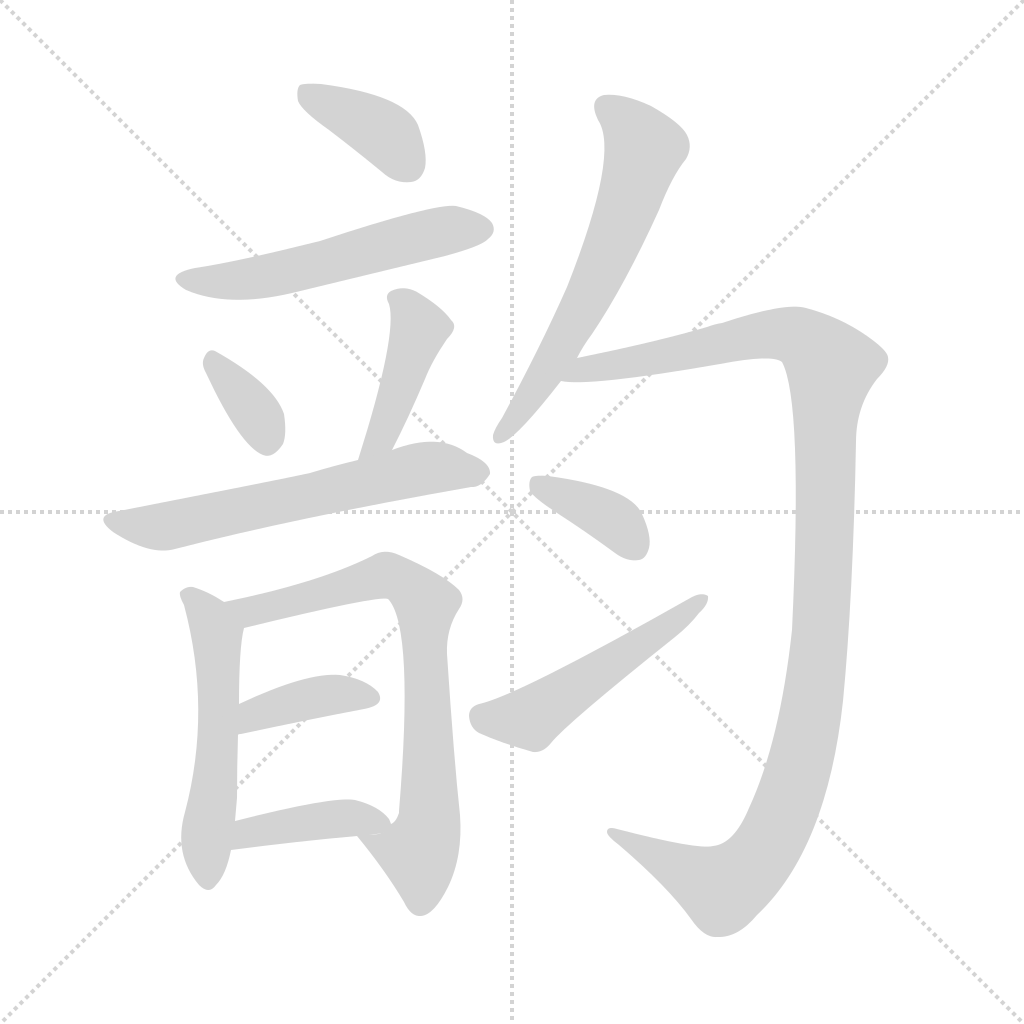
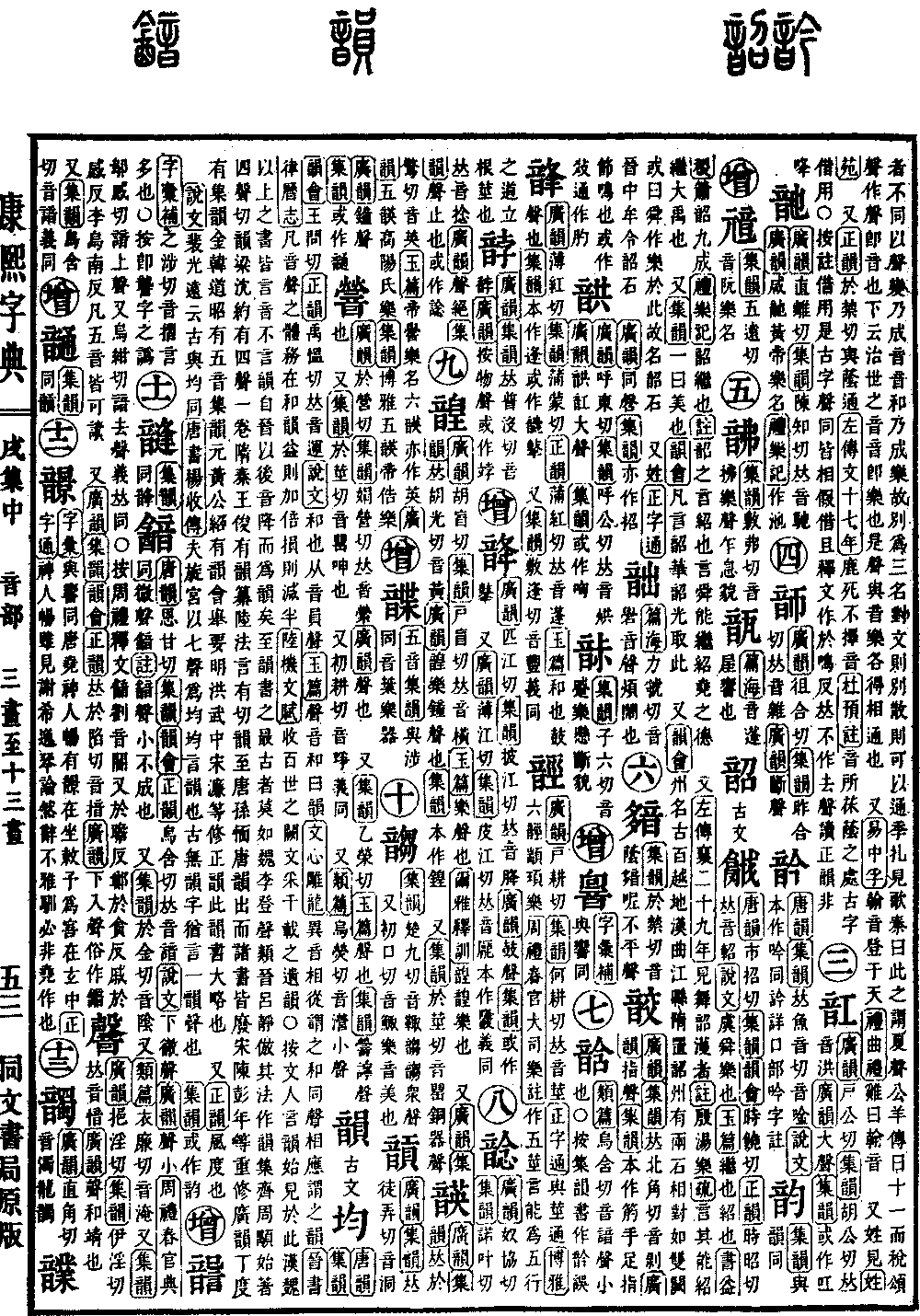
Xu Collection, Middle Volume. Radical: Sound (yīn). Kangxi stroke count: 19. Page 1397, Entry 05.
Collected Rhymes (Jiyun) states it is the same as the character for rhyme. The ancient form of the character for rhyme is the character for equal.
Tang Rhymes (Tangyun), Collected Rhymes (Jiyun), and Rhyme Compendium (Yunhui) state it is pronounced yun (falling tone). Correct Rhymes (Zhengyun) states it is pronounced yun (falling tone). The pronunciation is the same as the character for movement.
Explanation of Writing and Analysis of Characters (Shuowen Jiezi) defines it as harmony. The character structure is derived from the character for sound, with the character for member acting as the phonetic component.
Jade Chapter (Yupian) states that harmonious sounds are called rhymes.
The Literary Mind and the Carving of Dragons (Wenxin Diaolong) states that disparate musical pitches coordinating with one another is called harmony, while identical sounds echoing each other is called rhyme.
History of the Jin Dynasty, Treatise on Musical Pipes and Calendars (Jinshu Lvli Zhi) states that for the foundation of all sounds, one must seek harmony and rhyme; increase by doubling and decrease by halving.
Lu Ji, Treatise on Literature (Wenfu) states: collect the texts lost through the ages, and adopt the rhymed prose left behind over a millennium. Note: This is the earliest mention of the term rhyme by men of letters. Books from the Han Dynasty and before the Cao Wei period speak only of sound and not of rhyme. From the Jin Dynasty onward, the status of sound declined and was replaced by rhyme.
As for the oldest rhyme books, none compare to the Classification of Sounds (Shenglei) by Li Deng of the Wei state. Lu Jing of the Jin Dynasty followed his method to create the Collection of Rhymes (Yunjí). During the Southern Qi dynasty, Zhou Yong began writing the Four Tones and Rhymed Sounds (Sisheng Qieyun). During the Liang dynasty, Shen Yue wrote one volume of the Four Tones (Sisheng). During the Sui dynasty, Prince of Qin Yang Jun had the Rhyme Compilation (Yunzuàn), and Lu Fayan had the Rhymed Sounds (Qieyun). By the Tang dynasty, the Tang Rhymes (Tangyun) by Sun Mian appeared, and all other books were discarded. In the Song dynasty, Peng Nian and others revised the Extensive Rhymes (Guangyun), and Ding Du had the Collected Rhymes (Jiyun). During the Jin dynasty, Han Daozhao had the Five Sound Collection of Rhymes (Wuyin Jiyun). During the Yuan dynasty, Huang Gongshao had the Essentials of the Rhyme Compendium (Yunhui Juyao). During the Hongwu era of the Ming dynasty, Song Lian and others compiled the Correct Rhymes (Zhengyun). This is the general history of the development of rhyme books.
Additionally, Correct Rhymes (Zhengyun) defines it as personal style. Pei Guangyuan in the Explanation of Writing and Analysis of Characters (Shuowen Jiezi) says that in ancient times it was the same as the character for equal.
History of the Tang Dynasty, Biography of Yang Shou (Tangshu Yangshou Zhuan) states that to revolve the musical palace uses seven sound levels as one equal. Equal refers to rhyme. In ancient times, the character for rhyme did not exist, much like referring to the sound of a rhyme group.
Collected Rhymes (Jiyun) notes it is sometimes written in a variant form.