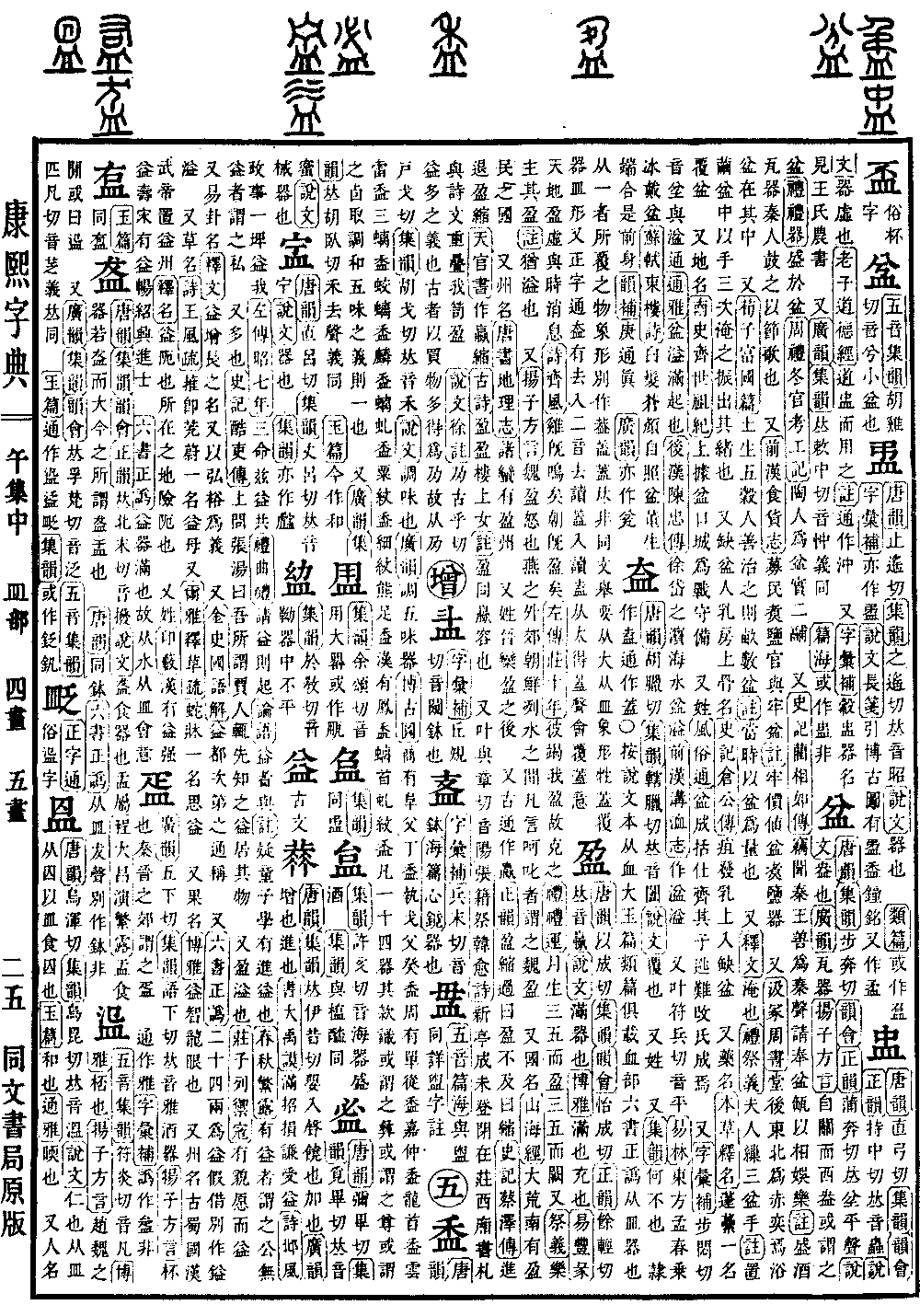
Wu Collection, Middle Volume
Radical: Vessel (mǐn)
Kangxi Strokes: 9
Page 793, Entry 07
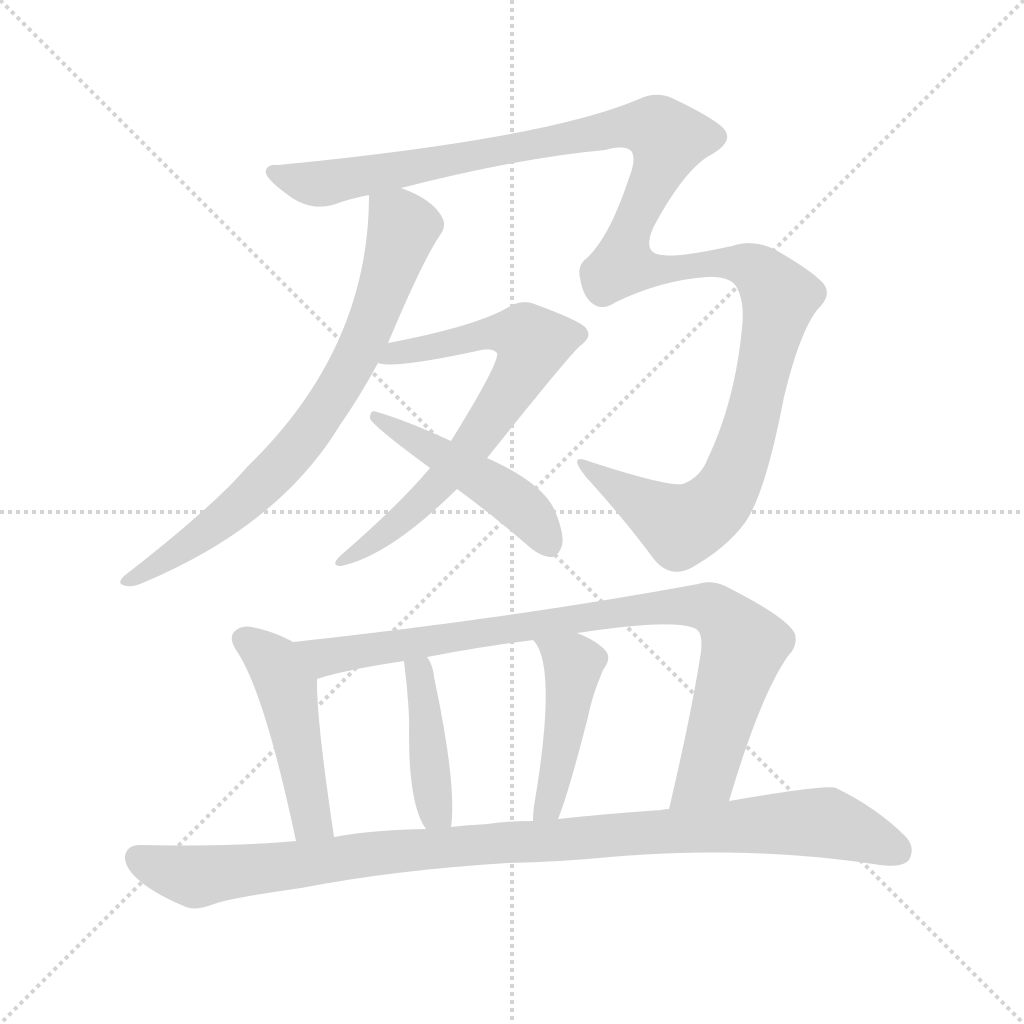
Pronounced yíng.
Explanation from Explaining Graphs and Analyzing Characters (Shuowen Jiezi): to fill a vessel.
Broadly Elegant (Boya): to be full, to be filled.
Book of Changes (Yijing), Commentary on the Judgments for the Abundance Hexagram: The fullness and emptiness of Heaven and Earth wax and wane with time.
Book of Odes (Shijing), Odes of Qi: The cock has already crowed, and the court is already full of people.
Zuo Tradition (Zuozhuan), Tenth Year of Duke Zhuang: The enemy's spirit was exhausted while our spirit was full, thus we were able to defeat them.
Book of Rites (Liji), Evolution of Rites: The moon reaches full maturity on the fifteenth day of the month and becomes deficient at the end of the month.
Book of Rites (Liji), Meaning of Sacrifices: Music relies on being full and rich. Note: Here, yíng is the same as yì (to overflow).
Dialects (Fangyan): Wèi yíng means to be angry. In the outskirts of the Yan state and the area of the Lie River in Korea, all scolding and berating is called wèi yíng.
Also a name of a state. Classic of Mountains and Seas (Shanhaijing): In the south of the Great Wilderness, there is the country of Yíngmín.
Also a name of a prefecture. Old History of the Tang Dynasty (Tangshu), Treatise on Geography: There is a Yíng Prefecture among the territories of the various southern tribes.
Also a surname. Descendants of Luán Yíng of the Jin state.
Also used interchangeably with the character yíng (嬴) in ancient times.
Correct Rhymes (Zhengyun): Regarding yíng and suō, to exceed is called yíng, and to be insufficient is called suō.
Records of the Grand Historian (Shiji), Biography of Cai Ze: Advancing and retreating, exceeding and lacking.
Records of the Grand Historian (Shiji), Treatise on the Celestial Offices: Written as yíng suō (嬴縮).
Ancient Poetry: A lady with a beautiful bearing on the upper floor. Note: Yíng is the same as yíng (嬴), referring to manner and appearance.
Also, when rhyming with zhāng, pronounced yáng.
Zhang Ji, Poem Sacrificing to Han Yu: The new pavilion is built but I have not yet ascended it, shut away in the west wing of the estate. Letters and poems, stacked one upon another, fill my chests.
Xu Notes on Explaining Graphs and Analyzing Characters (Shuowen Jiezi Xuzhu): Gū, anciently pronounced hū, denotes an increase. In ancient times, purchasing much was called gū, hence the character yíng (盈) is derived from gū (夃). To purchase much should be the character gū.