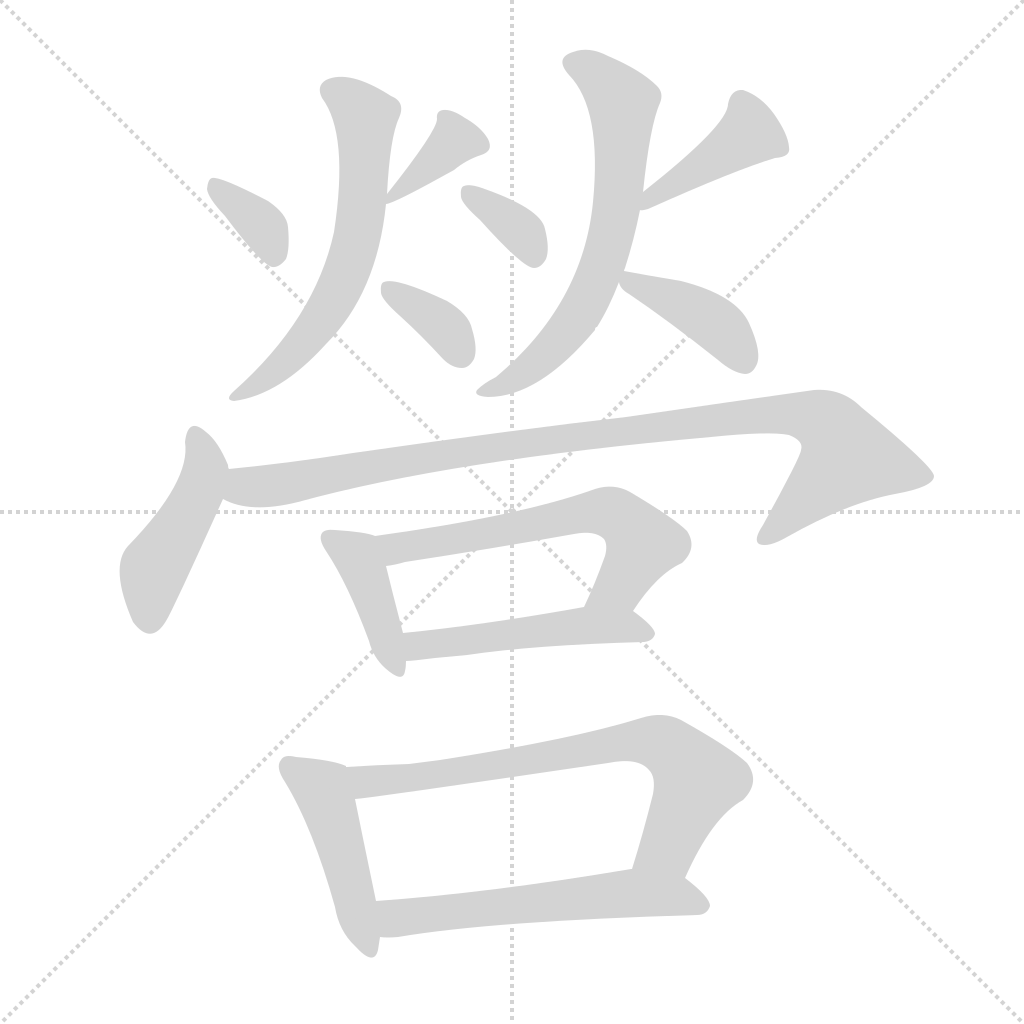
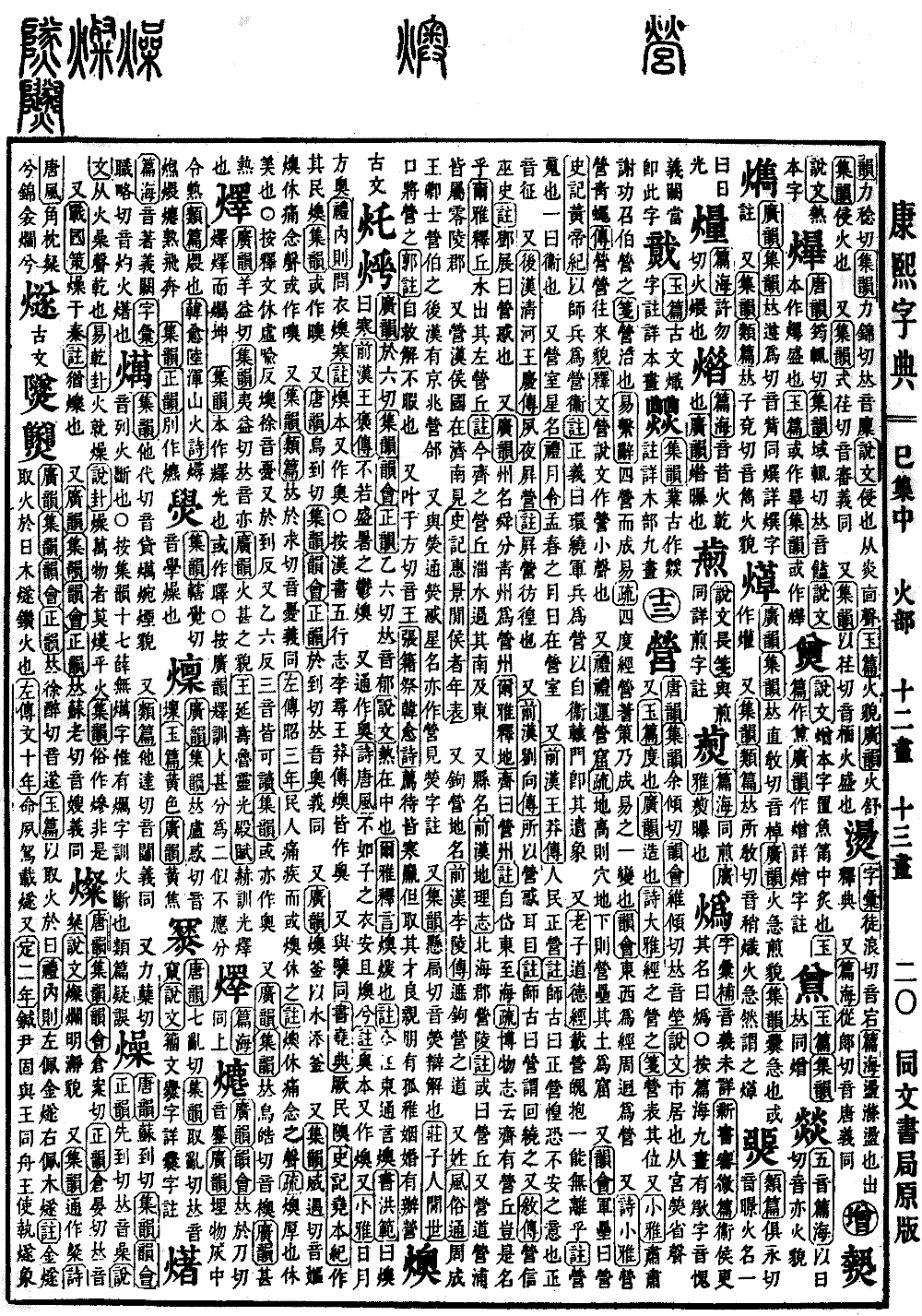
Si Collection, Middle Volume
Radical: Fire (huǒ)
Kangxi Strokes: 17
Page 684, Entry 17
Pronounced ying.
According to the Explaining Graphs and Analyzing Characters (Shuowen Jiezi), it refers to a market dwelling. Formed by the radical for palace, with the abbreviated character for fire (ying) acting as the phonetic component.
Also, according to the Jade Chapters (Yupian), it means to measure.
According to the Broad Rhymes (Guangyun), it means to build or construct.
In the Book of Odes (Shijing), it is written: He planned it, he built it. The commentary (Jian) states: He marked out its location.
In the Book of Odes (Shijing), it is written: Respectfully Xie completes the work, the Duke of Shao managed it. The commentary (Jian) states: It means to manage or administer.
In the Book of Changes (Yijing), it is written: Four operations (ying) complete the Changes. The sub-commentary (Shu) states: Through four measurements of manipulating the milfoil stalks, one change of the Book of Changes is completed.
According to the Collection of Rhymes (Yunhui), that which runs east-west is a warp (jing), and that which encompasses is an encampment (ying).
In the Book of Odes (Shijing), it is written: The buzzing blue flies. The commentary (Zhuan) states: Ying-ying describes their coming and going. The Explication of Text (Shiwen) notes that in the Explaining Graphs and Analyzing Characters, this is written with the variant character (ying). It refers to a small sound.
In the Book of Rites (Liji), it is written: Hollowed mounds. The sub-commentary (Shu) states: If the ground is high, one digs a hole; if the ground is low, one constructs an embankment (ying-lei), and the soil from this forms the hollow.
According to the Collection of Rhymes (Yunhui), a military fortification is called an encampment (ying).
In the Records of the Grand Historian (Shiji), it is written: Used soldiers as an encampment and defense. The commentary notes: The authoritative interpretation states that surrounding the soldiers as an encampment is to protect the entrance, which is the surviving form of this practice.
In the Laozi (Daodejing), it is written: Can you embrace the unity of the soul (ying-po) and not let it depart? The commentary notes: Ying refers to the soul. Another says it means to protect.
Also refers to the Encampment Chamber (Yingshi), the name of a star. In the Book of Rites (Liji), it is written: In the first month of spring, the sun is in the Encampment Chamber.
In the History of the Former Han (Qianhan), it is written: The people were agitated and restless (zheng-ying). The commentary by Yan Shigu states: Zheng-ying refers to the state of being fearful and uneasy. Zheng is pronounced zheng.
In the History of the Later Han (Houhan), it is written: Morning and night, I am apprehensive (bing-ying). The commentary states: Bing-ying means to be hesitant or pacing back and forth.
In the History of the Former Han (Qianhan), it is written: The reason for confusing (ying-huo) the ears and eyes. The commentary by Yan Shigu states: Ying means to revolve around or obscure.
In the History of the Former Han (Qianhan), it is written: Confused by (ying) the claims of sorcerers and historians. The commentary by Deng Zhan states: Ying means to confuse.
According to the Broad Rhymes (Guangyun), this is the name of a province. Emperor Shun divided Qing Province to create Ying Province.
In the Erya (Erya), it is written: Qi is called Ying Province. The commentary states: From Mount Tai to the east, reaching the sea. The sub-commentary (Shu) states: The Records of All Things (Bowuzhi) states: Qi has Ying Hill, could this be the origin of the name?
In the Erya (Erya), it is written: Water flows from the left of its Ying Hill. The commentary states: Today's Ying Hill of Qi, the Zi River passes its south and east.
Also the name of a district. In the History of the Former Han (Qianhan), it is written: Beihai Prefecture had Yingling. The commentary mentions: Some say it is Ying Hill.
Also, Yingdao and Yingpu both belong to Lingling Prefecture.
Also the title of the Marquis of Yinghan, located in Jinan. See the Records of the Grand Historian (Shiji).
Also, Gouying, a place name. In the History of the Former Han (Qianhan), it is written: Blocking the road at Gouying.
Also a surname. According to the Customs of the People (Fengsutong), it is the lineage of the Ying Earl, a high official under King Cheng of Zhou. During the Han Dynasty, there was a man named Ying He from Jingzhao.
Also used interchangeably with the character for fire-star (ying). Ying-huo is the name of a star. Also written as ying. See the entry for the character for fire-star.
According to the Collection of Rhymes (Yunhui), pronounced ying, it means to argue or explain. In the Zhuangzi (Zhuangzi), it is written: My mouth will attempt to defend it. The commentary by Guo Xiang states: One is too busy to save oneself, let alone explain.
Also read as wang (level tone). In the poetry of Zhang Ji, it is written: My recommendations all met with cold indifference, I only sought those with natural talent. Among friends and relatives, there are orphans, and regarding marriages, there are those to be managed (ying).