Si Collection, Middle Volume
Radical: Fire (huǒ)
Kangxi strokes: 17
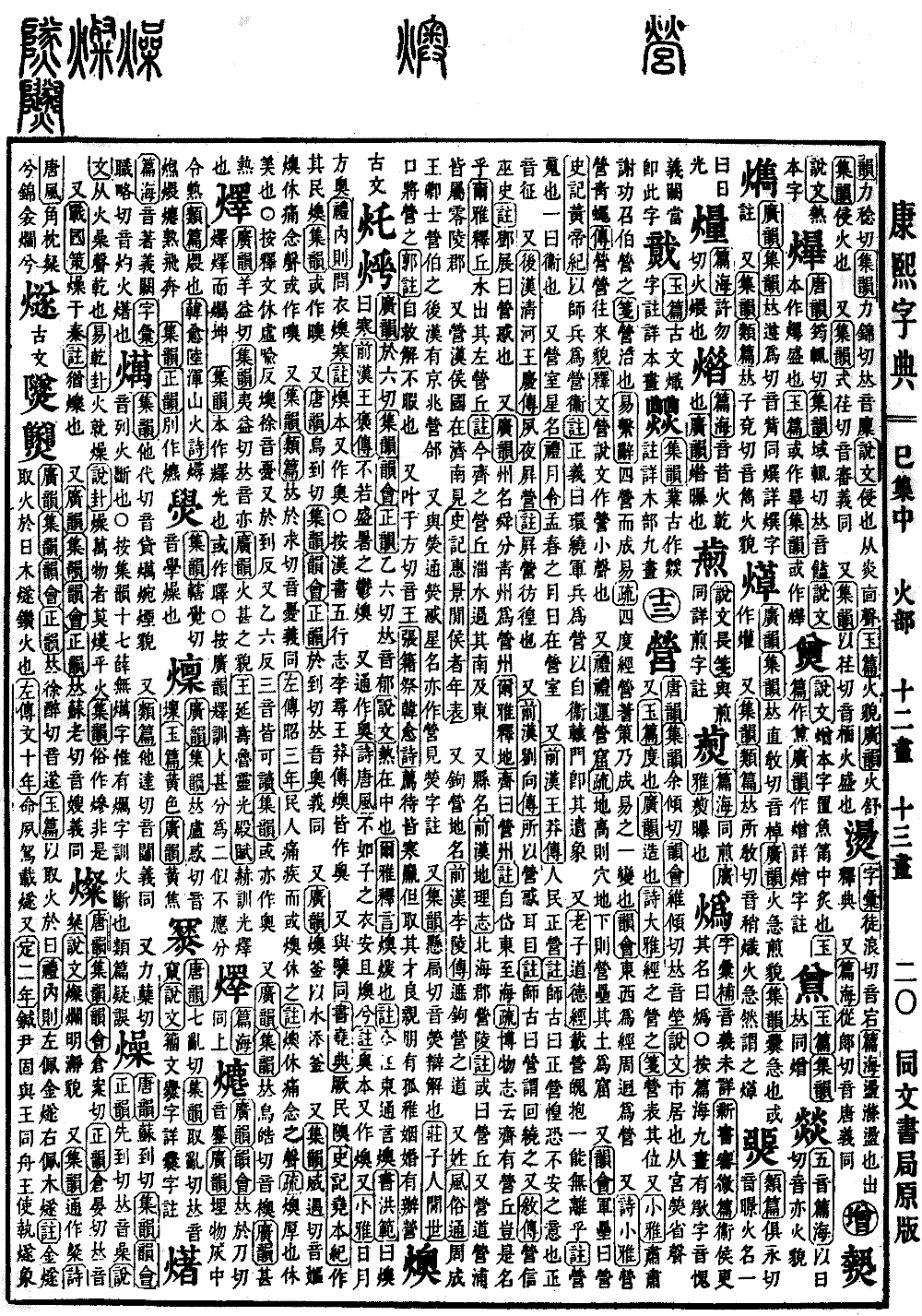
Page 684, Entry 01
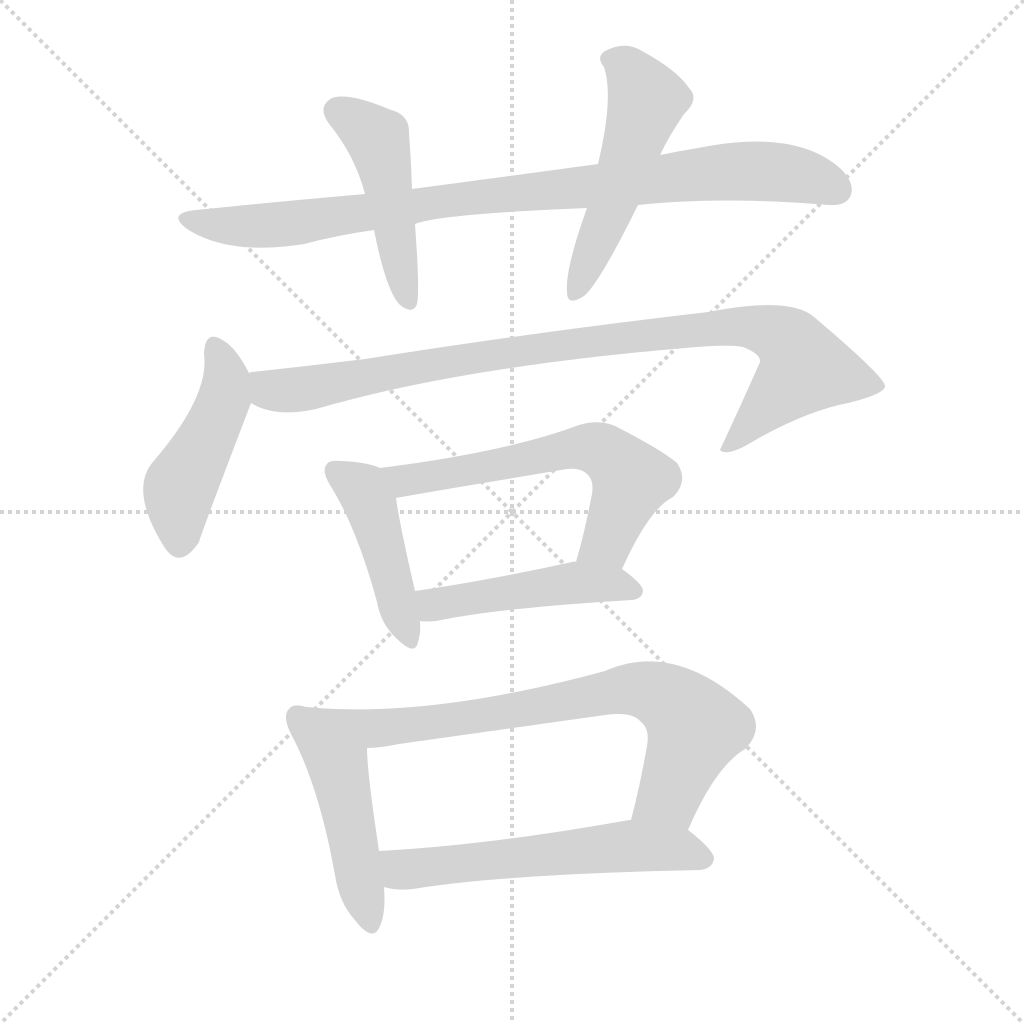
Pronounced ying.
According to the Explaining Graphs and Analyzing Characters (Shuowen Jiezi), it refers to living in a marketplace. Composed of the character for palace (gōng) and the abbreviated sound of the character for flickering (yíng).
Also, according to the Jade Chapter (Yupian), it means to measure.
According to the Broad Rhymes (Guangyun), it means to construct.
In the Book of Odes (Shijing), it is written: To plan it, to construct it.
The commentary states: To mark out its position.
Also in the Lesser Odes of the Kingdom (Xiaoya): Respectfully acknowledging the work, the Duke of Zhao managed it.
The commentary states: Managed signifies to regulate or oversee.
In the Book of Changes (Yijing), regarding the Appended Remarks: Four operations are conducted to form the changes.
The sub-commentary states: Measuring and managing the milfoil stalks four times completes one change of the hexagrams.
According to the Collection of Rhymes (Yunhui), the east-west direction is termed jing, while a circular enclosure is termed ying.
Also in the Book of Odes (Shijing), Lesser Odes of the Kingdom (Xiaoya): Buzzing blue flies.
The commentary states: Ying-ying describes the sound of coming and going.
The explanation of texts notes: The Shuowen Jiezi writes this character as ying, denoting a small sound.
Also, in the Book of Rites (Liji), specifically the Evolution of Rites (Liyun): Ying-ku.
The sub-commentary states: Where the land is high, one digs a cave; where the land is low, one builds an enclosure (ying-lei) of earth to form a dwelling.
Also, according to the Collection of Rhymes (Yunhui), a military encampment is called a ying.
In the Records of the Grand Historian (Shiji), Biography of the Yellow Emperor: Used troops and soldiers to create defensive camps.
The commentary states: The correct interpretation is that encircling the soldiers forms an encampment to provide self-defense, for which the gate of the chariots is a remnant symbol.
Also, in the Tao Te Ching (Daodejing): Can one carry the soul and spirit and embrace the one, without letting them depart?
The commentary states: Ying means to manage. Another interpretation is that it means to guard.
Also, Ying-shi, the name of a star. In the Book of Rites (Liji), Monthly Ordinances (Yueling): In the first month of spring, the sun is in the Ying-shi constellation.
Also, in the History of the Former Han (Qian Han Shu), Biography of Wang Mang: The people were zheng-ying.
The commentary by Yan Shigu states: Zheng-ying signifies a state of panic and unease. The character zheng is pronounced zheng.
Also, in the History of the Later Han (Hou Han Shu), Biography of Prince Qing of Qinghe: Morning and night, bing-ying.
The commentary states: Bing-ying means to pace back and forth in uncertainty.
Also, in the History of the Former Han (Qian Han Shu), Biography of Liu Xiang: The reason for confusing the eyes and ears.
The commentary by Yan Shigu states: Ying refers to the act of circling around them.
Also, in the Narrative Chapters: To deceive and delude by sorcery and history.
The commentary by Deng Zhan states: Ying means to confuse.
Also, according to the Broad Rhymes (Guangyun), the name of a province. Emperor Shun divided Qing Province to create Ying Province.
In the Erya, a dictionary of synonyms (Erya): Qi is called Ying Province.
The commentary states: From east of Mount Tai to the sea.
The sub-commentary states: The Record of All Matters (Bowuzhi) states: Qi has Ying-qiu; could this be the origin of the name?
In the Erya, a dictionary of synonyms (Erya): Where water emerges to its left is Ying-qiu.
The commentary states: Today, Ying-qiu in Qi, the Zi River passes its south and east.
Also, the name of a county. In the History of the Former Han (Qian Han Shu), Geography Treatise: Yingling in Beihai Commandery.
The commentary states: Some say it is Ying-qiu.
Also, Yingdao and Yingpu, both belong to Lingling Commandery.
Also, the marquisate of Yinghan. Located in Jinan. Seen in the Records of the Grand Historian (Shiji), Table of Marquises between the reigns of Emperors Hui and Jing.
Also, Gouying, a geographical name. In the History of the Former Han (Qian Han Shu), Biography of Li Ling: Blocking the road at Gouying.
Also, a surname. According to the Comprehensive Customs (Fengsu Tong), descendants of the Duke of Ying, a minister of King Cheng of Zhou. In the Han Dynasty, there was Ying He of Jingzhao.
Also, interchangeable with the character for flickering (yíng). The star Ying-huo. Also written as ying. Seen in the entry for the character yíng.
Also, according to the Collection of Rhymes (Yunhui), pronounced ying. Meaning to argue or explain.
In the Zhuangzi, section on In the World of Men (Renjianshi): The mouth will try to excuse it.
The commentary by Guo Xiang states: One is too busy to save or excuse oneself.
Also, rhyming with the character for king (wáng), pronounced wáng. In the poem by Zhang Ji mourning Han Yu: Recommendations are all cold and weak, only taking those who are talented and good. Among relatives and friends, there are orphans, and in marriages, there are arrangements (yíng) to be made.