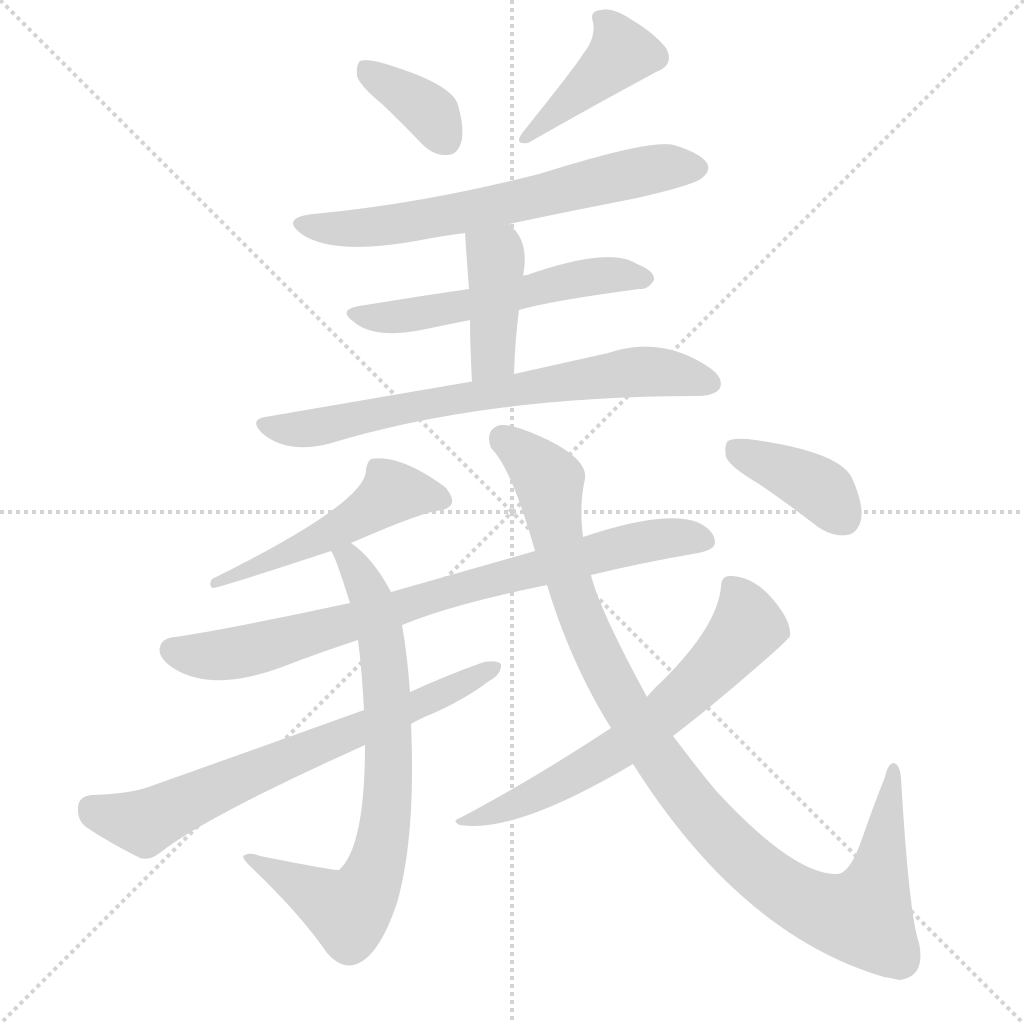
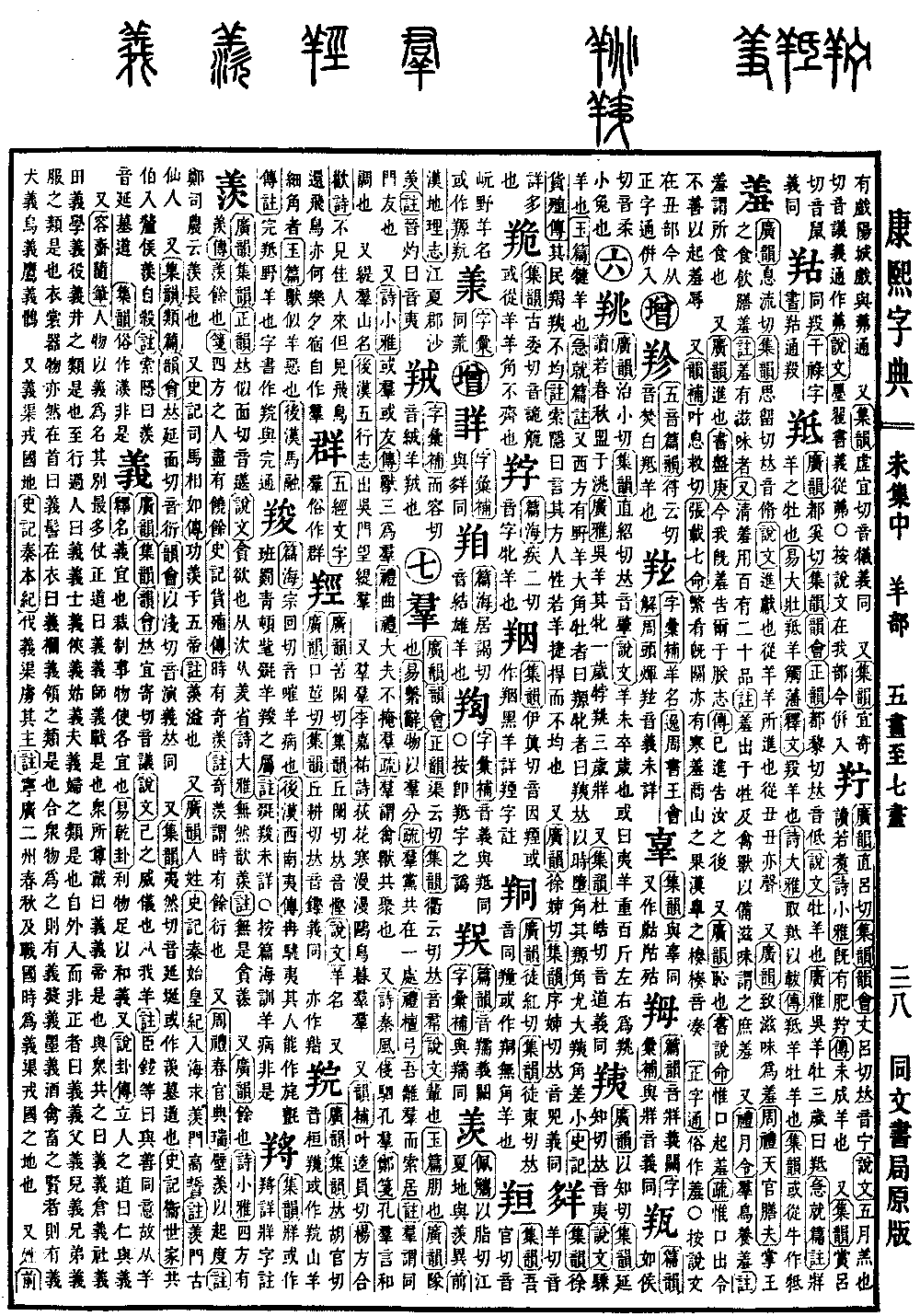
Wei Collection, Middle Volume. Radical: Sheep (yáng). Yi. Kangxi stroke count: 13. Page: 952, Number: 32.
The pronunciation in the Comprehensive Rhymes (Guangyun), Collected Rhymes (Jiyun), and Rhyme Meeting (Yunhui) is given by the fanqie method as yí-jì, pronounced the same as the character yì.
Explaining Simple and Analyzing Compound Characters (Shuowen Jiezi) explains: It refers to one's own dignified bearing. The character form is composed of the components for "me" (wǒ) and "sheep" (yáng). Note: Xu Xuan and others state that this character shares a common meaning with "goodness" (shàn), which is why it follows the radical "sheep" (yáng).
Explaining Names (Shiming) explains: Yi means appropriateness. It involves judging matters so that each is made appropriate.
The Book of Changes (Yijing), Hexagram Qian, says: Benefiting all things is sufficient to harmonize and accord with righteousness. Also, the Treatise on the Hexagrams (Shuoguazhuan) says: The fundamental principles of being human are benevolence and righteousness.
Also, the Casual Notes from Rongzhai (Rongzhai Suibi) records: People and things named with "yi" are of the greatest variety. Upholding the correct path is called yi, such as a righteous army (yìshī) or a righteous war (yìzhàn). One who is honored and supported by the masses is called yi, such as a righteous emperor (yìdì). Things shared with the public are called yi, such as a public granary (yìcāng), public association (yìshè), public land (yìtián), public school (yìxué), public service (yìyì), or public well (yìjǐng). Those with extraordinary conduct are called yi, such as a righteous man (yìshì), righteous hero (yìxiá), righteous aunt (yìgū), righteous husband (yìfū), or righteous wife (yìfù). Relationships formed through external ties rather than bloodline are called yi, such as an adoptive father (yìfù), adoptive son (yìér), sworn brother (yìxiōngdì), or mourning garments for non-relatives (yìfú). This also applies to clothing and utensils. On the head, it is called a false hair bun (yìjì); on clothing, it is called an ornamental border (yìlán) or a detachable collar (yìlǐng). Items made by combining various ingredients include mixed medicinal drink (yìjiāng), mixed ink (yìmò), or mixed wine (yìjiǔ). Outstanding animals are also called yi, such as the righteous dog (yìquǎn), righteous crow (yìwū), righteous hawk (yìyīng), or righteous falcon (yìhú).
There is also Yiqu, a state established by the Rong people. The Records of the Grand Historian (Shiji), Annals of Qin, records: They campaigned against Yiqu and captured its ruler. Note: The regions of Ningzhou and Guangzhou were the lands of the Rong state of Yiqu during the Spring and Autumn and Warring States periods.
It is also a surname. The Book of Han (Qianhanshu), Biographies of Harsh Officials, records: Yi Zong was a person from Hedong.
It is also the same as the character yì (meaning friendship). The Book of Han, Biography of Dong Zhongshu, says: Use benevolence to transform the people, and use righteousness to temper the people.
It is also interchangeable with the character yí (meaning ceremony). The Book of Han, Biography of Zou Yang, says: Let Dongmou and Zhuxu praise the descendants of Yi Fu. Note: Ying Shao says this refers to Zhu Yi Fu. Yan Shigu says yi is pronounced the same as yí.
It is also the same as the character yí (meaning suitable). The Rhyme Supplement (Yunbu) records: In the Rites of Zhou (Zhouli), wherever killing is done in accordance with righteousness, and in the Records of the Grand Historian, the phrase "the ruler's righteous heir," the pronunciation is yú-jī.
Also, the Rhyme Supplement gives the rhyming pronunciation niú-hé. The commentary on the Rites of Zhou says: The character for ceremony (yí) was written as yi, and in ancient times both were pronounced é. The Old Text Book of Documents (Guwen Shangshu) says: Do not be biased or slanted, follow the great righteousness of the former kings. Here, the character for "slanted" (bēi) rhymes with "slope" (pō).
Note: In Explaining Simple and Analyzing Compound Characters, this character is classified under the radical "me" (wǒ). It is now included here following the Correct Character Mastery (Zhengzitong).