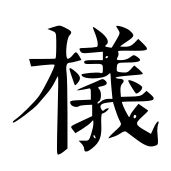
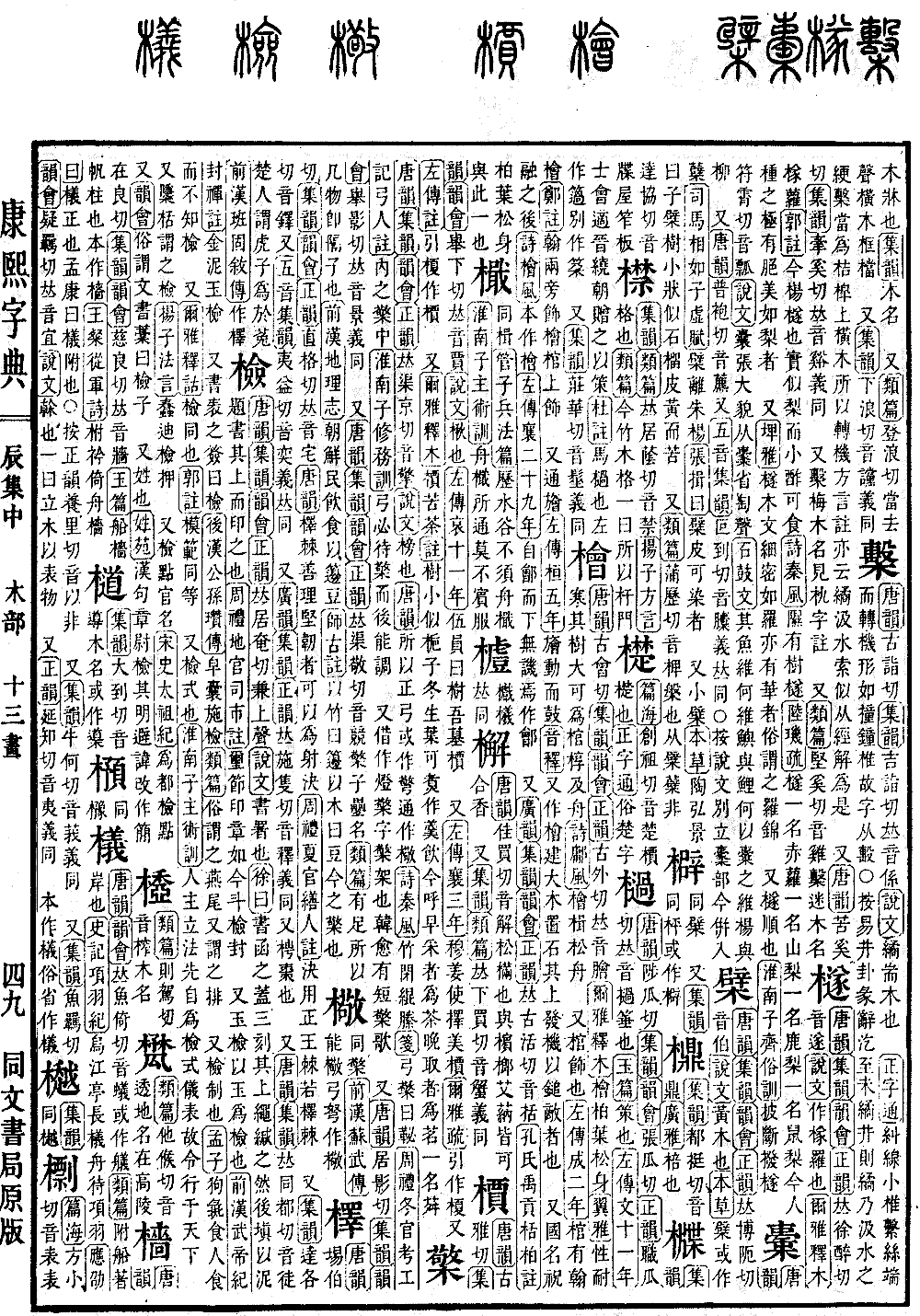
Chen Collection, Middle Volume
Radical: Tree (mù)
Kangxi strokes: 17
Page 557, Entry 25
Tang Rhyme (Tangyun) and Rhyme Collection (Yunhui) define the pronunciation as yi (rising tone). Sometimes also written in a variant form (yǐ).
Categorized Lexicon (Leipian) defines it as mooring a boat to the shore.
Records of the Grand Historian (Shiji): The elder of the Wujiang Pavilion moored his boat to the shore to wait for Xiang Yu.
Ying Shao says: Yi means to set upright. Meng Kang says: Yi means to lean against or attach to.
Note: The Correct Rhymes (Zhengyun) records the pronunciation as yi (rising tone), which is incorrect.
Additionally, Collected Rhymes (Jiyun) defines the pronunciation as e (rising tone). The meaning remains the same.
Additionally, Collected Rhymes (Jiyun) and Rhyme Collection (Yunhui) define the pronunciation as yi (rising tone).
Explaining Graphs and Analyzing Characters (Shuowen) defines it as a tree trunk. Another interpretation suggests it refers to setting up a wooden stake as a marker.
Additionally, Correct Rhymes (Zhengyun) defines the pronunciation as yi (rising tone). The meaning remains the same.
The original form is written as tree, while the common simplified form is written as the character currently being defined.