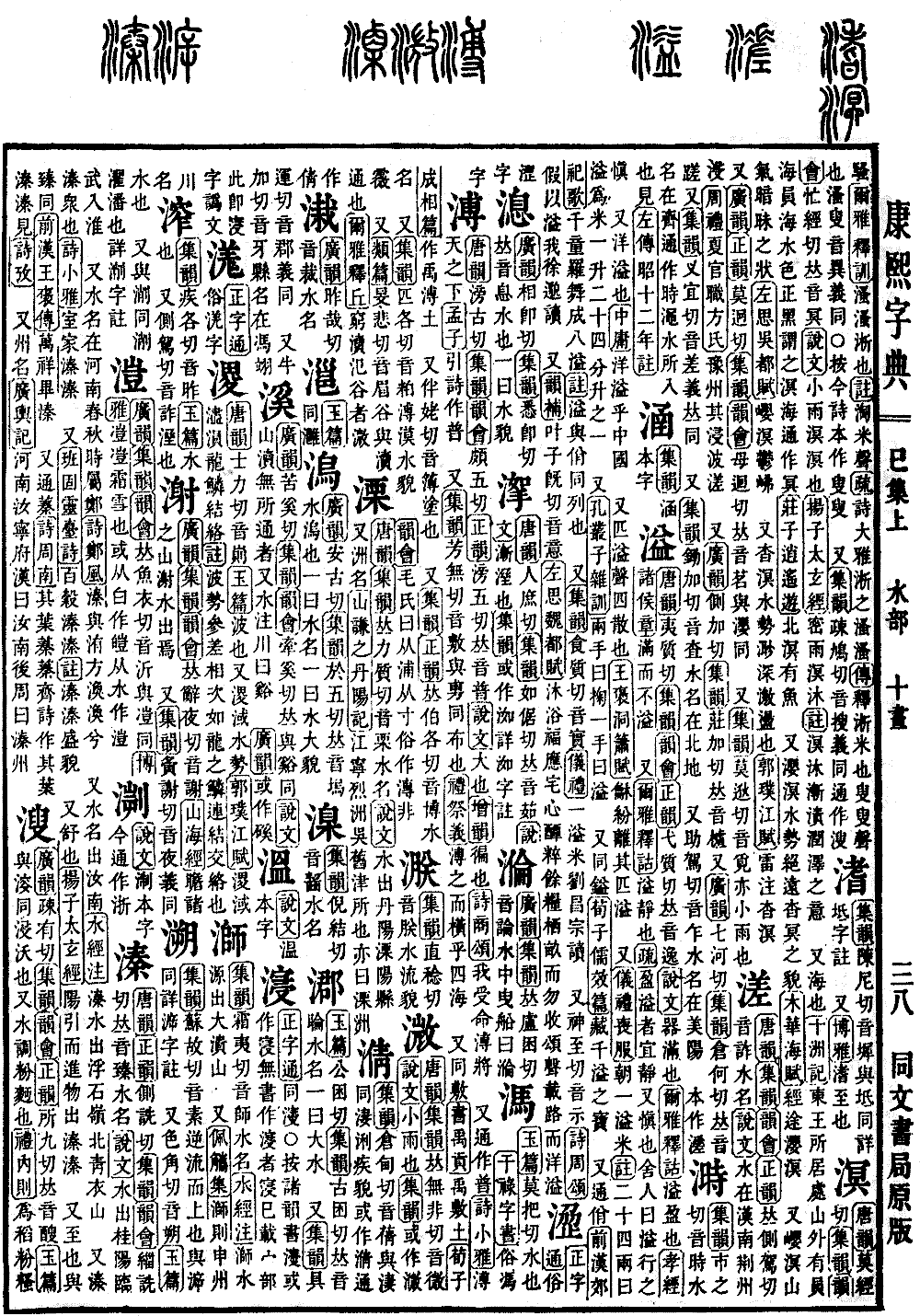
Si Collection, Upper Volume
Radical: Water (shuǐ)
Kangxi Strokes: 14
Page 640, Entry 06
Pronounced yi (falling tone).
Shuowen (Explaining Graphs and Analyzing Characters): Refers to a vessel being filled to capacity.
Erya (Approaching Elegance), Explaining Ancient Words: Yi means to be full or overflowing.
Classic of Filial Piety (Xiaojing), Chapter on Feudal Lords: Being full and overflowing without spilling outward.
Also, Erya, Explaining Ancient Words: Yi carries the meaning of being still. Commentary: A person who is full and satisfied should be tranquil. It also carries the meaning of being cautious. Sheren states: Yi is the caution of one's actions.
Also, it means to be overflowing or abundant. Doctrine of the Mean (Zhongyong): Overflowing throughout the Middle Kingdom.
Also, piyi, referring to sound spreading in all directions. Wang Bao, Rhapsody on the Bamboo Flute (Dongxiao Fu): Harmonious and intricate, spreading in all directions.
Also, Ceremonial and Ritual (Yili), Mourning Attire: One yi of rice in the morning. Commentary: Twenty-four liang is called one yi, equivalent to one twenty-fourth of a sheng of rice.
Also, Kongzi Jiayu (Family Sayings of Confucius), Miscellaneous Teachings: Holding something with both hands is called ju, and holding something with one hand is called yi.
Also, synonymous with yi (a unit of weight). Xunzi, Chapter on the Efficacy of Confucianism: Possessing treasures worth a thousand yi.
Also, variant of yi (a row of dancers). Former Han History (Qianhan Shu), Hymns for Suburban Sacrifices: A thousand children arranged in eight rows (yi) during the dance. Commentary: Yi is the same as yi, meaning a row or column.
Also, pronounced shi (entering tone). Ceremonial and Ritual (Yili): One yi of rice, read this way by Liu Changzong.
Also, pronounced shi (falling tone). Book of Odes (Shijing), Odes of Zhou: Bestowed upon me with abundance. Read this way by Xu Miao.
Also, as cited in the Rhyme Supplement (Yunbu), pronounced yi (falling tone). Zuo Si, Rhapsody on the Capital of Wei (Weidu Fu): Bathed in good fortune, keeping one's heart pure and beautiful, surplus grain left in the fields unharvested, songs of praise filling the roads and overflowing.
Textual Verification: Rhyme Supplement, pronounced yi (falling tone). According to the original text of the Rhyme Supplement, the phonetic reference has been corrected to reflect the pronunciation yi.