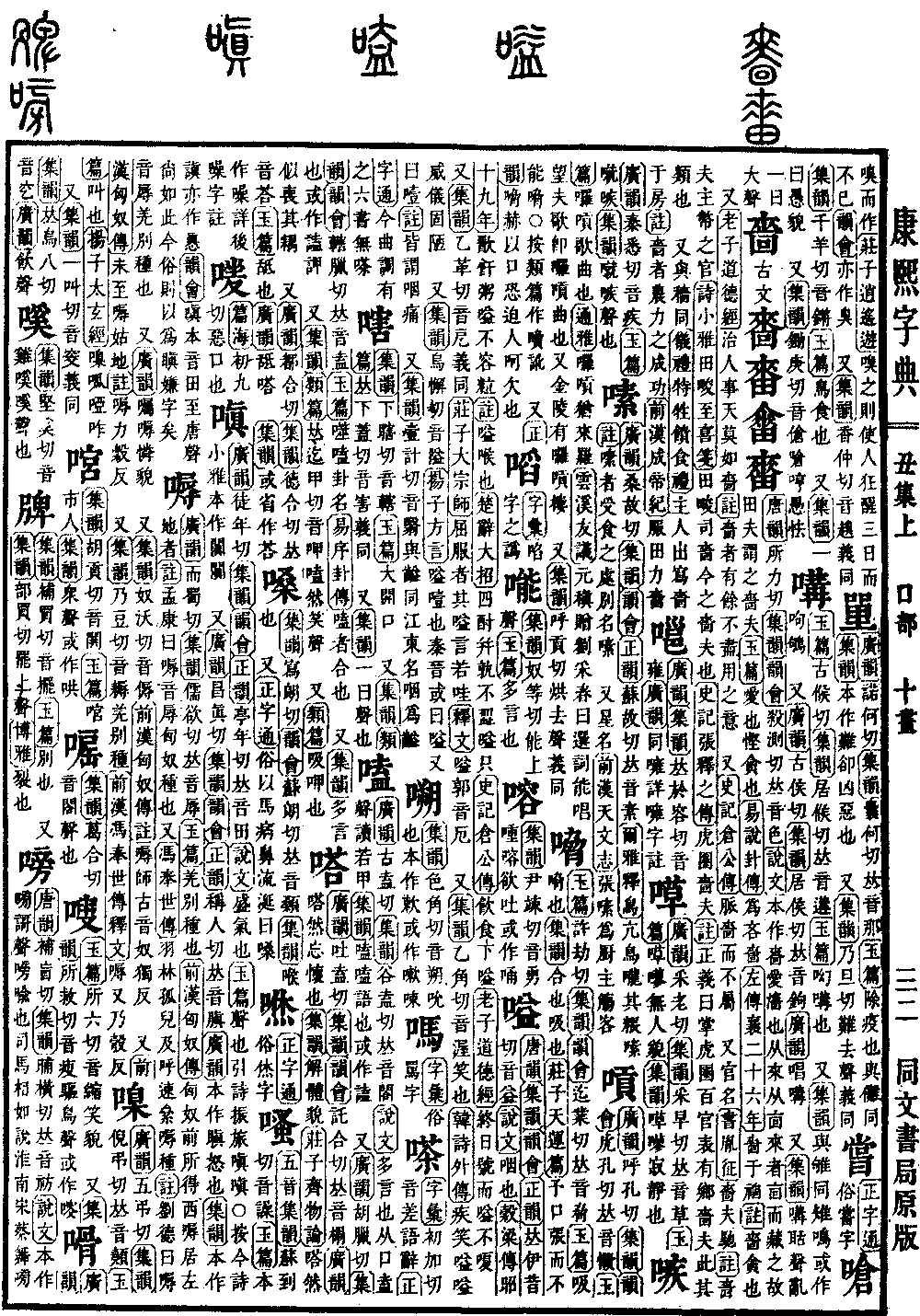
Chou Collection, Upper Volume
Radical: Mouth (kǒu)
Kangxi Strokes: 13
Page 202, Entry 19
Pronounced yi. According to the Explaining Graphs and Analyzing Characters (Shuowen Jiezi), it refers to the throat. In the Commentary of Guliang (Guliang Zhuan) on the nineteenth year of Duke Zhao, it describes the throat being blocked when drinking porridge such that not even a grain of rice can pass. The commentary notes that this word refers to the throat. In the Songs of Chu (Chuci), it is mentioned that when the four types of pure wine are fermented, drinking them does not cause the throat to feel obstructed. In the Records of the Grand Historian (Shiji), it is written that food and drink pass down through the throat. In the Classic of the Way and Virtue (Daodejing), it is noted that one may wail all day but the throat will not become hoarse.
Additionally, per the Collected Rhymes (Jiyun), it is pronounced e. The meaning is the same. In the Zhuangzi, it is used to describe a person who, when speaking, sounds as if their throat is blocked. The Explanation of the Text (Shiwen) notes that Guo Xiang pronounces it as e.
Additionally, per the Collected Rhymes (Jiyun), it is pronounced wo. It refers to the sound of laughter. In the Han Dynasty Illustrations of the Classic of Poetry (Han Shi Waizhuan), it describes a rapid, coarse, and shallow sound of laughter.
Additionally, per the Collected Rhymes (Jiyun), it is pronounced ai. According to the Regional Languages (Fangyan) by Yang Xiong, this term is synonymous with choking. In the regions of Qin and Jin, some use this term, and some use the word for choking. The note clarifies that both refer to pain in the throat.
Additionally, per the Collected Rhymes (Jiyun), it is pronounced yi. This is identical to the character for throat. In the Jiangdong region, the throat is referred to by this term.