Chou Collection, Upper Volume
Radical: Mouth (kǒu)
Kangxi strokes: 12
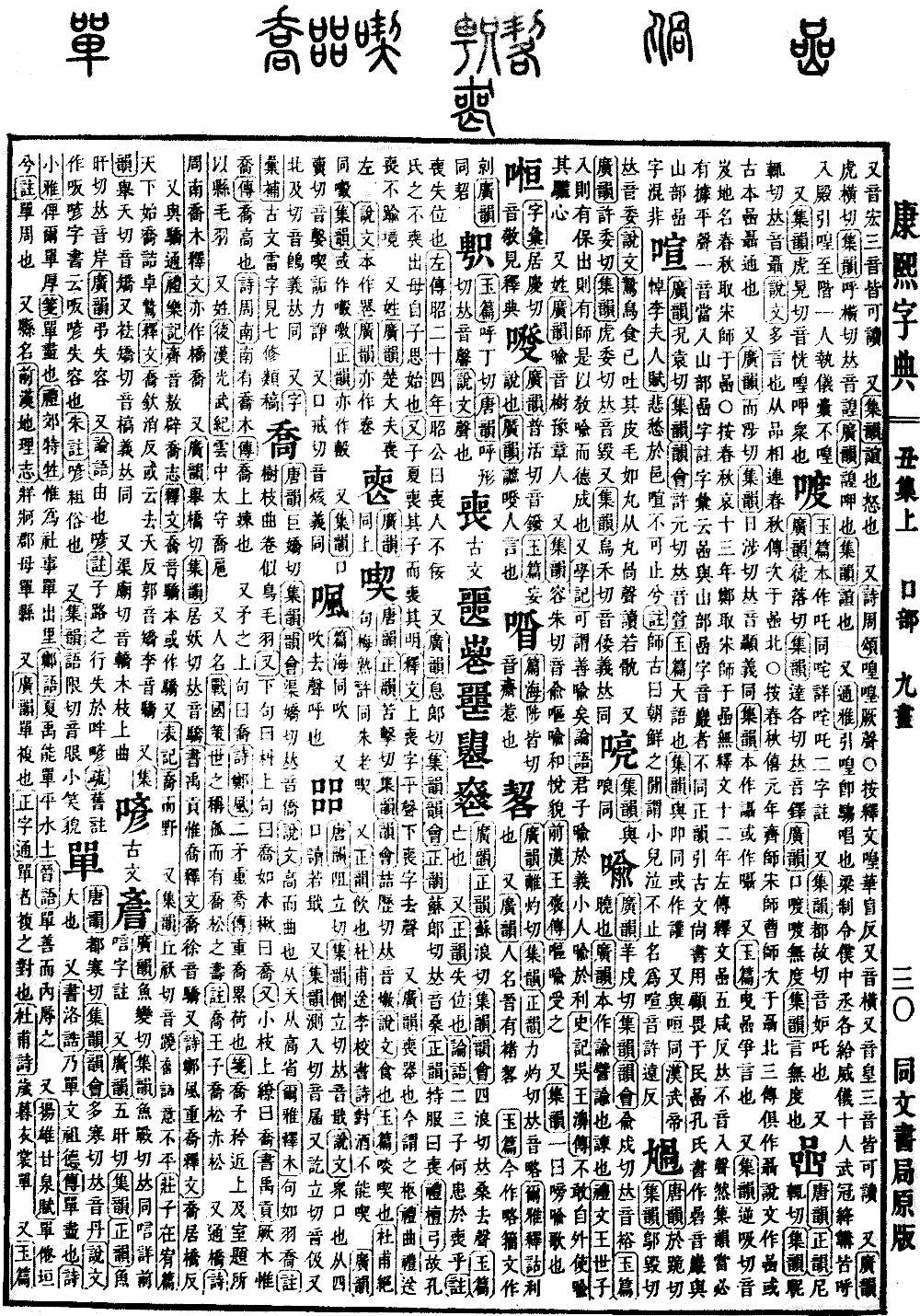
Page 200, Entry 02
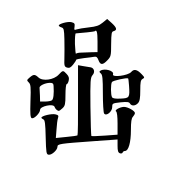
Tang Dynasty Rhymes (Tangyun) and Correct Rhymes (Zhengyun) indicate the pronunciation is nie. Collected Rhymes (Jiyun) indicates the pronunciation is ni, read the same as nie. Explaining Graphs and Analyzing Characters (Shuowen Jiezi) defines this as speaking excessively. The character shape consists of three mouths connected. The Commentary of Zuo (Chunqiu Zhuan) records: "Stationed north of Nie." Note: In the first year of Duke Xi of Lu, records state that the armies of Qi, Song, and Cao were stationed north of Nie. The three commentaries all write this as nie. Explaining Graphs and Analyzing Characters writes it as this character; perhaps in ancient texts, this character and nie were interchangeable.
Also, Broad Rhymes (Guangyun) indicates the pronunciation is er; Collected Rhymes (Jiyun) indicates the pronunciation is ri, read the same as nie. The meaning is the same. Collected Rhymes states the original character is nie. It is also sometimes written in a variant form (nie).
Also, Jade Chapter (Yupian) defines this as dragging and quarreling, meaning to argue.
Also, Collected Rhymes (Jiyun) indicates the pronunciation is ni, read the same as ji. This is a place name. The Spring and Autumn Annals (Chunqiu) record: "Captured the Song army at Nie." Note: In the thirteenth year of Duke Ai of Lu, records state that the state of Zheng captured the Song army at the place of Nie; no pronunciation is provided. Regarding the pronunciation provided in the Commentary of Zuo for the twelfth year of Duke Ai, it is read as xian; it is not read as an entering tone. However, the pronunciation in Collected Rhymes should have its basis, and the level tone pronunciation should be included in the entry for the mountain-radical character pronounced yan. The Dictionary of Characters (Zihui) states: This character and the mountain-radical character pronounced yan are different. Correct Rhymes (Zhengyun) cites the Ancient Version of the Book of Documents (Shangshu), "Use care and awe before the people," where the Kong family edition of the Book of Documents writes it as yan, read as yan, and confuses it with the mountain-radical character pronounced yan; this is incorrect.