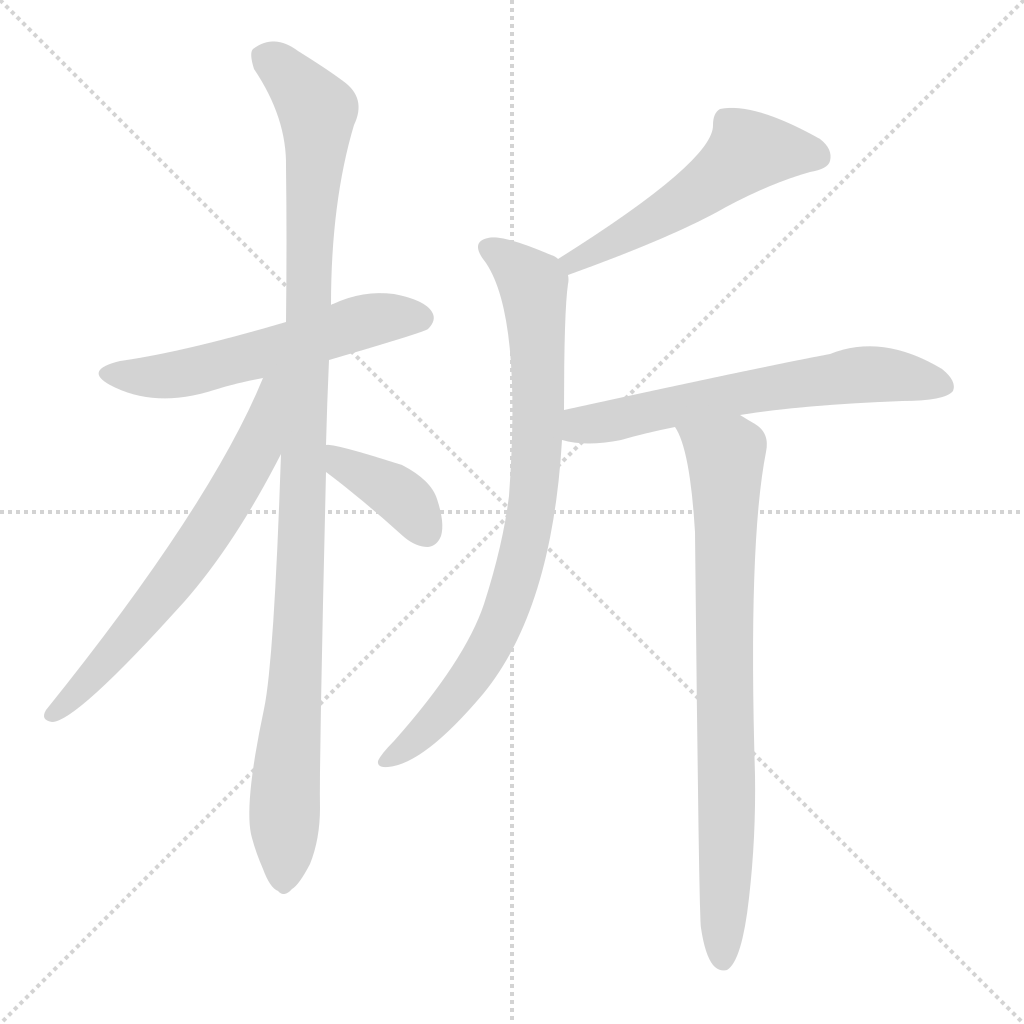
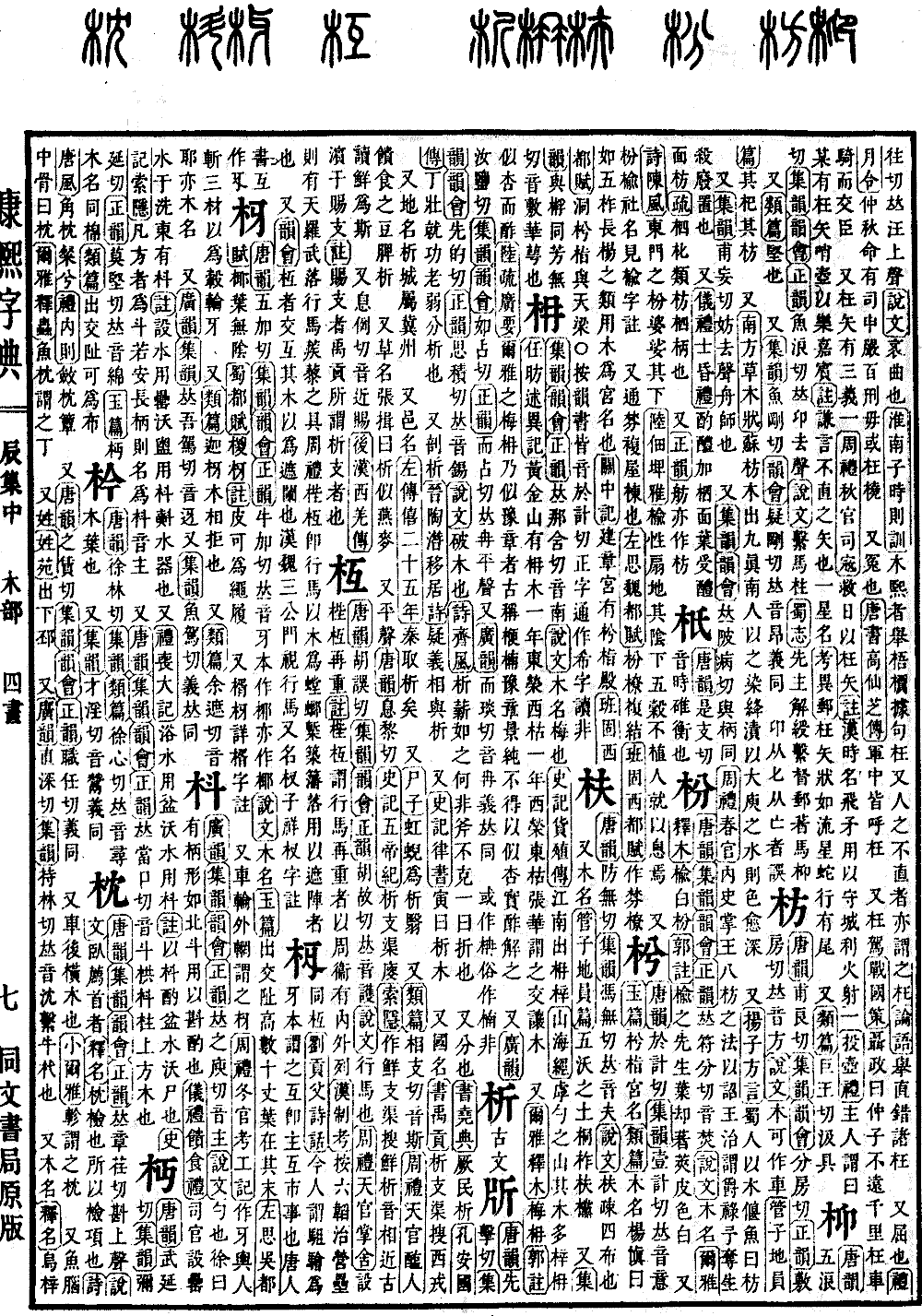
Chen Collection, Middle Volume. Radical: Wood (mù). Kangxi stroke count: 8. Page 515, Entry 08. Ancient form. Pronounced xi. According to the Analytical Dictionary of Characters (Shuowen Jiezi), it means to split wood. In the Book of Odes (Shijing), it states that one cannot split firewood without an axe. Another interpretation is to break. It also means to separate. In the Book of Documents (Shangshu), it refers to the people of that region being separated. According to the commentary by Kong Anguo, the young and strong went to labor, while the old and weak lived separately. It also refers to analysis and differentiation. In the poem Moving House by Tao Qian of the Jin dynasty, it is noted that when there are doubts or difficult problems, they are analyzed and discussed together. In the Records of the Grand Historian (Shiji), the zodiac sign Yin is called Ximu. It also refers to a country name. In the Book of Documents (Shangshu), it mentions Kunlun, Xizhi, and Qusou. It also refers to a place name. Xicheng belongs to Jizhou. It also refers to a city name. In the Zuo Tradition (Zuo Zhuan), it states that the state of Qin captured Xiyi. According to the Master Shi (Shizi), a rainbow is called xiyi. According to the Classified Chapters (Leipian), it is pronounced si. In the Rites of Zhou (Zhouli), it mentions that during sacrificial rites, the dou vessel used for presenting cooked food is called xi. It also refers to a type of grass. Zhang Yi states that the xi grass resembles oats. It is also read in the level tone. According to the Tang Rhymes (Tangyun), it is pronounced xi. In the Records of the Grand Historian (Shiji), it appears as Xizhi Qusou. According to the Search for Hidden Matters (Suoyin), it is written as Xianzhi Qusou. Xian and xi have similar pronunciations, and in ancient times, xian was pronounced as si. It is also pronounced ci. In the Book of the Later Han (Hou Hanshu), it refers to the region bordering Cizhi. The commentary notes that Cizhi is the same as Xizhi mentioned in the Book of Documents (Shangshu). Textual Research: In the Book of Documents (Shangshu), it lists Xizhi and Qusou among the Western Rong. It has been corrected to read Kunlun, Xizhi, and Qusou according to the original text.