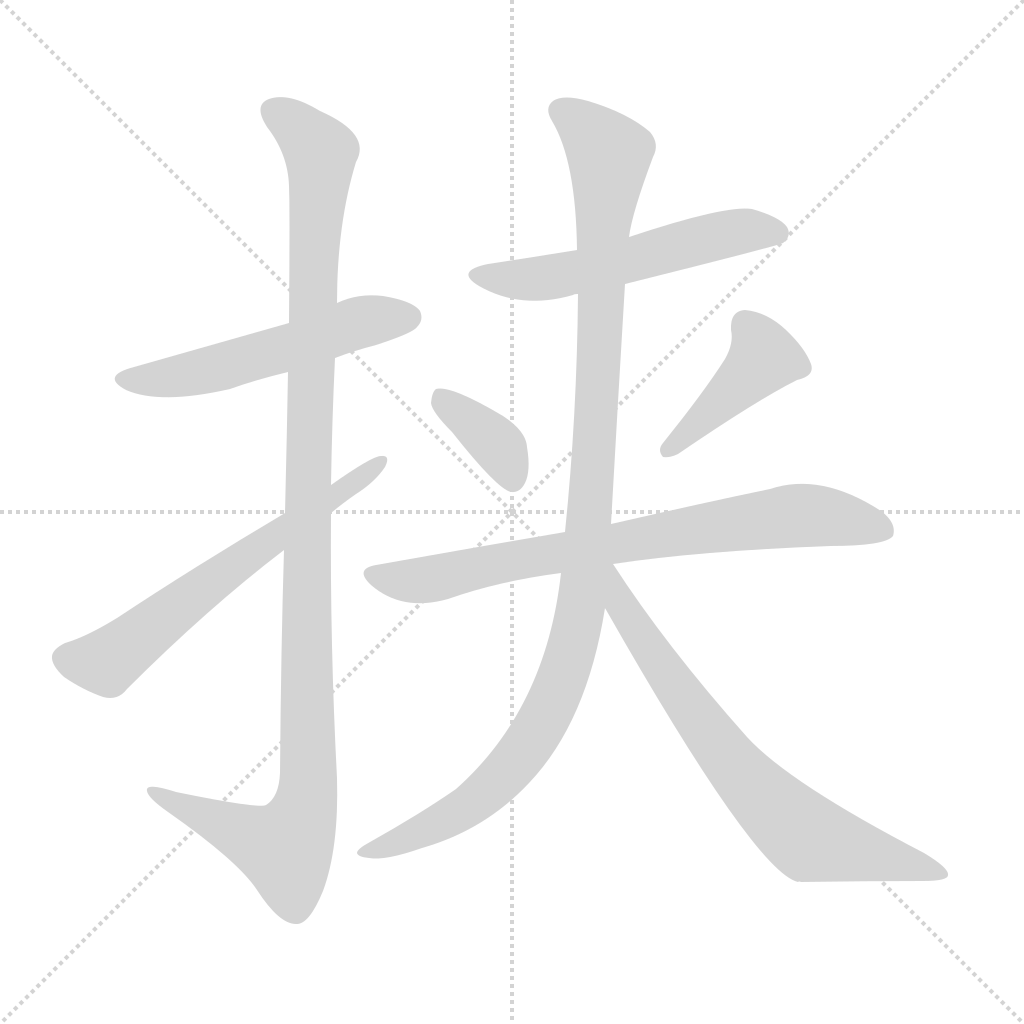
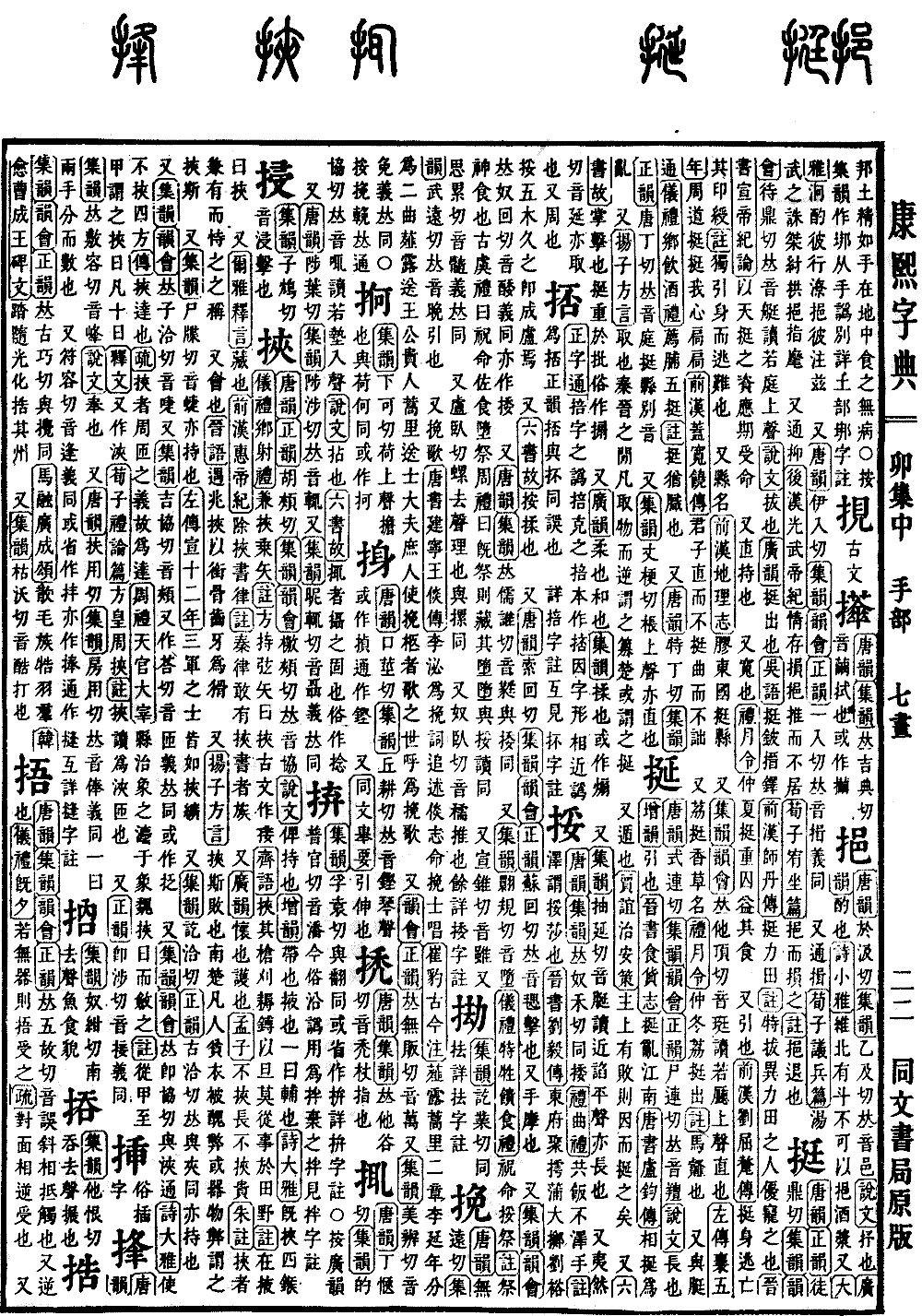
Mao Collection, Middle Volume. Radical: Hand (shǒu). Kangxi strokes: 11. Page 432, Entry 02.
Pronounced xie. According to the Shuo Wen Jiezi (Shuowen), it means to hold. According to the Zeng Yun, it means to carry at the side or under the arm. It also means to assist. In the Book of Odes (Shijing), it is written: Already holding four arrows. In the Book of Etiquette and Ceremonial (Yili), the chapter on Archery Rituals states: Holding multiple arrows. The commentary states: To hold the string and the arrow simultaneously is called xie. The ancient form is written as jie. In the Discourses of the States (Guoyu), it is written: Carrying their tools for weeding and tilling to work in the fields from morning until night. The commentary states: What is kept under the arm is called xie.
Furthermore, according to the Erya, a dictionary of synonyms, it means to store or conceal. In the History of the Former Han (Qianhan), Biography of Emperor Hui, it mentions: Abolished the law against possessing forbidden books. The commentary notes: According to Qin law, anyone who dared to possess books would have their entire clan executed.
Additionally, according to the Guang Yun dictionary, it means to cherish or to protect. In the Works of Mencius (Mengzi), it states: Do not rely on seniority, do not rely on high status. The commentary by Zhu Xi states: The term xie refers to having something and relying upon it.
It also means to meet or encounter. In the Discourses of Jin (Jinyu), it states: Encountering a portent, holding a bone in the mouth, the teeth becoming a source of disorder.
According to the Fangyan, a dictionary of regionalisms by Yang Xiong, xie si means to be ruined. In the Southern Chu region, when a person is poor or their clothing and belongings are tattered and worn, it is called xie si.
Also pronounced die. It also means to hold. In the Zuo Tradition (Zuo Zhuan), twelfth year of Duke Xuan, it states: The soldiers of the three armies felt as if they were holding silk batting.
Also pronounced qia, same as jia. It also means to hold.
Also pronounced jie. Also pronounced za. The meaning is the same. Sometimes written as xie.
Also pronounced xie. It is interchangeable with jia (to encompass). In the Book of Odes (Shijing), it states: Causing not to encompass the four directions. The commentary states: Xie means to reach or penetrate. The sub-commentary explains: Xie signifies the meaning of surrounding or completing a circuit, therefore it means to reach. In the Rites of Zhou (Zhouli), chapter on the Offices of Heaven, it states: Post the models of laws on the palace gate towers, and collect them after one cycle of ten days. The commentary explains: From one jia day to the next jia day is called xie. It refers to ten days in total. The textual notes state: Also written as jia. In the Xunzi, chapter on the Theory of Ritual, it states: Widely encompassing everywhere. The commentary states: Xie is read as jia, meaning to circle or surround.
Also pronounced jie. The meaning is the same.