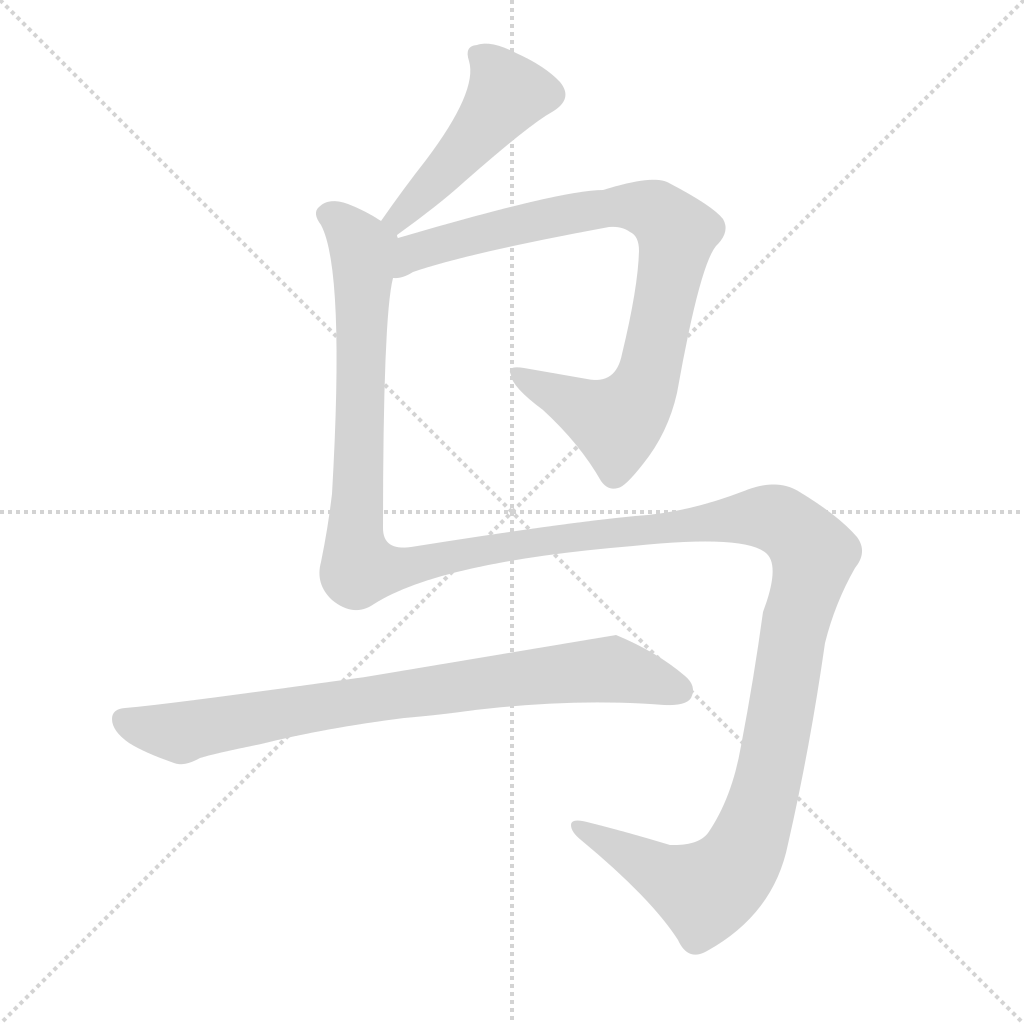
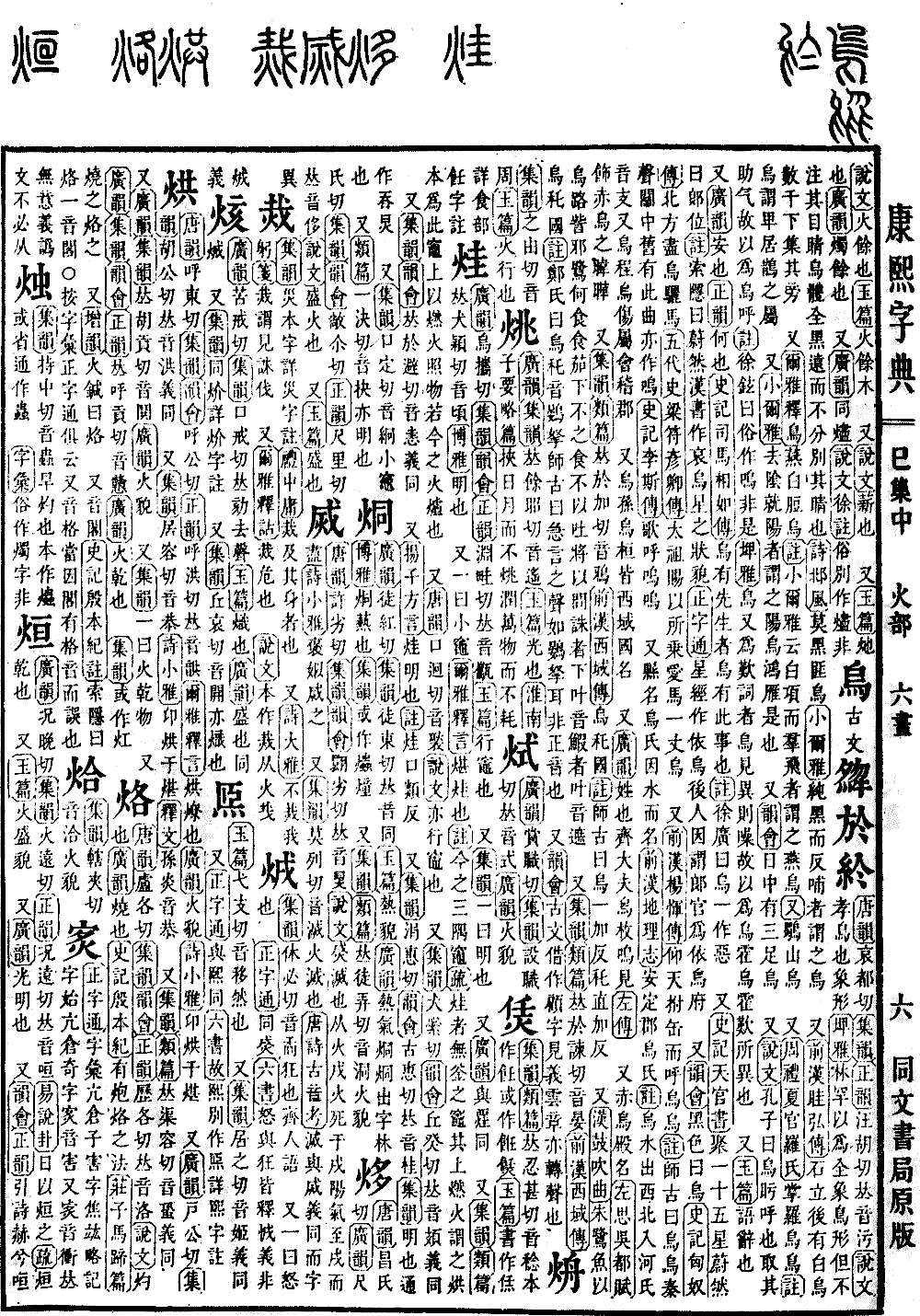
Si Collection, Middle Volume. Radical: Fire (huǒ). Character: Wu. Kangxi strokes: 10. Page number: 670.
In ancient script, it was written as yu.
The Rhyme Dictionary (Tangyun) gives the fanqie pronunciation ai-du. The Collected Rhymes (Jiyun) and Correct Rhymes (Zhengyun) give the fanqie pronunciation wang-hu. The pronunciation is similar to wu.
Explaining Graphs and Analyzing Characters (Shuowen Jiezi) explains it as a filial bird. The character form is a pictograph.
The Increasing Refinement (Piya) mentions that Lin Han believed this character completely imitates the shape of a bird, but without the eyes drawn. Because the crow is entirely black, its eyes cannot be distinguished from a distance.
Nothing is blacker than a crow — Book of Odes (Shijing).
A bird that is entirely black and feeds its parents is called a crow — Lesser Erya (Xiao Erya).
Also, the Book of the Former Han (Qian Hanshu) in the Biography of Sui Hong records: Stones stood upright, and later thousands of white crows flew down and gathered beside the stones.
Also, the Erya in the section Explaining Birds mentions: The swallow-white-necked crow. The commentary says: The Lesser Erya explains that a bird with a white neck that flies in flocks is called a yanwu.
It also mentions: The zhu-mountain crow.
Also, the Rites of Zhou (Zhouli) in the section Officers of Summer, Netters records: In charge of using nets to catch crows and birds. The commentary says: Here, crow refers to birds like the jackdaw or magpie.
Also, the Lesser Erya says: Birds that leave the shade and move toward the sun are called yangwu; wild geese belong to this category.
Also, the Collected Rhymes (Yunhui) says: There is a three-legged crow in the sun.
Also, Explaining Graphs and Analyzing Characters quotes Confucius saying: Wu means to exhale; it is taken for its function in aiding the breath, thus used to express wuhu. Commentary: Xu Xuan says writing it with the common character wu is incorrect.
The Increasing Refinement says: Wu is also used as an interjection because crows cry out upon seeing unusual things; thus, wuhuo is used to express exclamation. Wuhuo signifies marveling at strange things.
Also, the Jade Chapters (Yupian) says: Wu is a grammatical particle.
Also, the Expanded Rhymes (Guangyun) explains it as an (where/how), and the Correct Rhymes explains it as he (what/how).
The Records of the Grand Historian (Shiji) in the Biography of Sima Xiangru mentions Master Wuyou, meaning Master Non-existent. Commentary: Xu Guang says that in some versions, wu is written as wu (how).
Also, the Records of the Grand Historian in the Treatise on Celestial Offices says: Fifteen stars gathered together in a lush appearance are called the Langwei. Commentary: The Suoyin says: The term weiran (lush) is written in the Book of Han (Hanshu) as aiwu, describing the appearance of the stars. The Correct Character Mastery (Zhengzitong) says: The Classic of Stars (Xingjing) writes it as yiwu; later generations thus called the office of the attendants the Yiwu Mansion.
Also, the Collected Rhymes says: Black is called wu.
In the north, there are all black horses (wuli horses) — Records of the Grand Historian.
The History of the Five Dynasties (Wudaishi) in the Biography of Fu Yanqing of the Liang records: Emperor Taizu of Liang bestowed his favorite horse, Ten-Foot Black (Yizhangwu), upon him.
Also, the Book of the Former Han in the Biography of Yang Yun records: He looked up to the sky and struck an earthen pot, letting out wuwu cries. Commentary: Shigu says: Wuwu is the music of the Qin region. Such songs originally existed in the Guanzhong area and were also written as wuwu.
Singing and shouting wuwu — Records of the Grand Historian in the Biography of Li Si.
It is also the name of a county. Wushi County is named after the Wu River. The Book of the Former Han in the Treatise on Geography records: Anding Commandery has Wushi County. Commentary: The Wu River originates in the northwest and flows into the Yellow River. Shi is pronounced as zhi.
There are also Wucheng and Wushang, belonging to Kuaiji Commandery.
There are also Wusun and Wuhuan, both names of states in the Western Regions.
Also, the Expanded Rhymes says: It is a surname. Wu Meiming was a high official of the State of Qi. This appears in the Zuo Commentary (Zuozhuan).
There is also Red Crow (Chiwu), the name of a palace. Decorating the Red Crow Palace, making it bright and radiant — Rhapsody on the Capital of Wu (Wudu Fu).
Also, the Collected Rhymes and the Classified Chapters (Leipian) give the fanqie pronunciation yu-jia, similar to the pronunciation ya.
The Book of the Former Han in the Treatise on the Western Regions records the state of Wucha. Commentary: Shigu says: Wu is pronounced as yi-jia. Cha is pronounced as zhi-jia.
The red heron and the fish by the black road zi-xie; what does the heron eat? It eats beneath the eggplant. If it does not eat, and does not spit it out, I shall ask the executioner — Han Drum and Fife Songs (Han Guchui Qu). Here the word xia rhymes as xia and zhe rhymes as zhe.
Also, the Collected Rhymes and the Classified Chapters give the fanqie pronunciation yu-jian, similar to the pronunciation yan.
The Book of the Former Han in the Treatise on the Western Regions records the state of Wucha. Commentary: Mr. Zheng says: Wucha is pronounced like anna. Shigu says: This is merely the sound when read quickly, like anna. It is not the correct pronunciation.
Also, the Collected Rhymes says: In ancient texts, it was borrowed for the character gu (to look back). This is found in the Chapters of Meaningful Clouds (Yiyun Zhang). This is also a result of phonetic transformation.