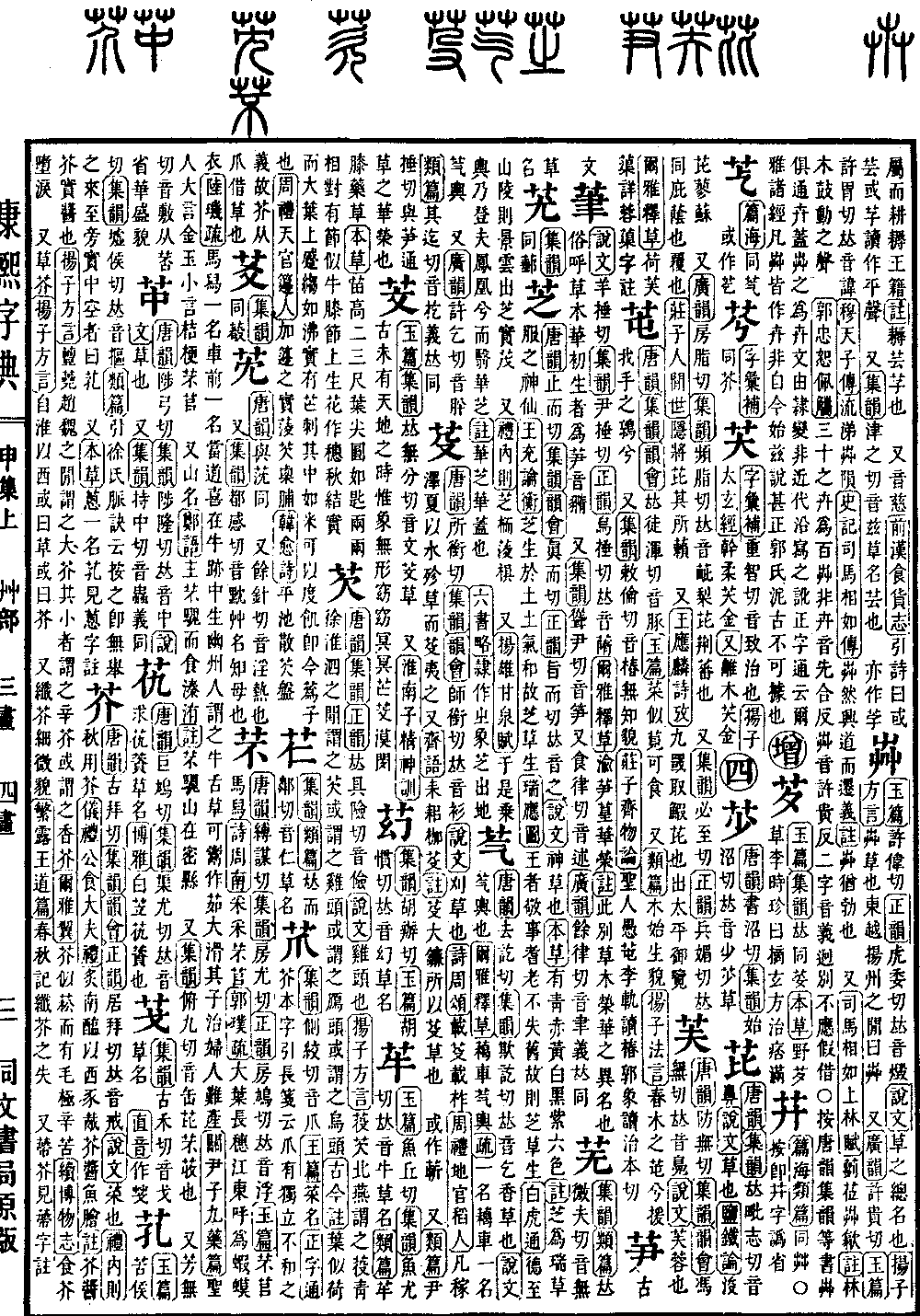
Shen Collection, Upper Volume
Radical: Grass (cǎo)
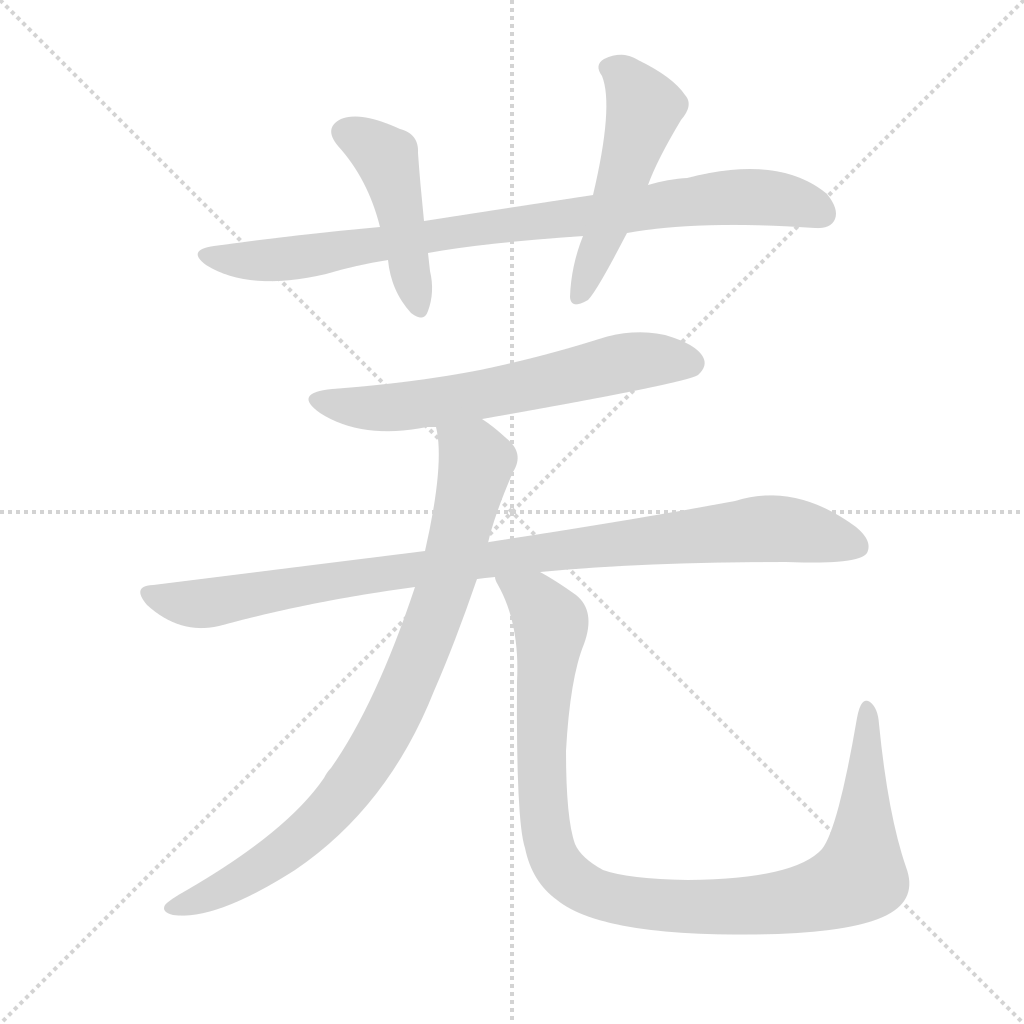
Wu
Kangxi stroke count: 18
Page 1019, Entry 13
According to the Sound Compendium (Jiyun) and the Classified Collection (Leipian), pronounced wu. A type of grass.
Wu. According to the Tang Rhyme (Tangyun) and Sound Compendium (Jiyun), the Rhyme Assembly (Yunhui), and the Correct Rhymes (Zhengyun), pronounced wu. According to the Analytical Dictionary of Chinese Characters (Shuowen), it means filthy or weedy.
In the Verses of Chu (Chuci), specifically the Lament (Lisao): To lament the many fragrant herbs that have become overgrown and filthy.
Also, according to the Approaches to Explaining Ancient Terms (Erya),芜 indicates abundance. Commentary: Abundant and luxuriant.
Also, to lie fallow or become overgrown. In the Verses of Chu (Chuci), specifically the Lament of Ying (Aiying): How can one allow the two eastern gates to become overgrown.
Also, according to the Little Approaches to Explaining Ancient Terms (Xiao Erya), it refers to grass.
Also, a place name. In the notes to the Rhapsody on the City of Wu (Wucheng Fu) by Bao Zhao: Refers to the old city of Guangling.
Also, a lake name. In the Book of Former Han (Qian Hanshu) Geographical Treatise: Wuhu in Danyang Commandery.
Also, interchangeable with the term for a covered corridor or veranda (wu). In the Book of Documents (Shujing), section on the Great Plan (Hongfan): The hundreds of grasses are flourishing.
Textual Research:
In the Verses of Chu (Chuci), Lament (Lisao): To lament the many fragrant herbs that have become overgrown and filthy. The original text has been corrected from many grasses to many fragrant herbs.
In the Approaches to Explaining Ancient Terms (Erya), section on explaining grasses: Bao wu mao. Commentary: Wu means abundant. The original text has been corrected from the section on explaining grasses to the section on explaining ancient terms. The phrase bao wu mao has been corrected to wu means abundant, and wu feng has been corrected to flourishing and abundant.