Si Collection, Middle Volume
Radical: Claw (zhuǎ)
Kangxi Strokes: 12
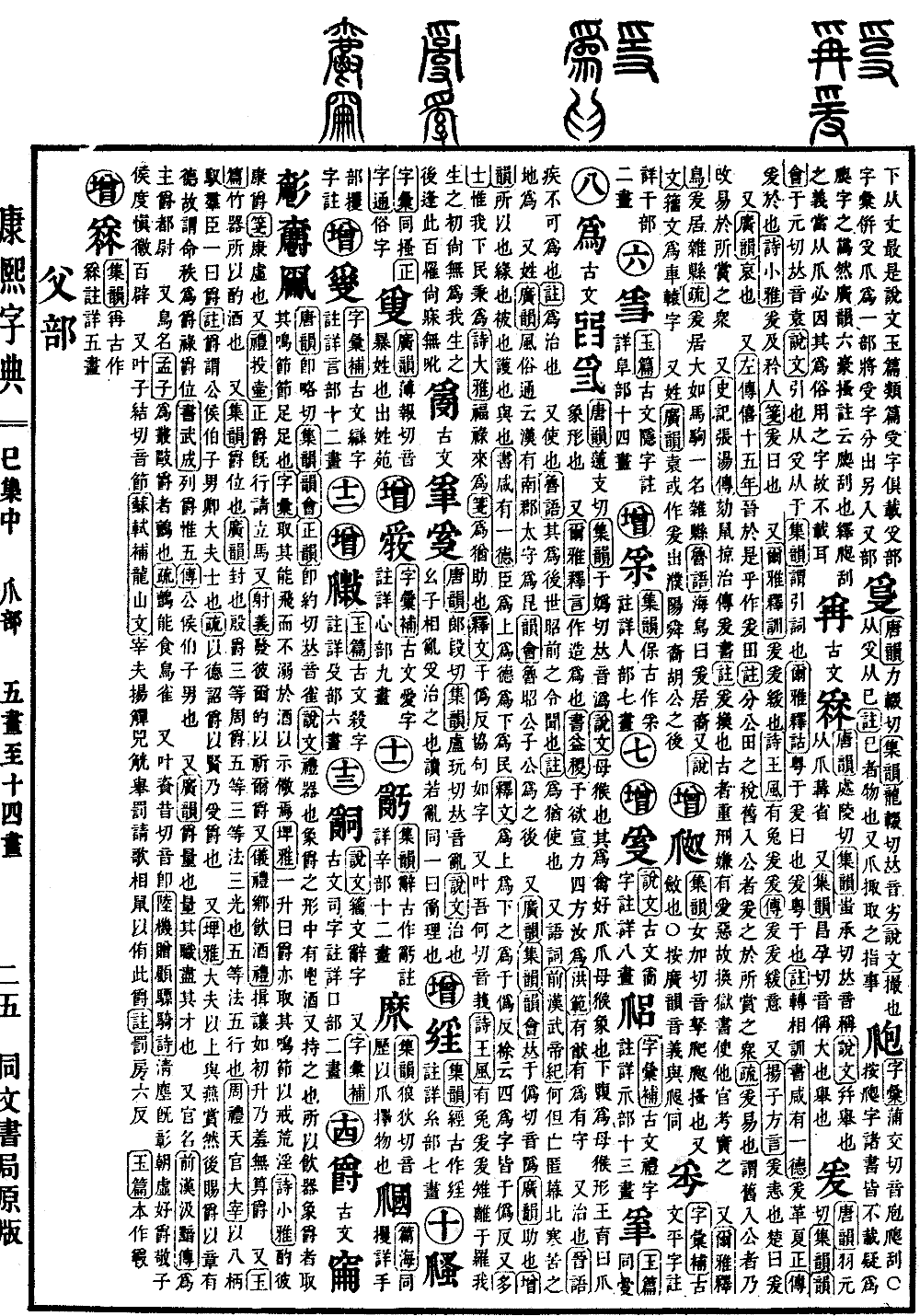
Page 689, Entry 13
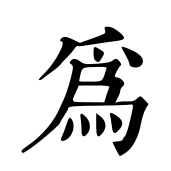
Ancient text. Pronounced wei. According to the Shuowen Jiezi, it refers to a macaque. As a creature, it is fond of using its claws. The character represents the claws of a macaque; the lower part of the abdomen represents the shape of a macaque. Wang Yu states that the character is a pictograph of claws.
Also, according to the Erya (Approaching Elegance), it means to create, to build, or to do. In the Book of Documents (Shujing), specifically the Yiji section, it says: I wish to exert my strength across the four quarters, for you to act. In the Great Plan (Hongfan), it says: Possessing plans, possessing actions, possessing stability.
Also, it means to govern. In the Discourses of the States (Guoyu), specifically the Jin section, it says: The illness cannot be governed. The commentary explains: This use of the character means to govern.
Also, it means to cause. In the Discourses of the States (Guoyu), specifically the Lu section, it says: In order to cause future generations to illuminate the virtuous reputation of those before. The commentary explains: This use of the character is synonymous with cause.
Also, it functions as a modal particle. In the History of the Former Han (Hanshu), specifically the Annals of Emperor Wu, it says: Why only flee and hide in the cold and bitter lands north of the desert?
Also, a surname. According to the Guangyun, the Fengsu Tong (Comprehensive Meaning of Customs) states: During the Han dynasty, there was a Governor of Nanjun named Wei Kun. The Yunhui dictionary states: He was a descendant of Gong Wei, a son of Duke Zhao of Lu.
Also, pronounced wei. According to the Guangyun, it means to assist. According to the Zengyun, it also means the reason why, the cause, the passive recipient, protection, and to give. In the Book of Documents (Shujing), specifically the Xianyou Yide section, it says: As a subject, one acts for the sovereign to cultivate virtue; one acts for the common people to provide for them. The Shijing commentary notes: The instances of the character in this passage are pronounced wei. Xu states: All four instances of the character in this passage are pronounced wei.
Also, in the Duoshi section of the Book of Documents (Shujing), it says: We the common people uphold our conduct. In the Book of Odes (Shijing), specifically the Daya section, it says: Blessings and prosperity come to assist. The commentary states: It means to assist. The Shijing commentary notes: Pronounced wei, which is the reading that maintains the rhyme scheme.
Also, rhyming with he, pronounced e. In the Book of Odes (Shijing), specifically the Wang Feng section: There is a rabbit, moving slowly, a pheasant caught in the net. At the beginning of my life, there was still no action. After my life, I encountered these hundred sufferings; I wish I could sleep and not awaken.