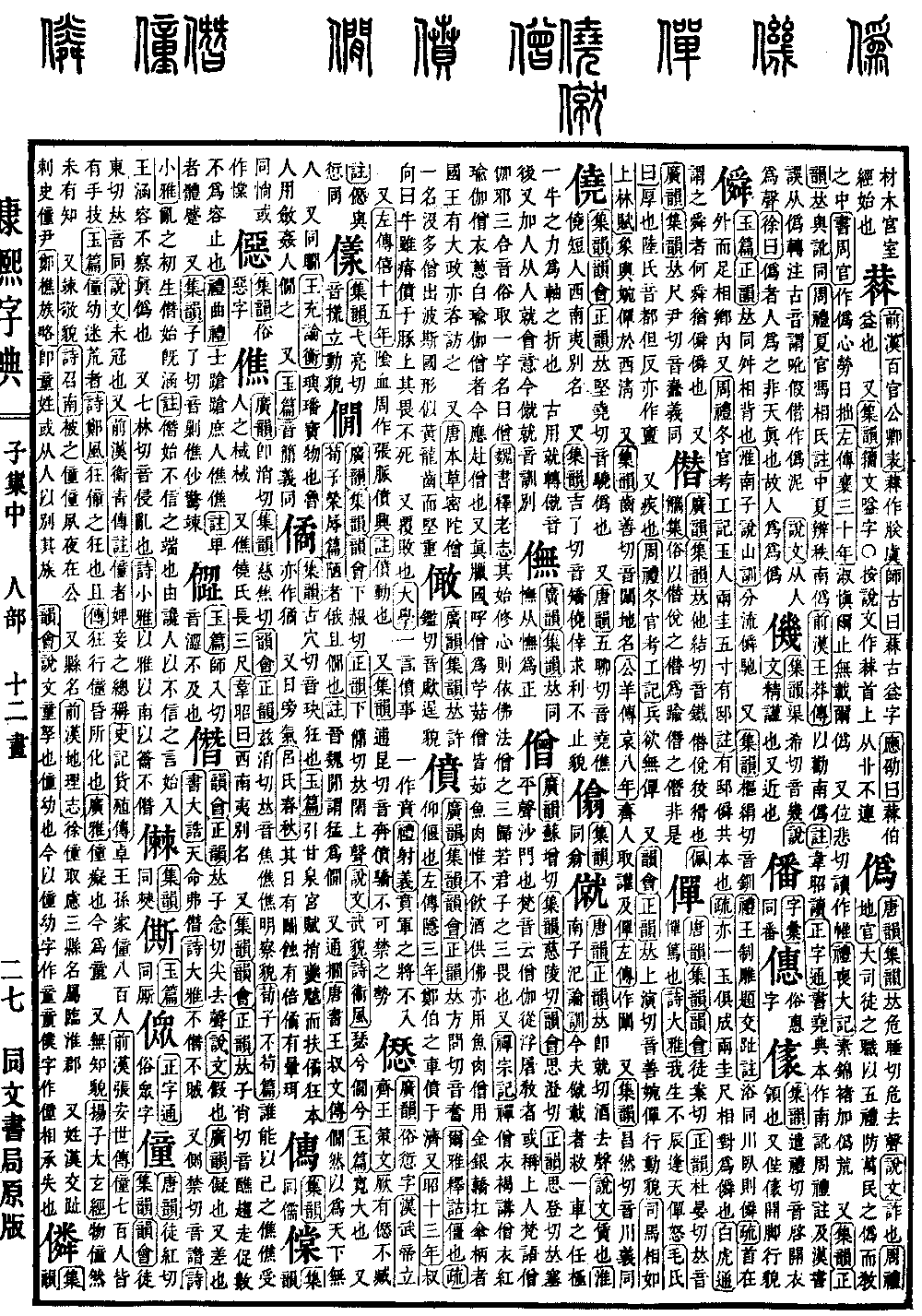
Zi Collection, Middle Volume
Radical: Person (rén)
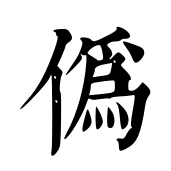
Character: wěi
Kangxi strokes: 14
Page 117, number 02
According to the Tang Rhymes (Tangyun) and Collected Rhymes (Jiyun), the pronunciation is a combination of the sounds wéi and shuì, read in the departing tone of the character wéi.
The Explanation of Graphs (Shuowen) defines the term as deception and fraud.
In the Rites of Zhou (Zhouli), Earthly Officials (Diguan), it is stated that the duty of the Grand Minister of Education is to use the Five Rites to prevent deception among the people and to teach them the virtues of the middle way and correctness.
In the Book of Documents (Shujing), Officers of Zhou (Zhouguan), it is said that those who engage in deception find their minds toiling in vain and become increasingly clumsy every day.
The Zuo Commentary (Zuozhuan), Thirtieth Year of Duke Xiang, states that one should make their conduct beautiful and be cautious, rather than carrying deception with them.
The character is also pronounced with the combined sounds of wèi and bēi, and is read like the word for curtain, wéi.
In the Classic of Rites (Liji), Great Records of Funeral Rites (Sangdaji), it refers to a casket cover made of plain brocade with an added curtain-like valance called a wéihuǎng.
Furthermore, in the Collected Rhymes (Jiyun) and Correct Rhymes (Zhengyun), this character is used synonymously with é.
In the Rites of Zhou (Zhouli), Spring Officials (Chunguan), the annotation for the Astrologer (Fengxiangshi) mentions that in mid-summer, one must distinguish the order of the southern transformation, known as nán'é.
In the History of the Former Han (Qianhanshu), Biography of Wang Mang (Wang Mang Zhuan), it is used in the context of encouraging the southern transformation, or nán'é. A commentary by Wei Zhao provides the reading for this usage.
In the Correcting Character Errors (Zhengzitong), it is noted that the Canon of Yao (Yaodian) in the Book of Documents originally used the character é, but the annotations in the Rites of Zhou and the History of the Former Han mistakenly used this character instead. While some argue that in ancient phonology the sound é was borrowed to serve as this character, such an interpretation is considered overly rigid.
According to the Explanation of Graphs (Shuowen), the character structure follows the Radical: Person (rén) and uses the character for do (wéi) for its sound.
Xu says that wěi refers to that which is man-made and not natural; therefore, human action is what constitutes the artificial or false.
Correction: Regarding the annotation for the Astrologer (Fengxiangshi) in the Rites of Zhou (Zhouli), the reference should be listed under Spring Officials (Chunguan) rather than Summer Officials, following the original text.