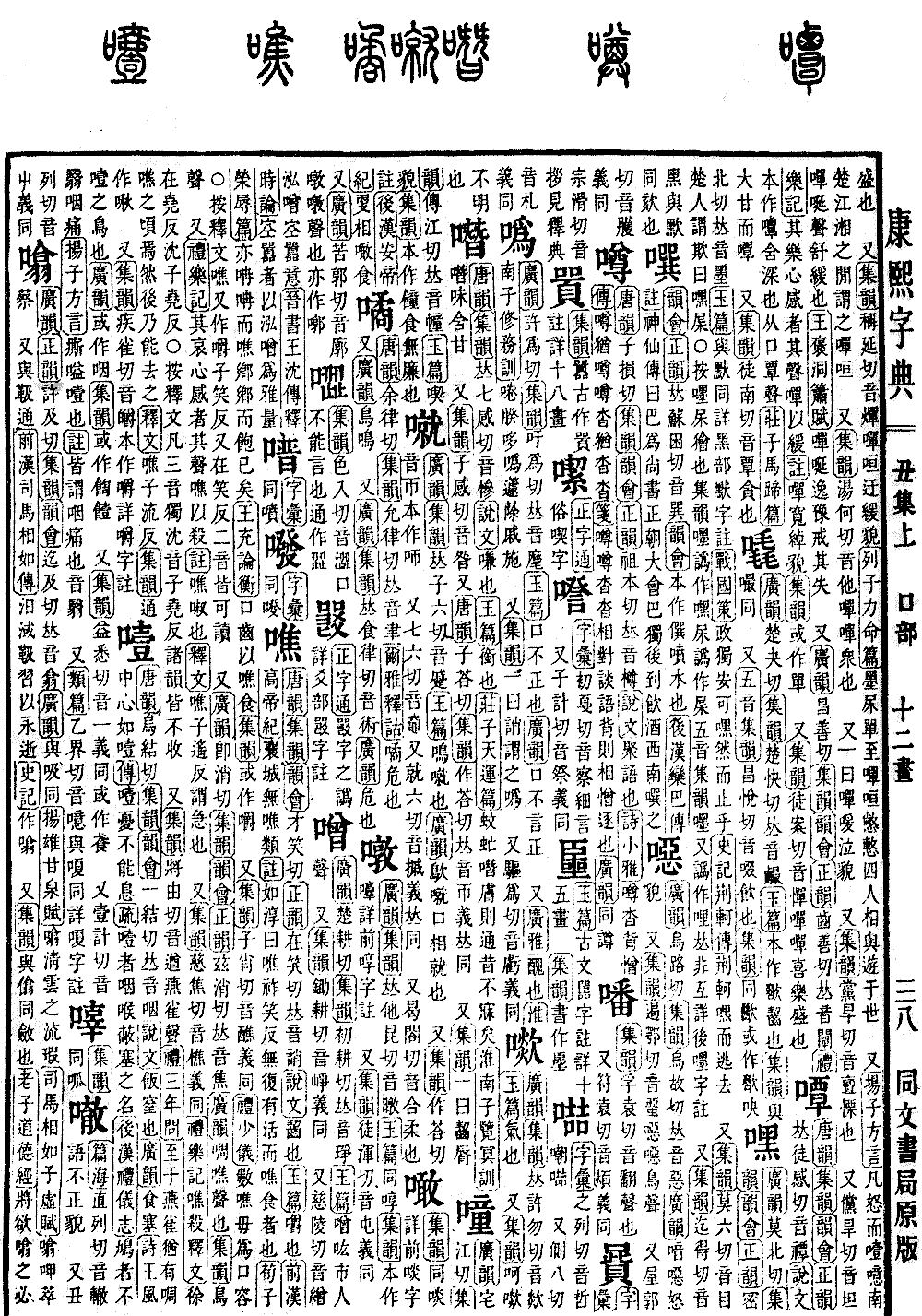
Chou Collection, Upper Volume
Radical: Mouth (kǒu)
Character: 噍
Kangxi strokes: 15
Page 208, Entry 27
Pronounced qiào.
Explanations in Tang Rhyme (Tángyùn), Collected Rhymes (Jíyùn), and Rhyme Meeting (Yùnhuì) cite the pronunciation qiào; Correct Rhymes (Zhèngyùn) cites the pronunciation qiào.
According to Explaining Graphs and Analyzing Characters (Shuōwén), it means to gnaw.
Jade Chapter (Yùpiān) states it means to chew.
In the History of the Former Han (Qián Hàn): Records of Emperor Gao, it is written: In Xiangcheng, there was not a single creature left to chew. The commentary by Ru Chun says: To chew means there is no one left alive to consume food.
In Xunzi: On Glory and Disgrace (Róngrǔ), it is written: They just chew in a leisurely way, satisfied once they are full.
In Wang Chong's Balanced Discourses (Lùnhéng), it is written: Mouth and teeth are used to chew food.
Collected Rhymes (Jíyùn) notes that it is sometimes written as the variant form (jué).
Also, per Collected Rhymes, pronounced jiào. The meaning is the same.
In Book of Rites (Lǐjì): Shao Yi, it is written: When chewing frequently, do not make expressions with the mouth.
Note: According to the Explanation of Texts (Shìwén), the character 噍 can also be written as the variant form (jué), pronounced both qiào and qiào; both pronunciations are acceptable.
Also, per Extensive Rhymes (Guǎngyùn), pronounced jiāo; per Collected Rhymes (Jíyùn), Rhyme Meeting (Yùnhuì), and Correct Rhymes (Zhèngyùn), pronounced jiāo.
Extensive Rhymes defines this as the sound of chirping. Collected Rhymes defines it as the sound of birds.
Also, in Book of Rites (Lǐjì): Record of Music (Yuèjì), it is written: For those whose hearts are moved by sorrow, their voices are thin and diminished (qiāo). The commentary says: This describes a high-pitched, thin sound. The Explanation of Texts (Shìwén) notes the pronunciation tiáo, meaning urgent or rapid.
Also, per Collected Rhymes, pronounced qiáo. The meaning is the same.
Regarding the Record of Music entry, the Explanation of Texts notes the pronunciation as qiáo, which is also supported by the scholar Shen. Other rhyme books do not record this pronunciation.
Also, per Collected Rhymes, pronounced qiú. It refers to the sound of swallows and sparrows.
In Book of Rites (Lǐjì): Questions on the Three Years of Mourning, it is written: As for swallows and sparrows, there is still the moment of chirping before they are able to leave. The Explanation of Texts records the pronunciation as qiú. Collected Rhymes notes this is commonly written as the variant form (jiū).
Also, per Collected Rhymes, pronounced jué. Originally written as the character (jué). See the entry for (jué) for further details.