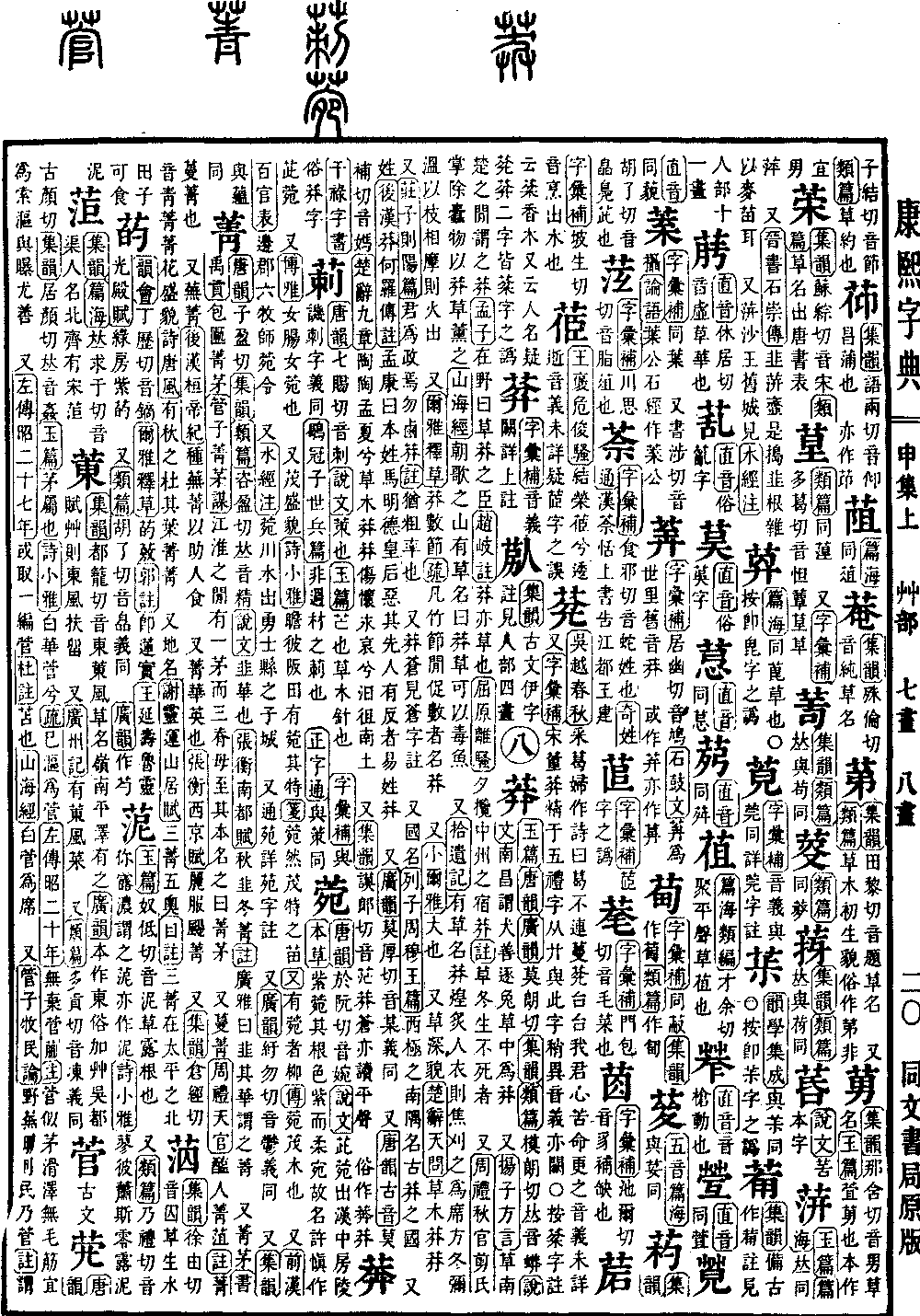
Shen Collection, Upper Volume
Radical: Grass (cǎo)
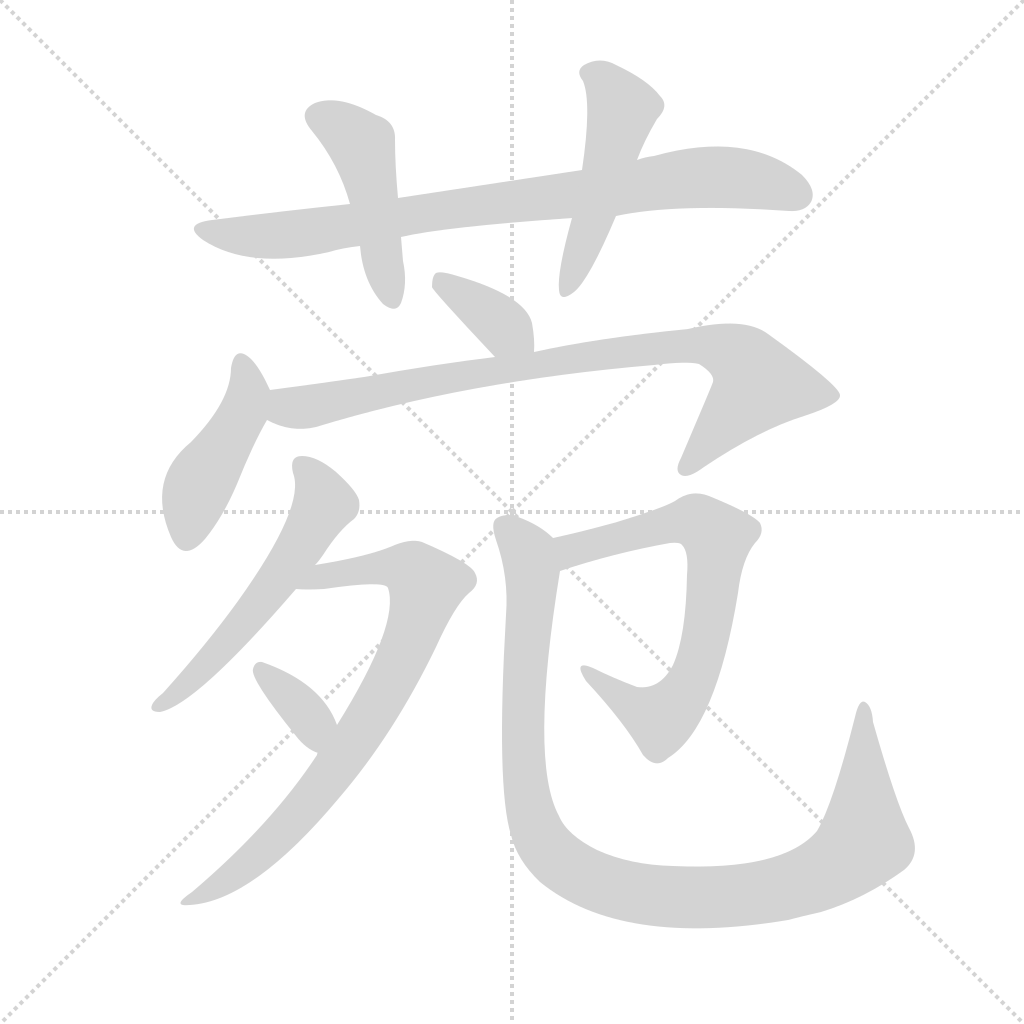
Entry: Wan
Kangxi stroke count: 14
Page 1036, Entry 44
Tang Rhymes (Tangyun): Pronounced wan (rising tone).
Explaining Graphs and Analyzing Characters (Shuowen): Ziwan, originates from Fangling in Hanzhong.
Materia Medica (Bencao): Ziwan, its roots are purple in color and soft yet curved, which is how it acquired this name. Xu Shen writes it as Ziwan.
Also, Broadened Erudition (Boya): Nuchang is the same as Nuwan.
Also, describes the appearance of luxuriant growth.
Book of Odes (Shijing), Lesser Odes (Xiao Ya): Look at the fields on the hillside, with luxuriant and prominent sprouts.
Commentary (Jian): Wanran describes the appearance of luxuriant and prominent sprouts.
Also: There are those luxuriant willow trees.
Commentary (Zhuan): Wan refers to luxuriant trees.
Also, Former Han (Qianhan), Table of Officials (Baiguan Biao): Frontier commanderies established six shepherd and pasture officials.
Also, Commentary on the Water Classic (Shuijingzhu): Wanchuan, this river originates from the sub-city of Yongshi County.
Also, functions as a variant of the character for park (yuan). See the notes for the entry on the park character for details.
Also, Extensive Rhymes (Guangyun): Pronounced yu (entering tone). The meaning is the same.
Also, Collection of Rhymes (Jiyun): Identical to the character for accumulated (yun).