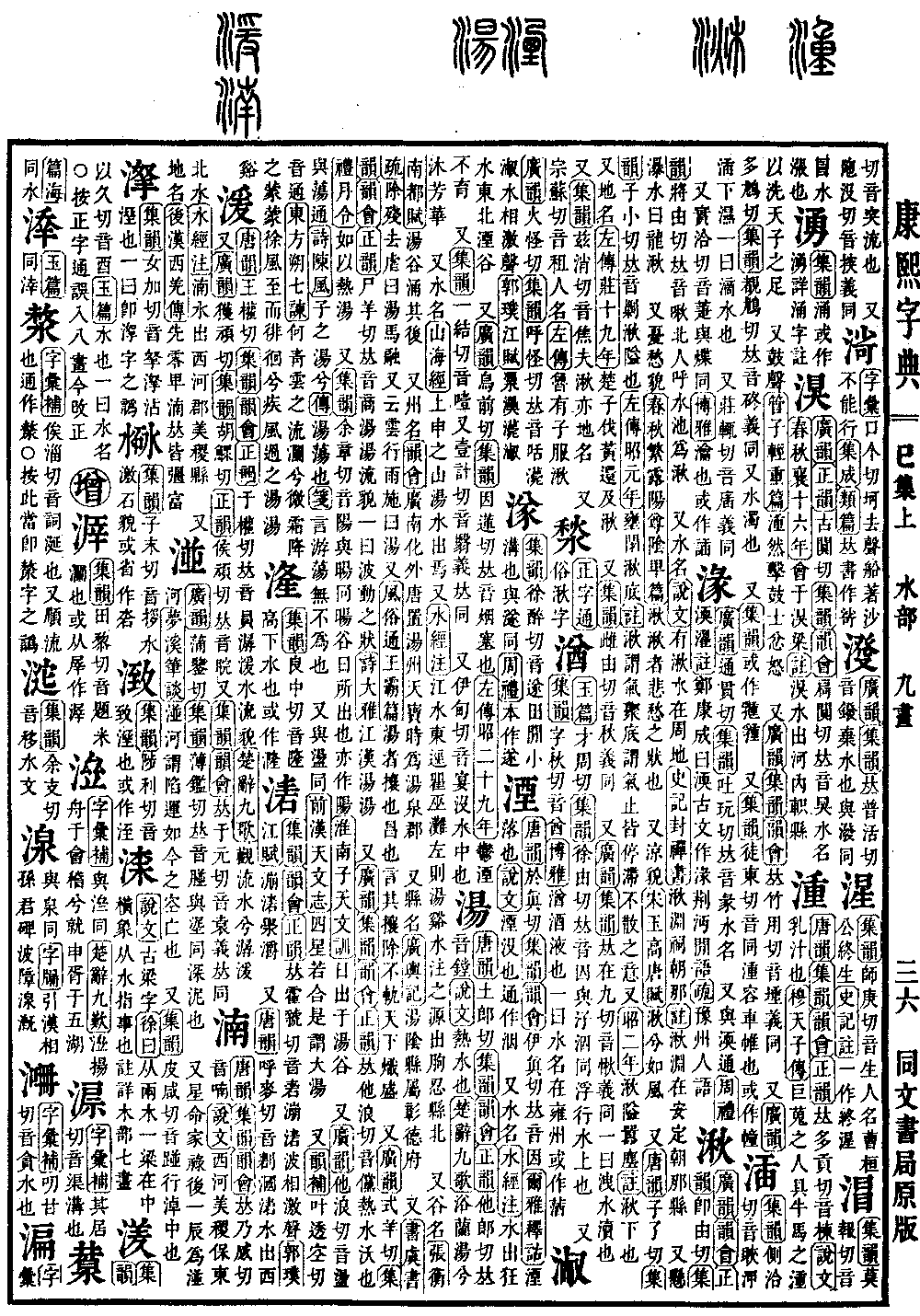
Si Collection, Upper Volume
Radical: Water (shuǐ)
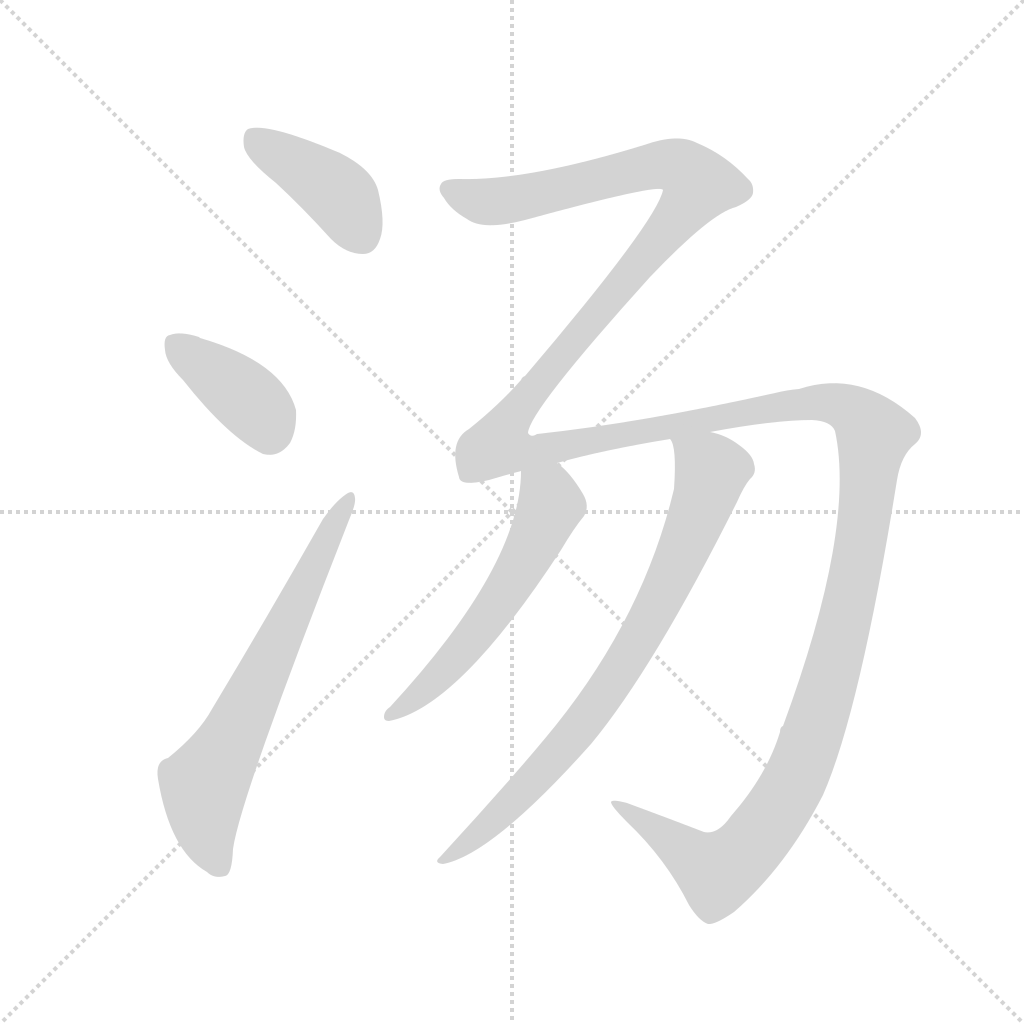
湯
Kangxi stroke count: 13
Page 638, Entry 01
Pronounced tāng.
Shuowen Jiezi: Hot water.
Chu Ci (Chu Elegies), Nine Songs (Jiuge): Bathing in orchid water, washing with fragrant herbs.
Also, a river name.
Classic of Mountains and Seas (Shanhaijing): From Shangshen Mountain, the Tang River emerges.
Also, Water Classic Commentary (Shuijingzhu): The Yangtze River flows east past Quwu Shoal, where it is joined on the left by the Tangxi River, which has its source north of Quren County.
Also, a valley name.
Zhang Heng, Rhapsody on the Southern Capital (Nandu Fu): The Tang Valley surges behind it.
Also, a prefecture name.
Rhyme Compendium (Yunhui): Located in the region beyond the civilizing influence of the South, the Tang Prefecture was established during the Tang Dynasty and renamed Tangquan Commandery during the Tianbao era.
Also, a county name.
Guang Yu Ji (Record of the Vast World): Tangyin County, belonging to Zhangde Prefecture.
Also, Commentary on the Book of Documents (Shu Yu Shu): To remove the cruel and eliminate the oppressive is called Tang. Ma Rong also stated: When clouds move and rain is distributed, it is called Tang.
Also, Fengsu Tong (Comprehensive Meaning of Customs), Chapter on Kings and Hegemons (Wangba Pian): Tang means to expel and to flourish. It refers to repelling and removing the rebellious, causing the world to flourish.
Pronounced shāng.
Tang-tang, the appearance of flowing water. Another interpretation: the state of waves moving.
Book of Odes (Shijing), Greater Odes (Daya): The Yangtze and Han rivers flow vigorously.
Pronounced tàng.
Hot water for washing.
Book of Rites (Liji), Monthly Ordinances (Yueling): As if using hot water.
Pronounced yáng.
Equivalent to the character for the rising sun (yáng). Yang Valley, where the sun emerges. Also written as Yang.
Huainanzi, Treatise on Astronomy (Tianwen Xun): The sun emerges from Tang Valley.
Pronounced dàng.
Equivalent to the character for wandering (dàng).
Book of Odes (Shijing), Odes of Chen (Chenfeng): Your wandering ways.
Commentary: Tang means to wander.
Notes: It refers to wandering without restraint.
Also equivalent to the character for great movement (dàng).
History of the Former Han (Qianhan Shu), Treatise on Astronomy: When four stars align, it is called the Great Tang.
Pronounced tōng (rhyming category adjustment).
Eastern Depot (Dongfang Shuo), Seven Remonstrances (Qijian): How the blue clouds flow in waves, hidden by the falling frost; the gentle breeze arrives and lingers, while the fierce wind passes by with a rushing sound.
Editorial Notes:
Chu Ci (Chu Elegies), Nine Songs (Jiuge): Bathing in orchid water, washing with fragrant herbs. Verified that in the original text, the character for flower is part of the next clause and not linked to the word fragrant; the character has been omitted here.