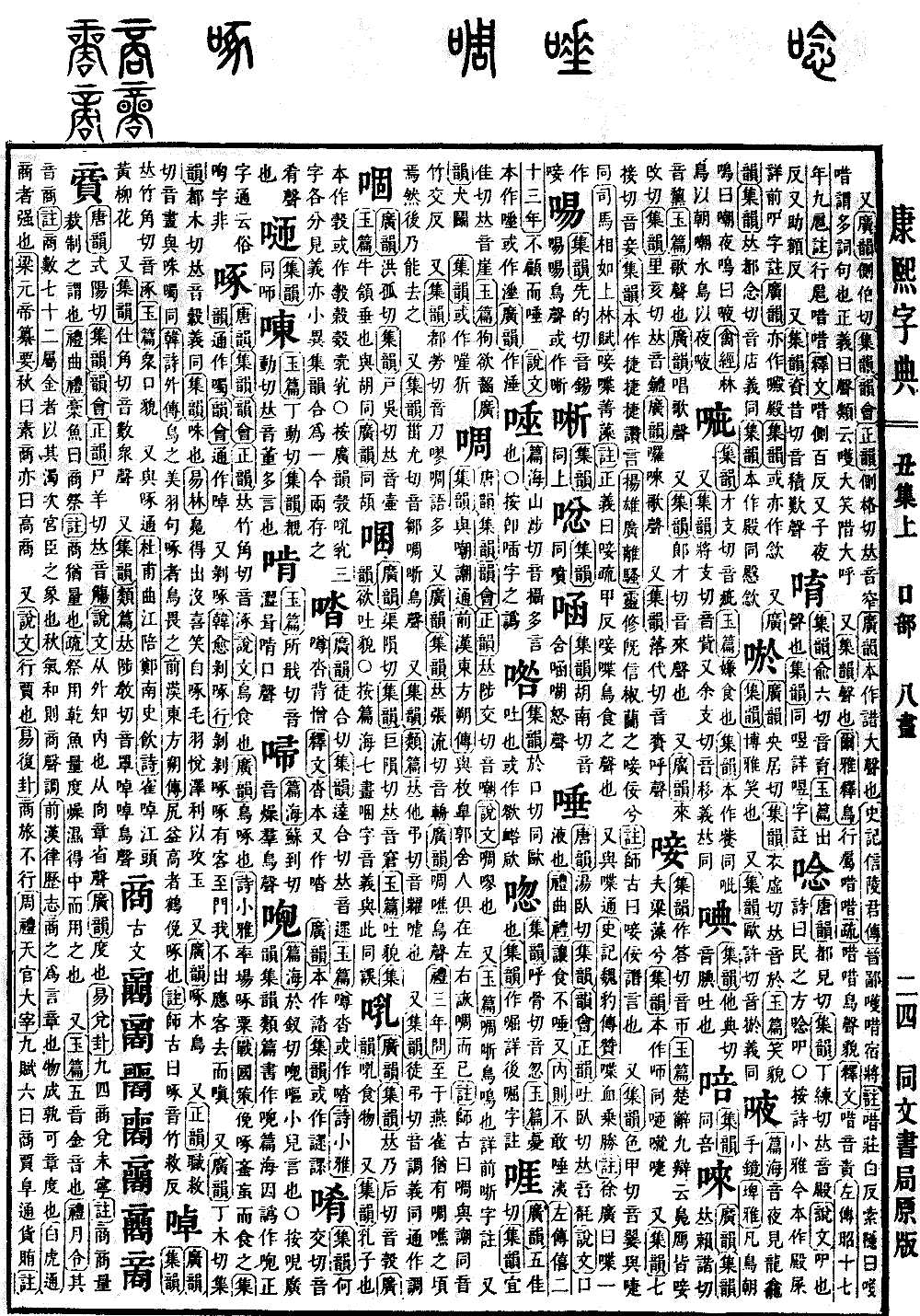
Chou Collection, Upper Volume
Radical: Mouth (kǒu)
Kangxi Strokes: 11
Page 194, Entry 32
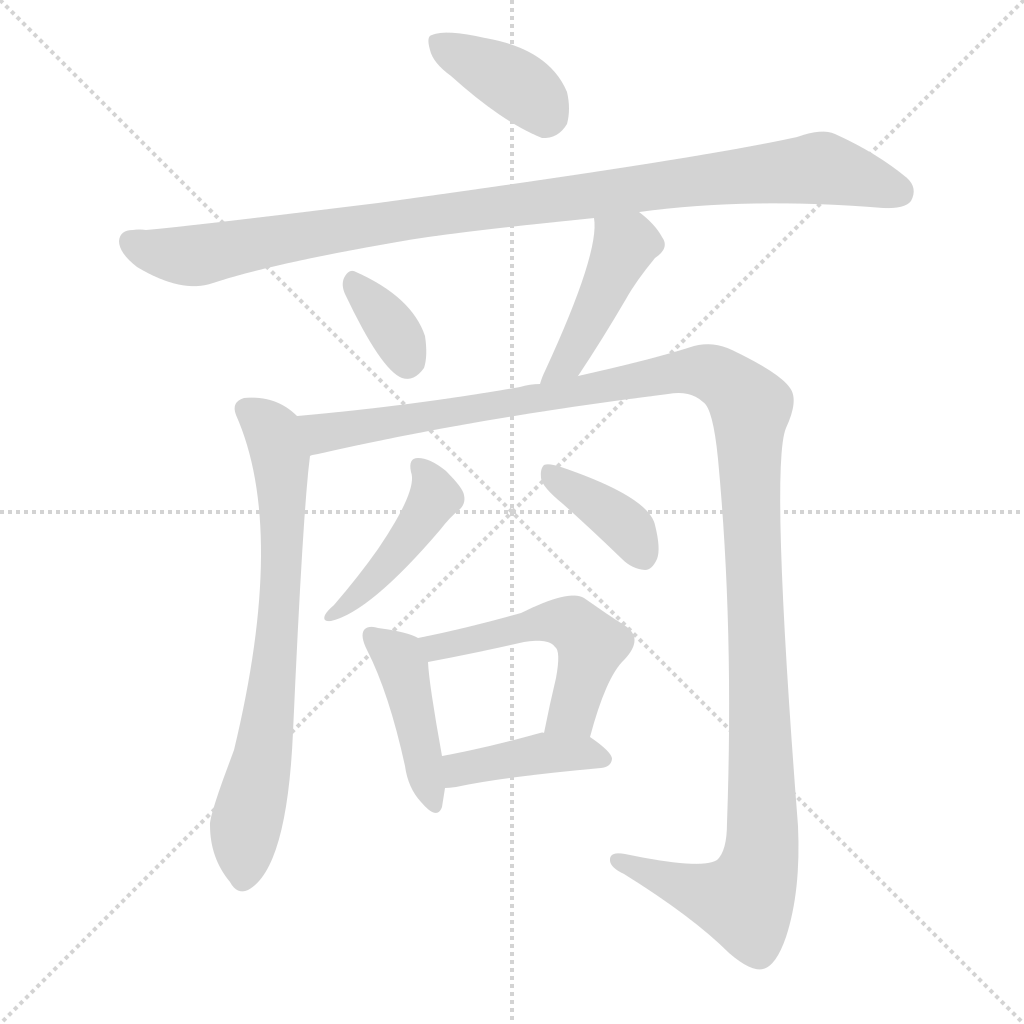
Ancient form. Pronounced shang.
According to the Shuowen Jiezi (Explaining Graphs and Analyzing Characters), it means to know the inside from the outside. Derived from the character meaning to follow, with the radical for chapter abbreviated to indicate sound.
According to the Guangyun (Broad Rhymes), it means to measure.
From the Book of Changes (Yijing), Hexagram Dui, Nine in the fourth place: "Consulting (shang) about the realization, not yet at peace." Annotation: Shang means to deliberate or regulate.
From the Book of Rites (Liji), Section on Qu Li: "Dried fish is called shang ji." Annotation: Shang here is synonymous with to measure. Sub-commentary: In sacrificial rites, dried fish is used; one measures its dryness and moisture, using it only when it is at the appropriate level.
Also, according to the Yupian (Jade Chapters), it is the second of the five musical tones, representing the metal note.
From the Book of Rites (Liji), Section on Monthly Ordinances (Yueling): "Its tone is shang." Annotation: The number of the shang note is seventy-two; it belongs to metal because, in terms of turbidity, it follows the gong tone, symbolizing a minister. When the autumn atmosphere is harmonious, the shang tone is in tune.
From the Book of Han (Hanshu), Treatise on Harmonics and Calendars: The word shang means to manifest (zhang); when things reach maturity, they can be measured and manifested.
From the Baihu Tong (Comprehensive Discussions in the White Tiger Hall): Shang means to be strong.
From the writings of Emperor Yuan of Liang, Cuan Yao: Autumn is called the white shang, also known as the high shang.
Also, according to the Shuowen Jiezi, it means to engage in trade.
From the Book of Changes (Yijing), Hexagram Fu: "Merchants (shang lv) do not travel."
From the Rites of Zhou (Zhouli), Section on the Heavenly Officials and the Grand Administrator: "Of the nine duties, the sixth is that of merchants (shang gu), facilitating the circulation of goods and wealth." Annotation: Those who travel are called shang, those who stay are called gu.
According to the Guangyun, this is the original form. The common form is incorrect.
Also, according to the Jiyun (Collected Rhymes), it means to carve.
From the Book of Documents (Shangshu), commentary on the Qi style: The Shangshu Wei (Apocryphal Treatise on the Book of Documents) calls engraving shang.
From the Yili (Book of Etiquette and Ceremonial), commentary on the Wedding Rites for Gentlemen: Zheng’s catalog states: "Sunlight fading by three measures (shang) constitutes twilight." Sub-commentary: Master Ma says that before sunrise and after sunset are both two and a half measures; the mention of three measures is based on a round number.
According to the Zhengzitong (Correction of Characters): Shang is the position marked on the clepsydra arrow. In ancient times, engraving or carving was called shang; terms such as shang gold or shang silver derive from this. Clepsydra water-clocks are marked with these traces to verify the water level.
Also, according to the Guangyun, it means to stretch, to descend, or to be constant.
Also, a country name. From the Book of Odes (Shijing), Preface to the Odes of Shang: "Shang is the land where Xie was enfeoffed." Sub-commentary: Master Zheng believes that King Tang took the place where Xie was enfeoffed as the dynastic title. However, Fu Qian and Wang Su disagree. The Zuo Zhuan (Commentary of Zuo), ninth year of Duke Xiang, states: "E Bo resided at Shangqiu, and Xiangtu inherited it." Fu Qian says: "Xiangtu, the grandson of Xie, resided at Shangqiu, and King Tang used this as his dynastic title." Furthermore, Wang Su’s commentary on the Book of Documents Preface also says this. However, the mention of Xie’s enfeoffment in Shang appears in historical records and texts with great clarity. Classical texts referring to Shang always use the single character Shang; there is no mention of Shangqiu. Moreover, the relationship of Xiangtu to the Yin house was not the basis of royal authority, so why would one take the place of his residence as a dynastic title?
Also, a place name. From the Zuo Zhuan, twenty-fifth year of Duke Xi: "The state of Chu defeated Qu Yu Kou and sent the armies of Shen and Xi to garrison Shangmi."
Also, from the Spring and Autumn Annals (Chunqiu), twenty-first year of Duke Xiang: "Meeting at Shangren."
Also, from the Stratagems of the Warring States (Zhan Guo Ce): The Battle of Gaoshang.
Also, a prefecture name. According to the Guangyun, it is the ancient state of Shang. During the Northern Wei dynasty, it was established as Luo Prefecture; during the Zhou dynasty, it was called Shang Prefecture, taking its name from the ancient Shang land.
From the Stratagems of the Warring States: When Wei Yang fled from Wei to Qin, Duke Xiao appointed him as chancellor and enfeoffed him in Shang, giving him the title Lord Shang.
From the Records of the Grand Historian (Shiji), Biography of Zhang Yi: "I request that you offer the land of Shangyu to the extent of six hundred li." Annotation: Shang Prefecture contained the ancient Shang city; two hundred li to the west was the ancient Yu city.
Also, Shangling, a marquisate during the Han dynasty, located in Linhuai. See the Records of the Grand Historian, Table of Nobles of the Hui and Jing Eras.
Also, a surname. From the Records of the Grand Historian, Biography of Confucius's Disciples: Shang Qu and Shang Ze.
Also, according to the Rules of Posthumous Titles: One who manifests merit and brings peace to the people is called Shang.
Also, interchangeable with the character for to blame (zhe). From the Xunzi, Section on Confucian Effectiveness: "To blame (zhe) virtue and determine rank." Annotation: Zhe is the same as shang.
Also, according to the Jiyun, pronounced zhang. To measure.
From the Book of Documents, Feishi chapter: "I shall measure (shang) and reward you." Commentary: The character is read as itself, though Master Xu pronounces it zhang.