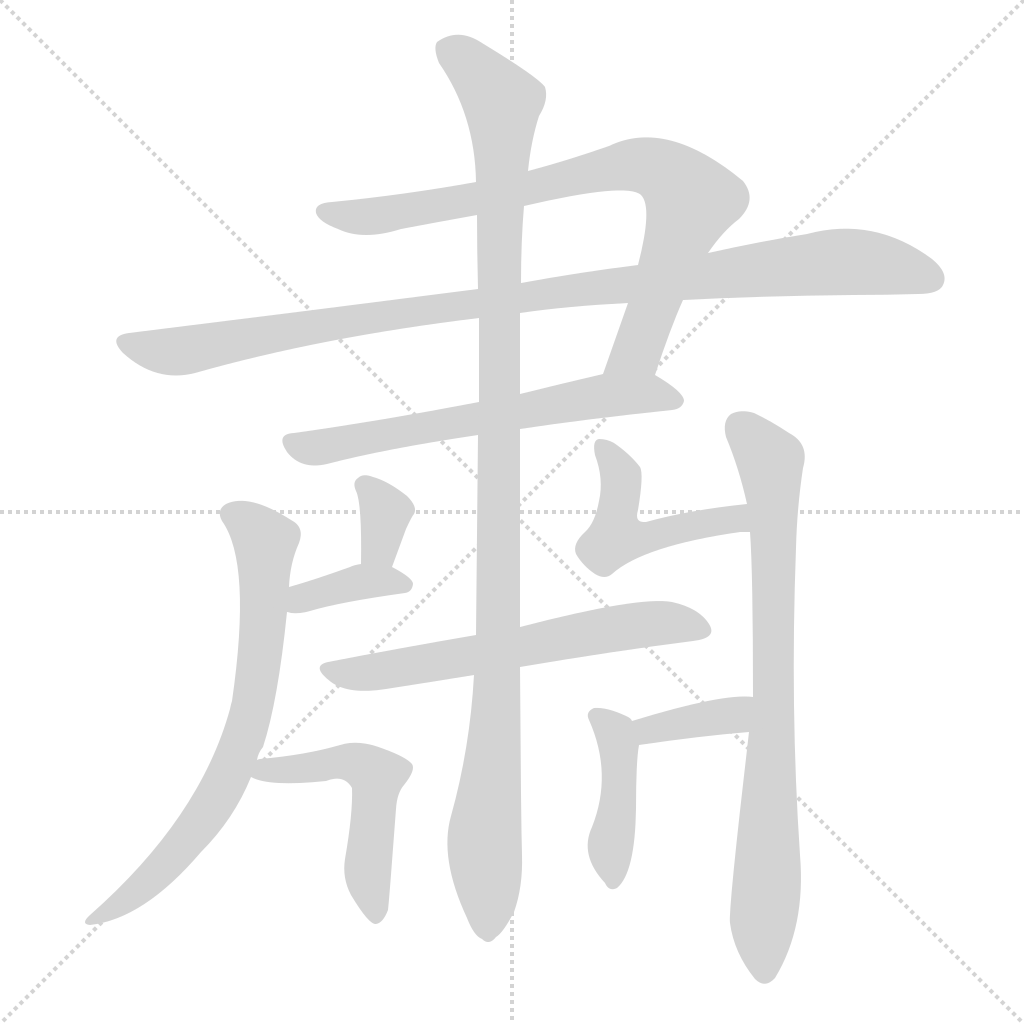
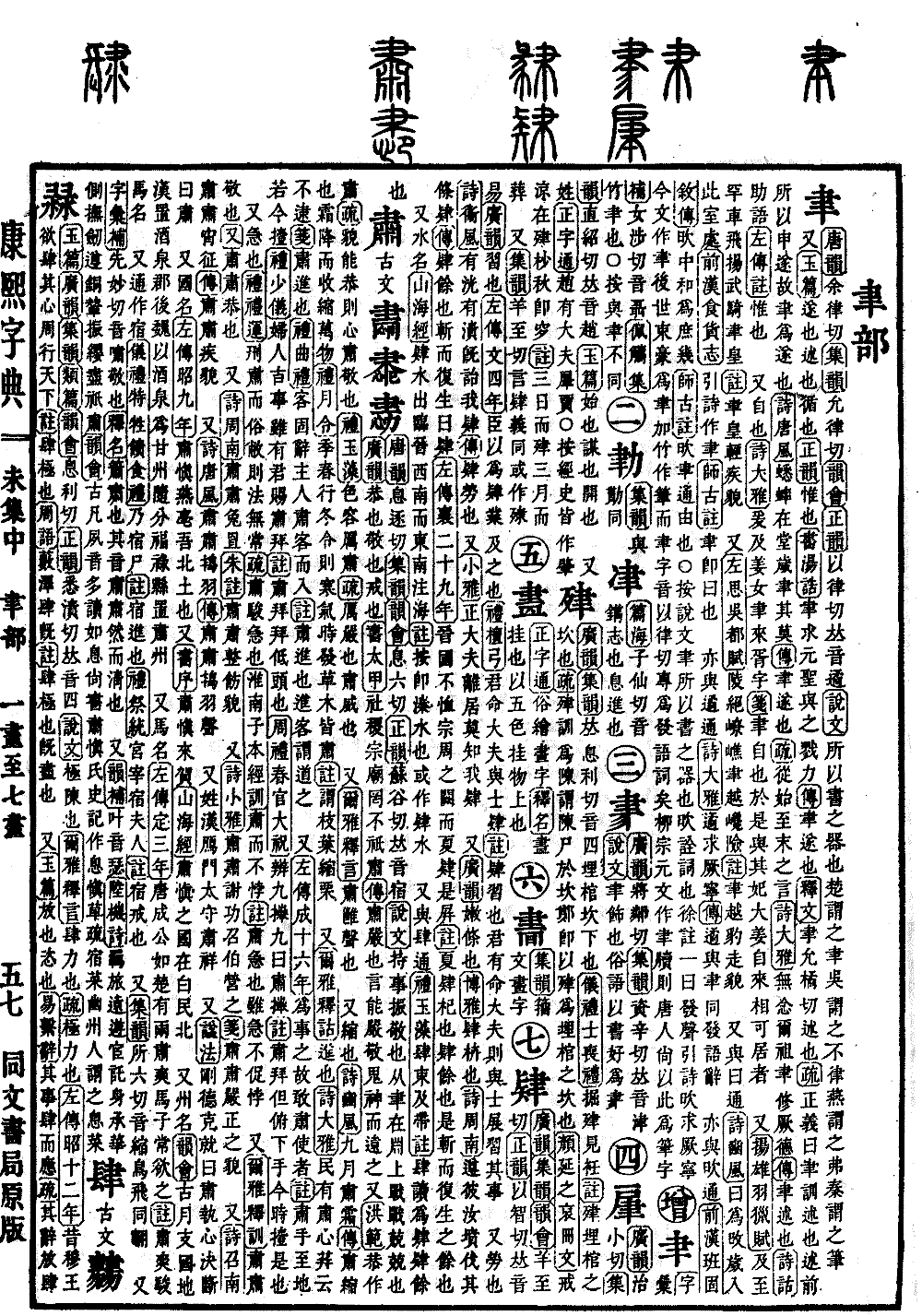
Wei Collection, Middle Volume
Radical: Writing Brush (yù)
Kangxi Strokes: 13
Page 971, Entry 11
Ancient form. Pronounced su (entering tone).
According to the Analytical Dictionary of Characters (Shuowen Jiezi), it means to hold a matter with focus and respect. It is composed of the radical for writing brush on top, suggesting a feeling of trepidation and careful attention.
According to the Broad Rhymes (Guangyun), it means respectful, reverent, and cautious.
In the Book of Documents (Shujing), specifically the Taijia chapter: Regarding the altars of grain and land and the ancestral temples, there is nothing that is not handled with reverent respect. The commentary states: Su means to be strict. It refers to the ability to hold the spirits in strict reverence and keep them at a distance.
In the Great Plan (Hongfan): To be respectful is to be strict. The commentary states: When one's appearance is respectful, the heart is reverent and strict.
In the Book of Rites (Liji), specifically the Jade Talisman (Yuzao) chapter: The expression and demeanor are stern and respectful. The commentary states: Li means strict; Su means majestic.
According to the Erling (Erya), the chapter on explaining words: Su-yong refers to the sound of something.
It also means to contract or shrink. In the Book of Odes (Shijing), in the Odes of Bin: In the ninth month, the frost arrives. The commentary states: Su means to shrink; when the frost descends, it causes all things to contract.
In the Book of Rites, the Monthly Commands (Yueling) chapter: If one acts according to winter policies during the last month of spring, cold air will periodically emerge, and plants and trees will all shrink. The commentary explains this as the branches and leaves shriveling.
According to the Erling (Erya), the chapter on explaining words: It also means to advance. In the Book of Odes (Shijing), in the Greater Odes: The people possess a progressive heart, but the weeds do not reach that point. The annotation states: Su means to advance.
In the Book of Rites, in the Record of Customs (Quli) chapter: The guest firmly declines, and the host motions the guest to advance and enter. The annotation states: Su means to advance. Advancing the guest refers to guiding them.
In the Zuo Commentary (Zuozhuan), the sixteenth year of Duke Cheng: Because of the business at hand, I dare to advance toward the messenger. The annotation states: To extend the hands to the ground, similar to the modern obeisance of yi.
In the Book of Rites, in the Lesser Rituals (Shaoyi) chapter: Regarding the happy occasions of women, even if there is a gift from the lord, one performs the su-bai. The annotation states: Su-bai is to bow and lower the head.
In the Rites of Zhou (Zhouli), in the Office of Spring: Distinguishing the nine types, the ninth is called su. The annotation states: Su-bai means to simply bow the hands downward, similar to the modern obeisance of yi.
It also means urgent. In the Book of Rites, in the Evolution of Rites (Liyun) chapter: If there is urgency but the customs are degenerate, then the law has no consistency. The commentary states: Su means fast and urgent.
In the Huainanzi, in the chapter on the teachings of the origin: Urgent but not contradictory. The annotation states: Su means urgent. Though urgent, it is not hurried or confused.
According to the Erling (Erya), in the chapter on explaining teachings: Su-su means respectful. It also means reverent.
In the Book of Odes (Shijing), in the Odes of Zhou: The respectful rabbits. The commentary by Zhu Xi states: Su-su describes a neat and tidy appearance.
In the Book of Odes (Shijing), in the Lesser Odes: The dignified work of the Xie, which the Duke of Shao managed. The annotation states: Su-su describes a strict and upright appearance.
In the Book of Odes (Shijing), in the Odes of Shao: Traveling respectfully in the night. The commentary states: Su-su means a rapid appearance.
In the Book of Odes (Shijing), in the Odes of Tang: The sound of the bustard's feathers. The commentary states: Su-su describes the sound of the bustard's feathers.
A surname. In the Han Dynasty, there was an official named Su Xiang, governor of Yanmen.
Regarding posthumous titles: One whose firm virtues are able to achieve perfection is called Su. One who is resolute and decisive in heart is called Su.
A country name. In the Zuo Commentary (Zuozhuan), the ninth year of Duke Zhao: The Sushen people and the Yan-Hao are our northern territories.
In the Preface to the Book of Documents (Shuoxu): The Sushen came to offer congratulations. In the Classic of Mountains and Seas (Shanhaijing): The country of the Sushen is located north of the White People.
A commandery name. According to the Rhyme Compendium (Yunhui): It was the territory of the ancient Yuezhi people; the Han established Jiuquan Commandery. During the Northern Wei Dynasty, they changed Jiuquan to Ganzhou, and during the Sui Dynasty, they separated it into Fulu County to establish Su Prefecture.
A horse name. In the Zuo Commentary (Zuozhuan), the third year of Duke Ding: When Duke Cheng of Tang went to Chu, he had two Su-shuang horses, which Zichang desired. The annotation states: Su-shuang is the name of a fine horse.
Also used interchangeably with su (to stay overnight). In the Book of Etiquette and Ceremonial (Yili), in the chapter on special offerings: Then one stays overnight with the corpse. The annotation states: Su means to advance.
In the Book of Rites, in the Record of Sacrifice (Jitong) chapter: The palace official warns the wife. The annotation states: Su means to warn.
According to the Collection of Rhymes (Jiyun): Pronounced su (entering tone), it refers to the flight of a bird.
According to the Dictionary Supplement (Zihui bu): Pronounced xiao. It means to be respectful. In the Explanation of Names (Shimingshi): The xiao instrument, which sounds clear and pure.
According to the Rhyme Supplement (Yunbu): Rhymes with se. In a poem by Lu Ji: A traveler far away on duty, entrusting the body to the side of the palace. Touching the sword, following the bronze carriage, shaking the tassels, all is strictly respectful.
According to the Rhyme Compendium (Yunhui): In ancient times, the sounds of su and su were often read as xi. In the Book of Documents, the Sushen tribe is written as Xishen in the Records of the Grand Historian (Shiji). In botanical texts, the vegetable su-cai is referred to by the people of You Prefecture as xi-cai.