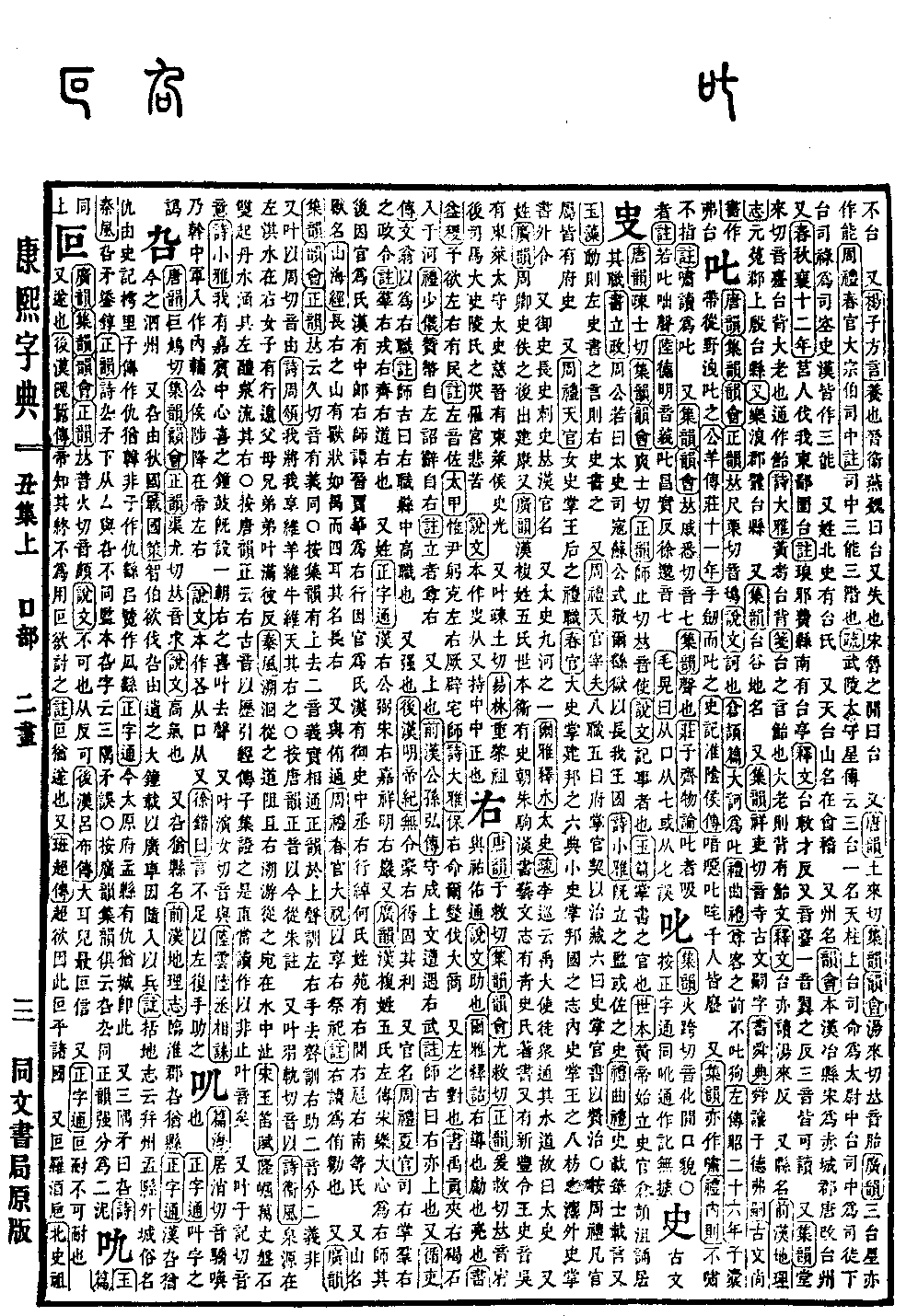
Chou Collection, Upper Volume
Radical: Mouth (kǒu)
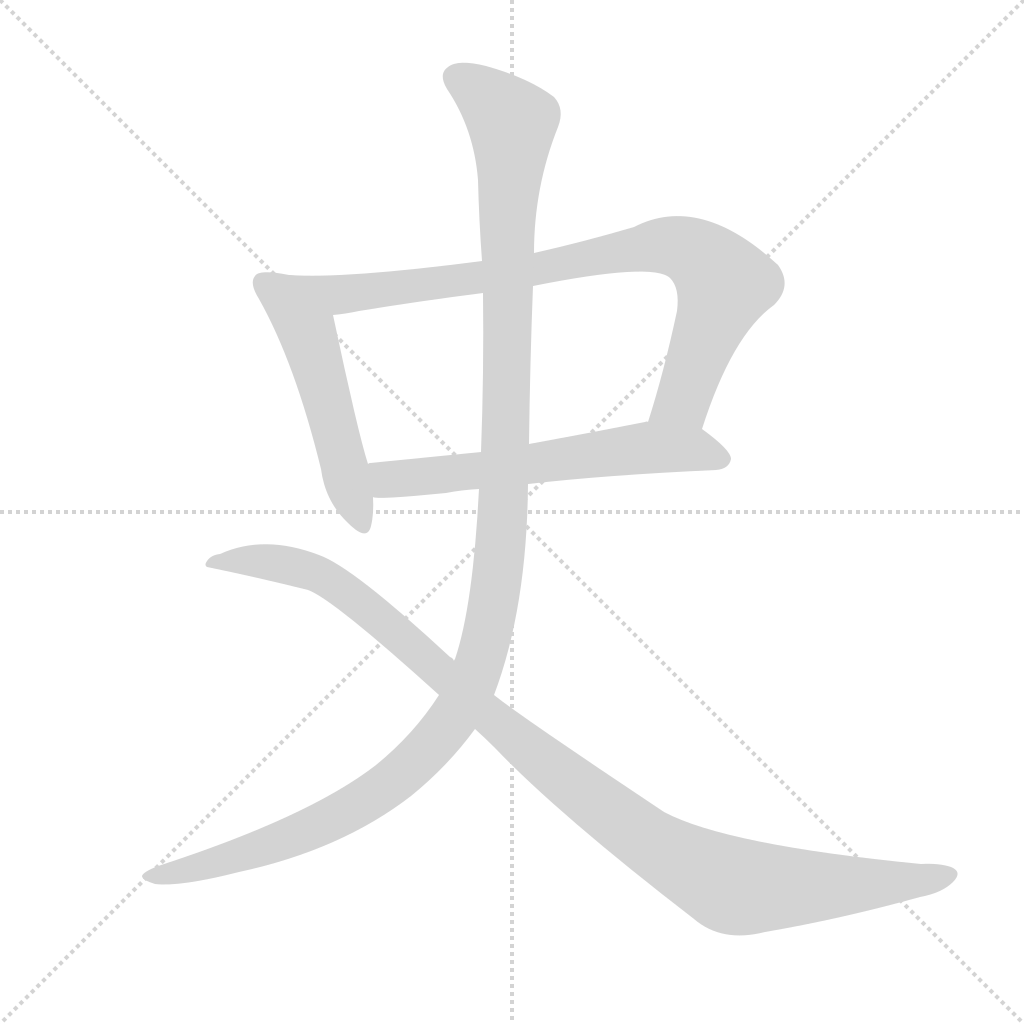
Character: 史
Kangxi Stroke Count: 5
Page 173, Entry 03
Ancient form.
Pronounced shi (rising tone).
According to the Explaining Graphs and Analyzing Characters (Shuowen): A person who records events.
According to the Jade Chapters (Yupian): An official in charge of documents.
According to the Genealogy of Generations (Shiben): The Yellow Emperor first established the office of the historian, with Cang Jie and Ju Song holding these posts.
Book of Documents (Shujing), section on Establishing Government (Li Zheng): The Duke of Zhou said this: Grand Historian, Minister Su, you must handle legal cases with reverence and caution, in order to long assist our kingdom.
Book of Odes (Shijing), Lesser Odes (Xiaoya): When censors have been established, there are also those to assist them as historians.
Book of Rites (Liji), section on the Summary of Propriety (Qu Li): Historians carry writing brushes, and scholars record speeches.
Also, according to the Jade Ornaments (Yuzao): Actions are recorded by the Left Historian, and speeches are recorded by the Right Historian.
Also, according to the Rites of Zhou (Zhouli), Offices of Heaven (Tianguan), Steward (Zaifu): Of the eight types of duties, the fifth is the archive, which manages office contracts to oversee collections, and the sixth is the historian, who manages official documents to assist in governance. Note: According to the Rites of Zhou, all government offices have archives and historians.
Also, according to the Rites of Zhou, Offices of Heaven (Tianguan): The Female Historian manages the ritual duties of the Queen.
Offices of Spring (Chunguan): The Grand Historian manages the six types of national statutes; the Junior Historian manages the records of the feudal states; the Inner Historian manages the laws for the eight types of sovereign authority; and the Outer Historian manages the writing of external decrees.
Also, Imperial Censor (Yushi), Chief Clerk (Zhangshi), and Inspector (Cishi) are official titles from the Han dynasty.
Also, Great Historian (Taishi) is one of the nine rivers.
According to the Errya, Explaining Water (Shi Shui): The Great Historian.
Commentary: Li Xun says: Yu the Great deployed masses of laborers to dredge its waterway, hence it is called the Great Historian.
Also, a surname.
According to the Broad Rhymes (Guangyun): A high official of the Zhou dynasty, a descendant of Shi Yi, originating from Jiankang.
Also, according to the Broad Rhymes: There were five compound surnames in the Han dynasty: The Genealogy of Generations records Shi Chao Zhu Ju of the State of Wei; the History of the Han (Hanshu), Treatise on Arts and Letters, mentions the Qing-Shi clan who wrote books; there was also a Magistrate of Xinfeng County named Wang Shi Yin; in the State of Wu, there was the Administrator of Donglai, Taishi Ci; in the Jin dynasty, there was the Marquis of Donglai, Shi Guang.
Also, rhymes with shu (rising tone).
Forest of Changes (Yilin): A descendant of Chongli who served as the Great Historian (Taishi) of the Marshall of State (Sima). Suffering the disaster of the Ling clan, he endured the agony of castration.
According to the Explaining Graphs and Analyzing Characters (Shuowen): Originally written as a different character. Derived from the hand radical (yòu) holding the middle (zhōng). Middle means upright.