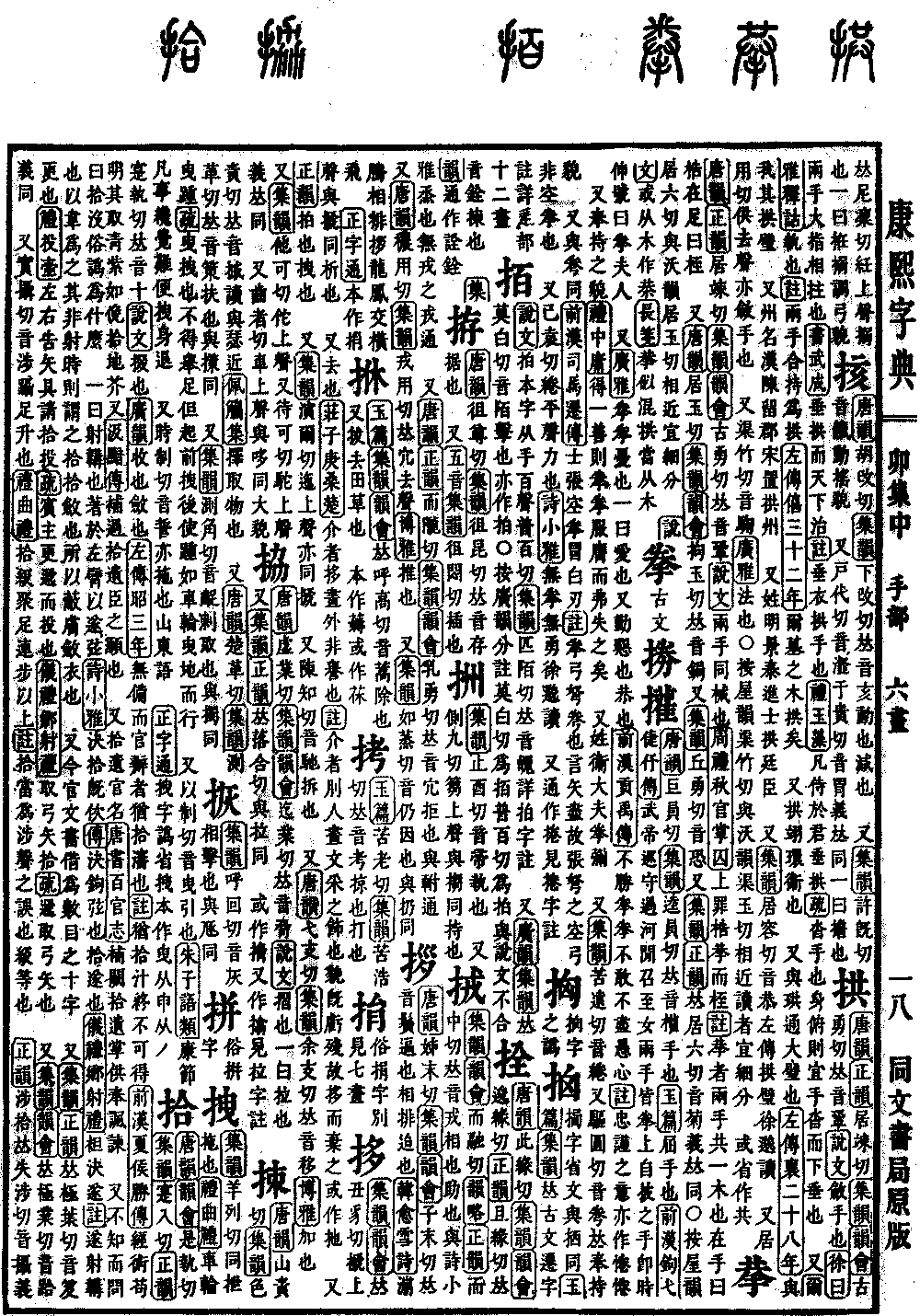
Mao Collection, Middle Volume. Radical: Hand (shǒu). Kangxi strokes: 10. Page 428, Entry 24.
Pronounced shi.
According to the Shuowen Jiezi (Analytical Dictionary of Characters), it means to pick up. According to the Guangyun (Broad Rhymes), it means to collect or to gather. In the Zuo Tradition (Zuozhuan), it is written: Without preparation, managing an office is like picking up water. The commentary notes this signifies that one cannot possibly obtain the desired outcome. In the History of the Former Han (Qian Hanshu), the biography of Xiahou Sheng states: If the study of the classics is clear, obtaining a high official position is as easy as bending down to pick up grass from the ground. Furthermore, in the biography of Ji An: To make up for mistakes and pick up what has been omitted is my wish. Also, Shi-yi (Remonstrator) is the name of an official post. The History of the Tang (Tangshu) states: The positions of Buque and Shiyi are responsible for offering advice and remonstrating with the throne. Also, to ask about something one does not know is called shi-mei. Common parlance mistakenly writes this as the character for why. Another opinion defines it as a sleeve guard used in archery, worn on the left arm to facilitate drawing the bowstring. The Book of Odes (Shijing) mentions that the ring and the sleeve guard are both ready. The commentary explains: The jue is the ring for pulling the string, and the shi is the sleeve guard for the arm. In the Book of Etiquette and Ceremonial (Yili), it states: Bare the left arm and wear the ring and sleeve guard. The commentary notes: The sui is the leather sleeve guard used for archery. When not used for archery, it is called shi. Shi means to gather or contain, used to cover the skin and gather the sleeves. In modern official documents, it is borrowed for the number ten.
Pronounced ji.
To alternate or take turns. In the Book of Rites (Liji), concerning the game of pitch-pot, it states: The left and right announce that the arrow count is ready, please take turns throwing. The commentary explains: Guests and hosts take turns throwing in order. In the Book of Etiquette and Ceremonial (Yili), it states: Take bows and arrows in turns. The commentary explains: Take the bows and arrows in sequence.
Pronounced jia.
The meaning is the same as above.
Pronounced she.
To ascend stairs by stepping. The Book of Rites (Liji) states: Step on the stairs one by one, ascending level by level. The commentary notes: The character shi here should be a phonetic error for the character she. The term ji refers to the levels of a staircase. The Zheng Yun dictionary states that she and shi are both pronounced she and share the same meaning, though it questions if the rhyme dictionaries contain omissions or errors in their phonetic notations.