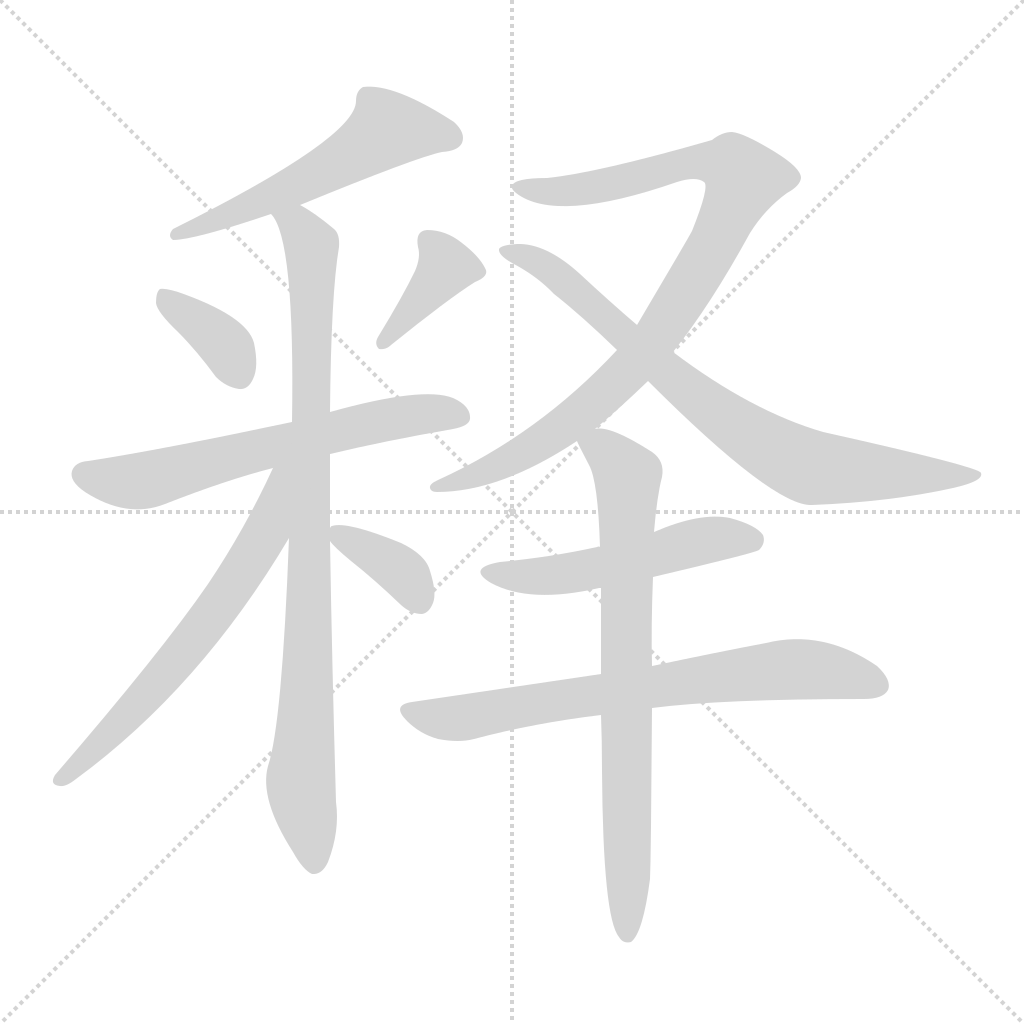
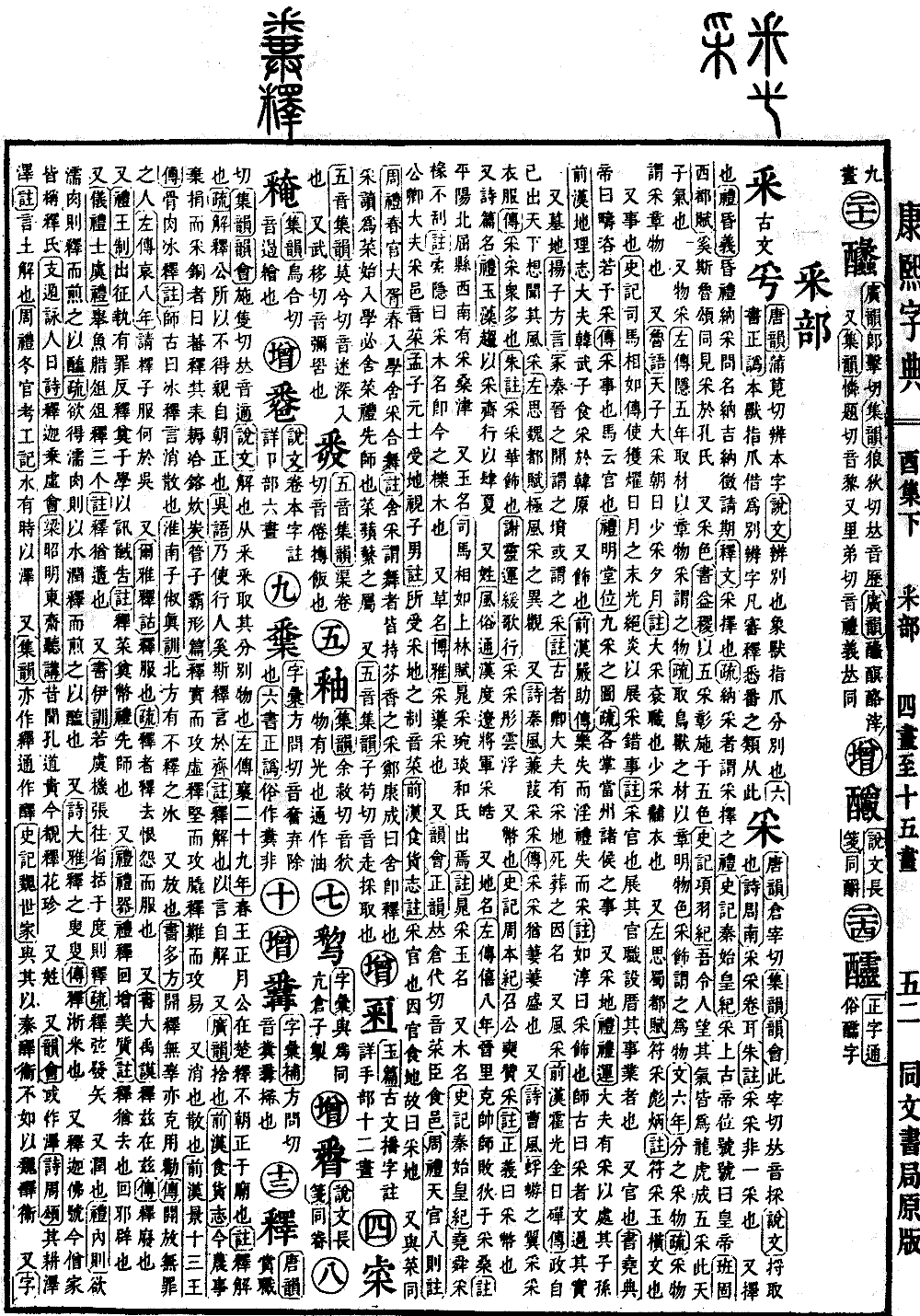
You Collection, Lower Volume
Radical: Variegated (biàn)
Pronounced shi (entering tone)
Kangxi stroke count: 20
Page 1290, Entry 10
Pronounced shi (entering tone).
According to the Explaining Graphs and Analyzing Characters (Shuowen Jiezi), it means to unravel. Derived from the variegated radical, as the radical represents distinguishing between objects.
In the Zuo Tradition (Zuozhuan), in the twenty-ninth year of Duke Xiang: In the spring, the first month of the royal year, the Duke was in Chu, and he released (shi) the duty of attending the New Year court at the temple. Commentary notes: Shi means to unravel. The sub-commentary states: To explain why the Duke could not personally attend the New Year court.
In the Discourses of Wu (Wuyu): He then ordered the envoy Xi Si to offer an explanation (shi yan) to Qi. Commentary notes: Shi means to unravel. To explain oneself through speech.
Also, according to the Extensive Rhymes (Guangyun), it means to abandon.
In the History of the Former Han (Qianhan Shu), Treatise on Food and Money: Now farming is abandoned, and those collecting copper increase daily; they abandon (shi) their plows and hoes, smelting and melting with charcoal fires.
In the Guanzi, Hegemonic Forms section: Abandon (shi) the solid and attack the void; abandon the firm and attack the fragile; abandon the difficult and attack the easy.
Also, to dissolve or scatter.
In the History of the Former Han (Qianhan Shu), Biography of the Thirteen Kings of Emperor Jing: Flesh and bone melted away like ice (bing shi). Commentary by Shigu says: Ice melting refers to dissolving or scattering.
In the Huainanzi, section on Original Truth (Chuzhen Xun): In the north, there is ice that does not melt (shi).
Also, to release.
In the Book of Documents (Shujing), section on Many Regions (Duofang): Release (shi) the innocent; this will also serve to encourage. Commentary: To set free those who have no guilt.
In the Zuo Tradition (Zuozhuan), the eighth year of Duke Ai: Please release (shi) Zifu He to Wu.
Also, according to the Er Ya, section on Explaining Words (Shigu): Shi means to submit. Sub-commentary: To release means to let go of hatred and resentment and submit.
Also, in the Book of Documents (Shujing), Grand Plan of Yu: Release (shi) this, here it is. Commentary: Shi means to discard.
Also, in the Book of Rites (Liji), Royal Regulations (Wangzhi): When returning from a campaign, having seized those with crimes, they perform the release-offering (shi dian) at the school, reporting with the ears of the slain enemies. Commentary: Shi refers to setting out vegetables and offering currency to honor the former masters.
Also, in the Book of Rites (Liji), Record of Rites (Liji): Ritual removes (shi) error and increases fine character. Commentary: Shi is like discarding. Error refers to that which is deviant.
Also, in the Book of Etiquette and Ceremonial (Yili), 士虞禮 (Shi Yu Li): Raise the fish and dried meat serving; release (shi) three of them. Commentary: Shi is like leaving behind.
Also, in the Book of Documents (Shujing), Instructions of Yi (Yixun): Like a bowstring stretched, when one examines the notch against the scale, then release (shi). Sub-commentary: To release (shi) the bowstring and discharge the arrow.
Also, to moisten.
In the Book of Rites (Liji), Internal Regulations (Neize): If one desires to moisten the meat, then moisten (shi) and fry it with pickled sauce. Sub-commentary: If one desires moist meat, then use water to moisten (shi) and fry it with pickled sauce.
Also, in the Book of Odes (Shijing), Greater Odes (Daya): Rinse (shi) it, swish-swish. Commentary: Shi means washing rice.
Also, Shakya, a name for the Buddha. Now, among the Buddhist community, all are called the Shakya clan (Shi shi).
Zhi Dun, Poem on the Day of the Human: Shakya rides the void to convene.
Liang Zhaoming, Hearing a Lecture at the Eastern Study: Once I heard the Confucian path was noble, now I observe the preciousness of the Shakya flower.
Also, a surname.
Also, according to the Rhyme Compendium (Yunhui), sometimes written as ze (marsh).
In the Book of Odes (Shijing), Zhou Odes (Zhousong): The plowing is moist (ze ze). Commentary: Describes the soil loosening.
In the Rites of Zhou (Zhouli), Winter Official, Artificers Record (Kaogongji): Water has times when it is moist (ze).
Also, according to the Collection of Rhymes (Jiyun), also written as yi. Commonly written as shi (to release).
In the Records of the Grand Historian (Shiji), House of Wei: Rather than using Qin to release (shi) Wei, it is better to use Wei to release (shi) Wei.
Also, according to the Supplement to the Dictionary (Zihuibui), pronounced yi (entering tone), meaning joy.
In the Six Books of Correct Interpretation (Liushu Zheng’e): Separately written as yi (joyful), which is incorrect.
Ji Kang, Rhapsody on the Zither (Qinfu): Those of healthy spirit hear it, and are pleased and joyful (huan shi).
Also, in the Rhyme Supplement (Yunbu), rhyming with shuo.
In the Songs of Chu (Chuci), Nine Declarations (Jiuzhang): Floating on the turbulent waters of the Yanghou; suddenly soaring, where shall I land? My heart is knotted and does not unravel (shi); my thoughts are distressed and do not release (shi).