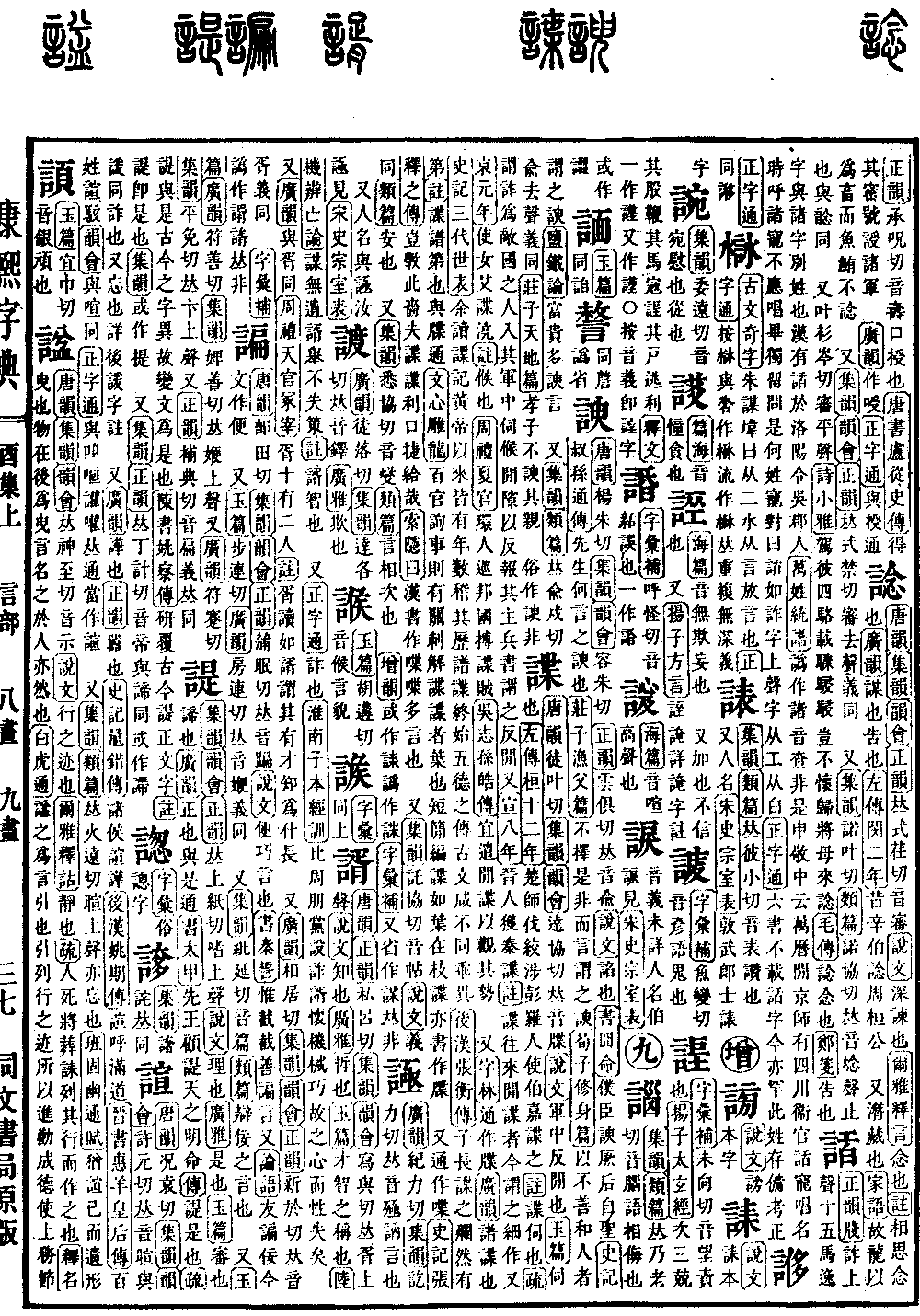
You Collection, Upper Volume
Radical: Speech (yán)
Kangxi strokes: 16
Page 1169, Entry 32
Tangyun, Jiyun, and Yunhui dictionaries state it is pronounced shi (falling tone).
Shuowen Jiezi states it is the trace of one's actions.
Erya, Shigu states it means quiet.
The commentary explains that after a person dies and is about to be buried, a eulogy is written to list their life's achievements.
Shiming states it means to drag or follow behind. When things are behind, they are called dragging, and applying a name to a person after death is like this.
Baihu Tong states that the meaning of a posthumous title is to draw forth. It draws forth and arranges life achievements to encourage the cultivation of virtue and to encourage those in superior positions to strive for restraint.
Zengyun states it is establishing a designation based on life achievements to change the name.
Jizhu Zhoushu states that the Duke of Zhou and Taigong Wang, having established the foundation for the successor king and achieved merit at the Battle of Muye, established the method for defining posthumous titles when finally laying the dead to rest. Those with great virtue received great titles, and those with small virtue received small titles. Virtue originates from the self, while the title is bestowed by others.
Book of Odes (Shijing), Daya states, King Wen is above. The commentary explains this means to be cautious and to be complete. A person's life actions are recorded from beginning to end in their entirety to determine the posthumous title.
Guliang Zhuan, Fan Ning commentary states that a posthumous title is used to encourage good deeds and punish evil deeds.
Book of Rites (Liji), Tangong states that establishing a posthumous title after death is the ritual system of the Zhou dynasty. The commentary notes that before the Shang dynasty, people used their living titles as their names after death, but in the Zhou dynasty, a separate posthumous title was established.
Rites of Zhou (Zhouli), Spring Offices, Grand Historian states that for minor deaths, one is bestowed a posthumous title. The commentary notes that the system of bestowing posthumous titles actually began in the Zhou dynasty.
Jiyun and Leipian state it is pronounced yi (falling tone).
Jiyun and Leipian also state it is pronounced yi (falling tone). The meaning is the same.
Leipian notes that some omit parts of the character in writing. It is different from the variant form (shì).