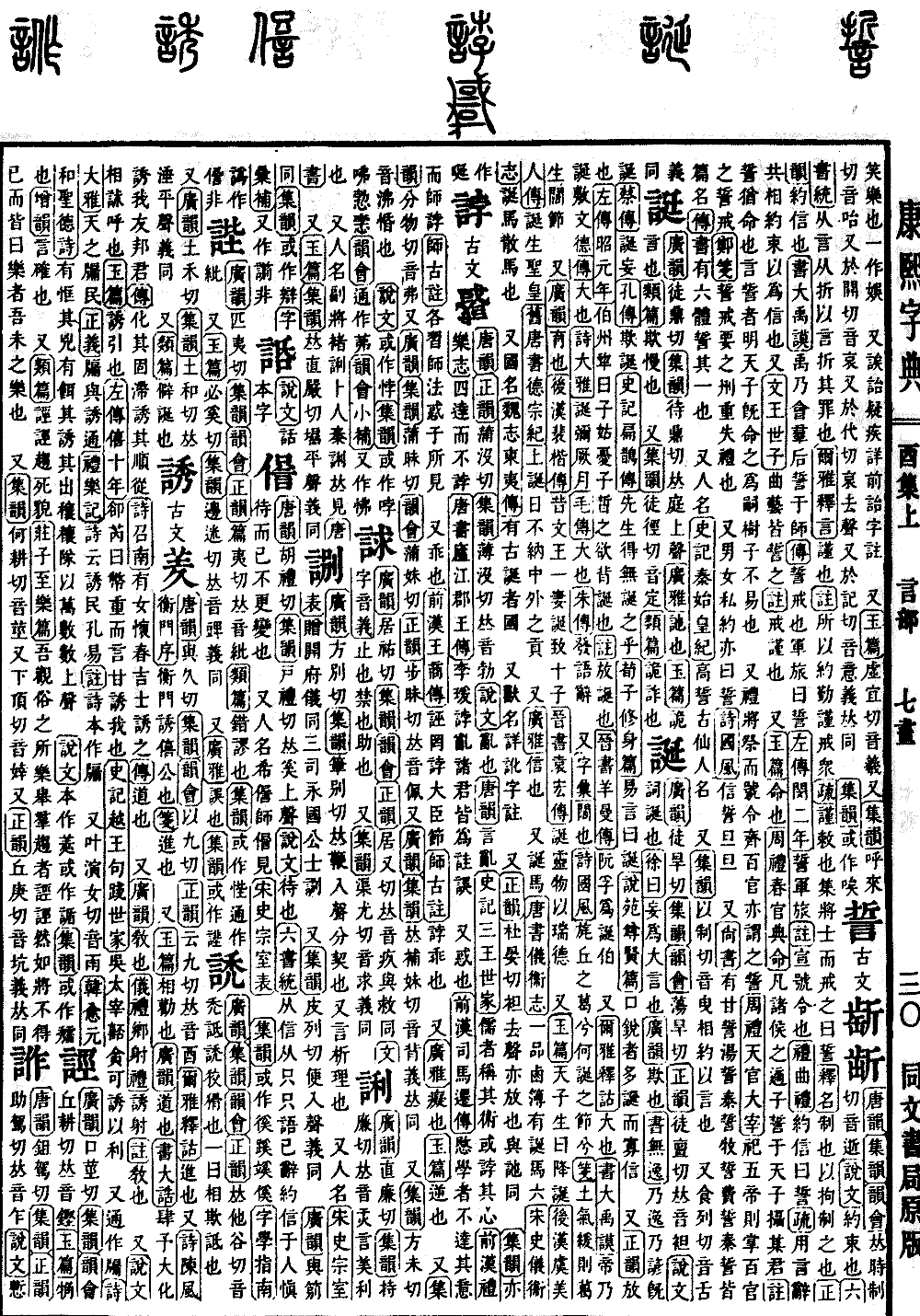
You Collection, Upper Volume
Radical: Speech (yán)
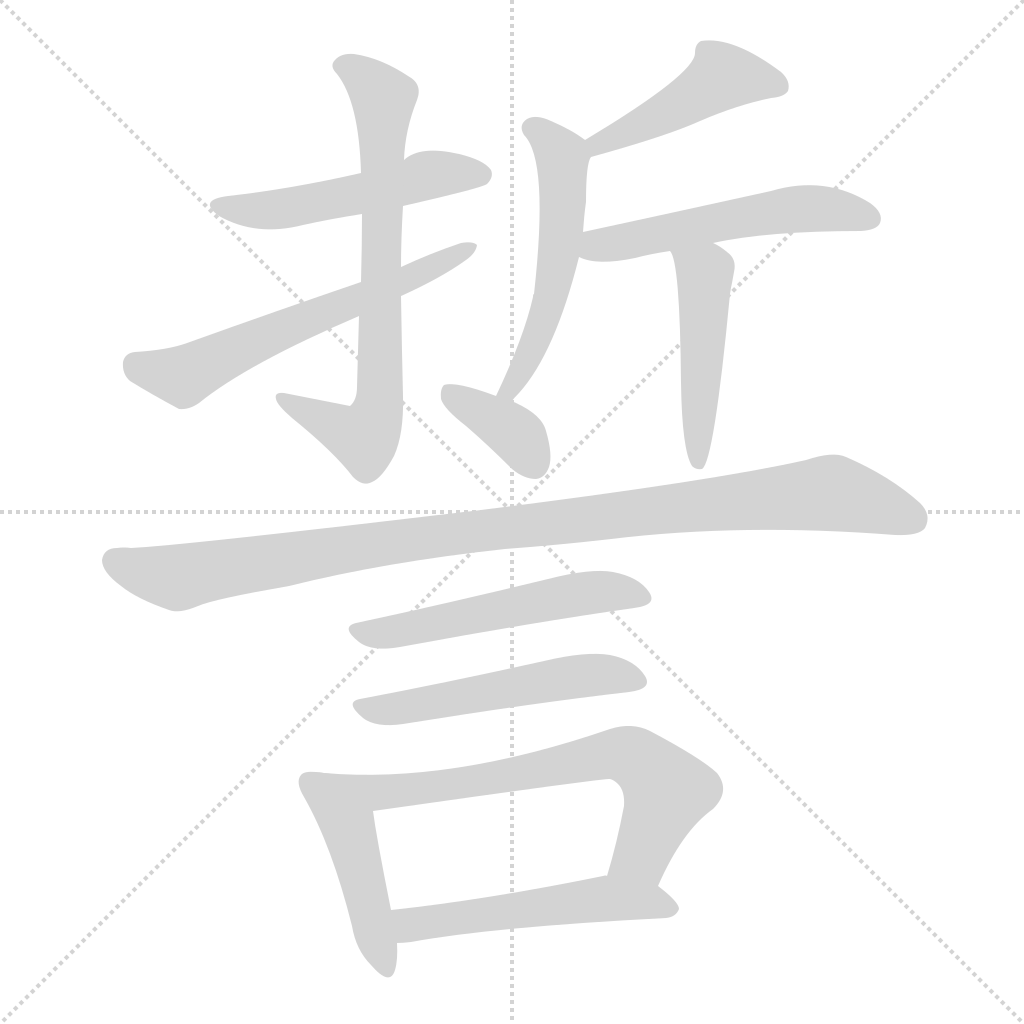
誓
Kangxi stroke count: 14
Page 1162, Entry 01
Ancient form. Pronounced shì.
According to the Explaining Graphs and Analyzing Characters (Shuowen jiezi), it means to bind by agreement. According to the Six Categories of Writing (Liushu tong), it is composed of speech and break; it refers to breaking one's faults through speech. According to the Erya (Erya), it means to be cautious. The commentary notes that it is used to bind and caution the masses. The sub-commentary states: to be cautious is to enjoin; gathering soldiers and cautioning them is called a pledge. According to the Explaining Names (Shiming), it means to restrain; to restrain them by constraints. The Orthography of Rhymes (Zhengyun) states it is a pledge of trust.
Book of Documents (Shangshu), Great Plan of Yu: Yu then gathered all the lords and made a pledge to the army. The commentary states: a pledge is a warning; when it concerns military expeditions, it is called a pledge. Zuo Commentary (Zuozhuan), Second Year of Min: Pledged the army. The commentary notes: to declare orders. Book of Rites (Liji), Summary of the Rules of Propriety: A pledge of trust is called a pledge. The sub-commentary states: using language to mutually bind one another to establish trust. Also, in the Hereditary House of King Wen: all minor arts are pledged. The commentary notes: to caution and be careful.
Also, according to the Jade Chapters (Yupian), it means to command. Rites of Zhou (Zhouli), Spring Offices, Statutes on Appointments: For all legitimate sons of the feudal lords, they are pledged to the Son of Heaven to act in place of their sovereign. The commentary notes: a pledge is like a command; saying it is a pledge clarifies that the Son of Heaven has already appointed him as heir, and the successor should not be changed. Also, in the rites, when about to perform a sacrifice, the calling of orders to alert all officials is also called a pledge. Rites of Zhou, Heavenly Offices, Great Administrator: When sacrificing to the Five Emperors, take charge of the pledges and warnings of all officials. The commentary notes: pledges and warnings are to hold them to terms, so as to avoid the mistake of missing a ritual.
Also, private agreements between men and women are also called pledges. Classic of Poetry (Shijing), Odes of the States: Pledges of faith are sincere.
Also, in the Book of Documents, there are the Gan Pledge, Tang Pledge, Tai Pledge, Mu Pledge, Fei Pledge, and Qin Pledge, all of which are chapter titles. The commentary states: the Book of Documents has six types, and the pledge is one of them.
Also, a person's name. Records of the Grand Historian (Shiji), Annals of Qin Shi Huang: Gao Shi, the name of an ancient immortal.
Also, pronounced yì. To mutually agree by speech.
Also, pronounced shé. Meaning is the same.
Verification: Rites of Zhou, Heavenly Offices, Great Administrator: When sacrificing to the Five Emperors, take charge of the pledges and warnings of all officials. The commentary states: pledges and warnings are to hold them to terms, so as to avoid the mistake of missing a ritual. Note: In the Rites of Zhou, the commentary is not called Zheng's Jian; the text has been corrected to note. Following the original text, the character with has been added after hold them to terms.