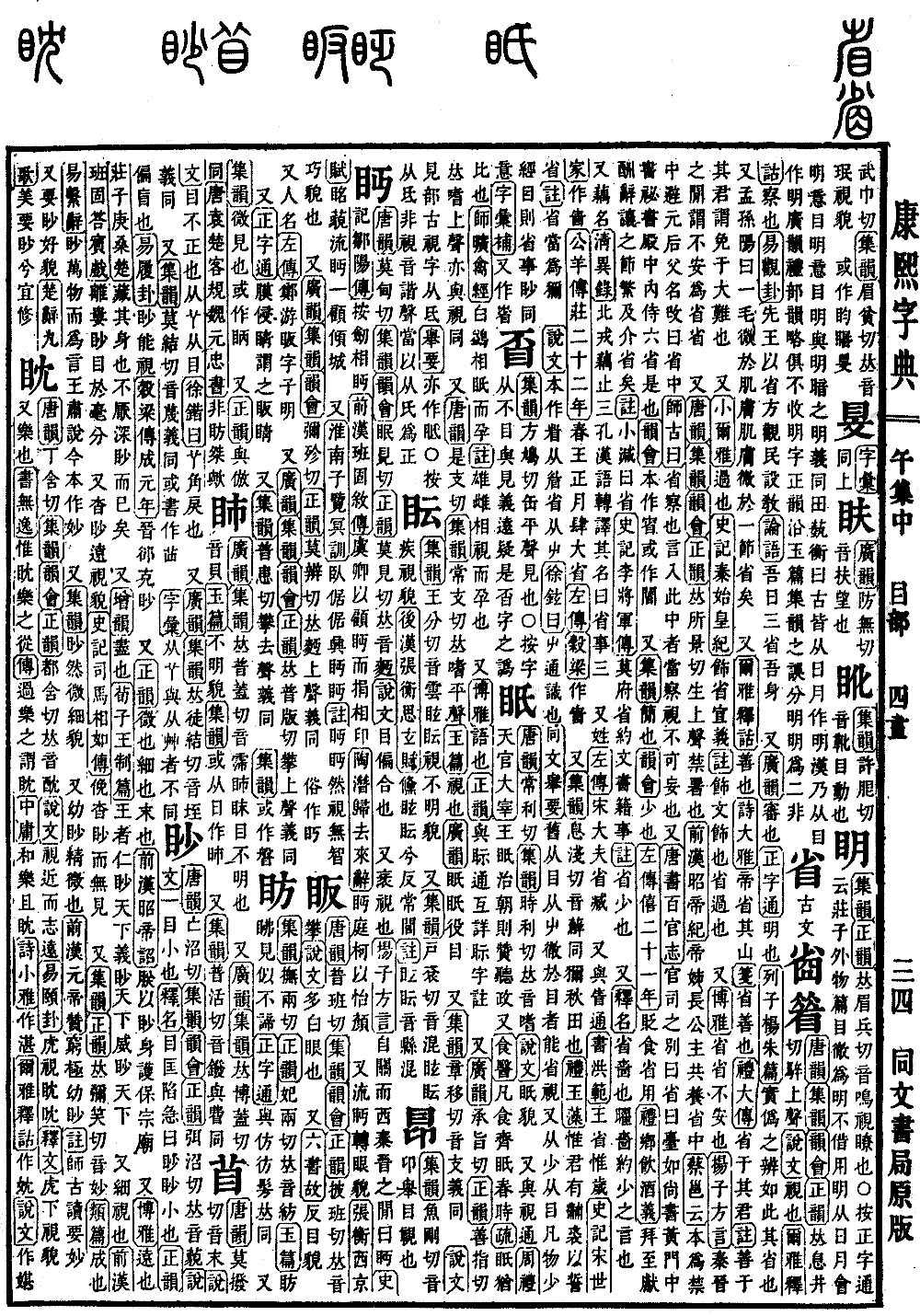
Wu Collection, Middle Volume
Radical: Eye (mù)
眂
Kangxi stroke count: 9
Page 802, Entry 09
Pronounced shi (falling tone).
Pronounced shi (falling tone), pronunciation same as shi (falling tone).
Explained in Explanation of Simple and Compound Characters (Shuowen Jiezi) as the appearance of looking. Also interchangeable with the character for sight (shi).
The Rites of Zhou (Zhouli), Heaven's Office, Grand Administrator records: When the king attends the morning court, assist in hearing government affairs.
Also, The Dietary Physician records: For all food, equate the seasons as in spring.
The Commentary (Shu) explains: This usage of shi is similar to the word for compare or match (bi).
Shi Kuang's Classic of Birds (Qin Jing) records: White egrets conceive by looking at one another.
The Commentary (Zhu) explains: Male and female look at each other and conceive.
Also explained in Extensive Refinements (Boya) as speech.
Orthophony (Zhengyun) notes it is interchangeable with the character for vision (shi). Refer to the notes under the entry for that character for more detail.
Also pronounced shi (rising tone). Also the same as the character for vision (shi).
Also pronounced shi (level tone).
Explained in Jade Chapters (Yupian) as sight.
Explained in Broad Rhymes (Guangyun) as a straining of the eyes.
Also pronounced zhi (level tone). Meaning is the same.
The Explanation of Simple and Compound Characters (Shuowen Jiezi) places this under the see radical, where the ancient character for vision (shi) was formed with a base component (di).
Essentials of Character Structure (Juyao) notes it is also written in the variant form (shi).
Note: Using the base component (di) is incorrect; the character for vision (shi) is a phono-semantic character and should correctly be formed using the component (shi).
Textual correction: In the Rites of Zhou (Zhouli), Heaven's Office, Grand Administrator, the original text says hear government affairs; this has been corrected to hear administration based on the primary source.