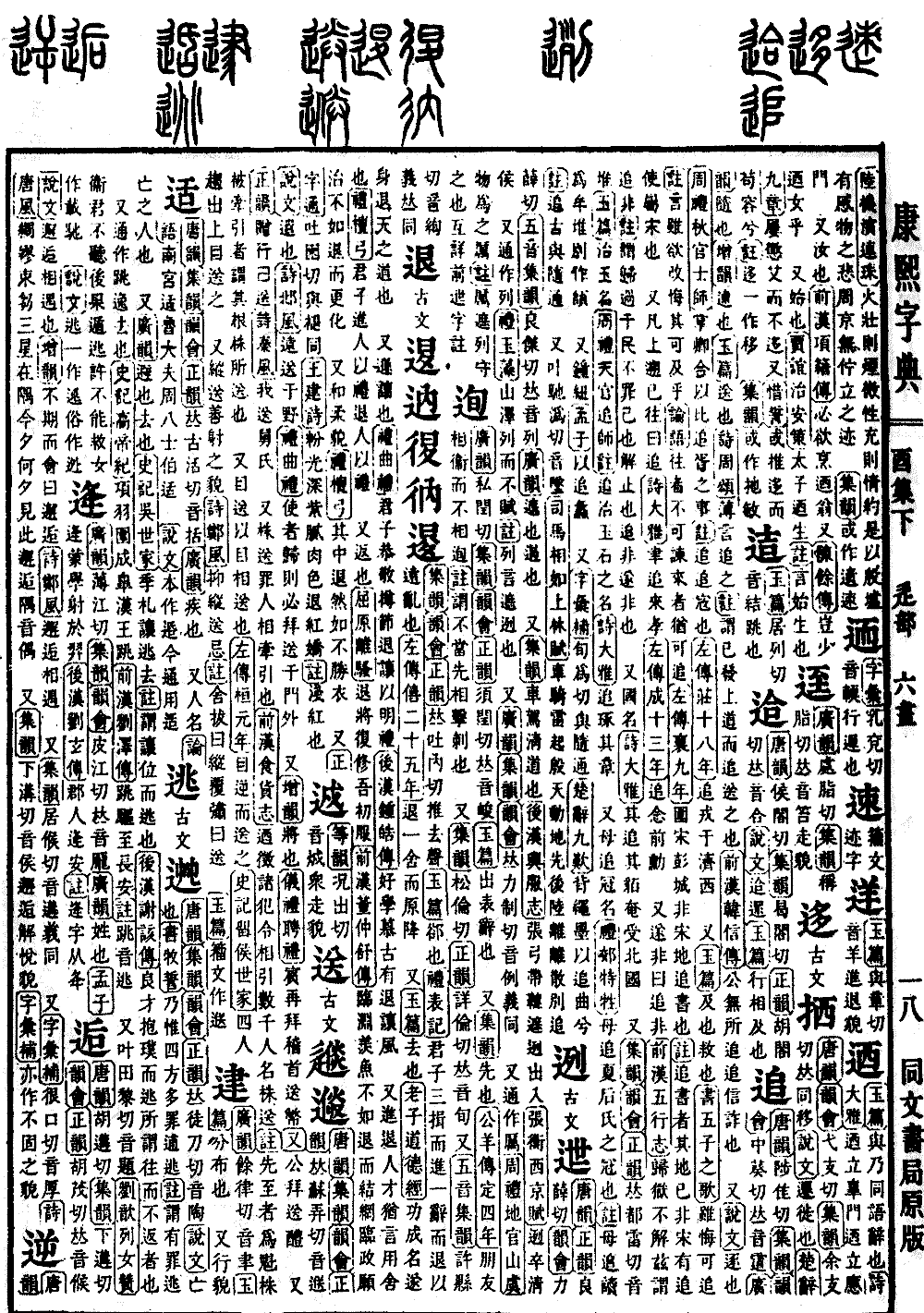
You Collection, Lower Volume
Radical: Walk (chuò)
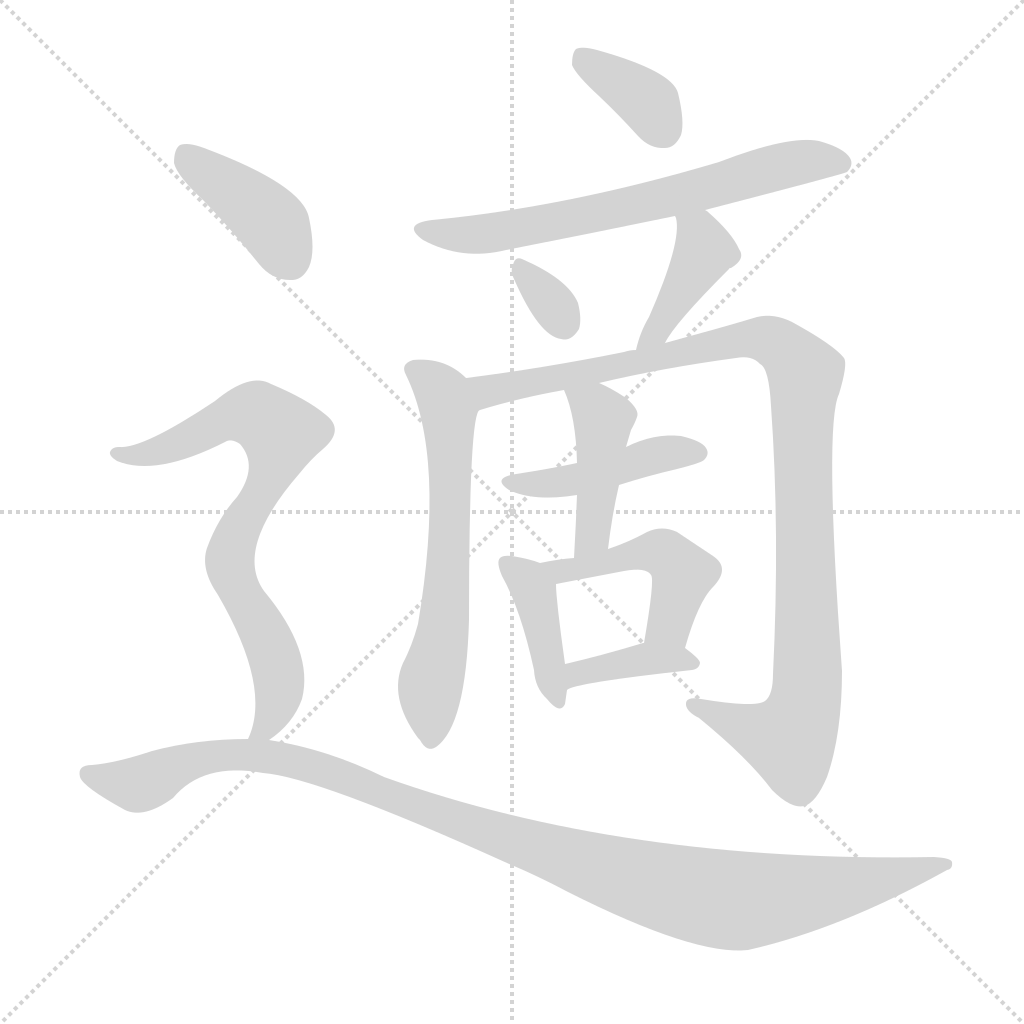
Character: 适
Kangxi Stroke Count: 18
Page 1256, Entry 01
Tang Rhyme (Tangyun), Collection Rhymes (Jiyun), Rhyme Meetings (Yunhui), Correct Rhymes (Zhengyun): Pronounced shi.
According to the Explaining Graphs and Analyzing Characters (Shuowen): To go.
Broad Rhymes (Guangyun): To travel.
Correct Rhymes (Zhengyun): To resemble, to arrive.
Book of Odes (Shijing), Zheng Winds: "Going to your lodging."
Book of Rites (Liji), Qu Li: "When about to arrive at a lodging, seek not to be rigid."
Also, Broad Rhymes (Guangyun): To be happy.
Correct Rhymes (Zhengyun): To be peaceful and comfortable, to be self-contented.
Book of Odes (Shijing), Zheng Winds: "It matches my wishes."
Zhuangzi, Great and Venerable Teacher (Dazongshi): "To find pleasure in others' pleasures, and not be self-contented in one's own."
Also, to follow.
Book of Documents (Shujing), Numerous Officers (Duoshi): "My affairs do not have two followings (shi)." Commentary: This speaks of the matter of ending the Yin dynasty, having no selfish motives, and being united in following the Emperor without hesitation.
Zuo Tradition (Zuo Zhuan), 15th Year of Duke Zhao: "The people knew where to follow."
Also, Correct Rhymes (Zhengyun): Accidental, just like by chance.
Book of Documents (Shujing), Kang Announcement (Kanggao): "It was merely a calamity of negligence (shi)." Commentary: Shi means accidental.
Also, the constant state of affairs. Also called accidental (shiran).
Former Han History (Qianhan Shu), Biography of Jia Yi: "Considering this to be merely accidental."
Also, Rhyme Meetings (Yunhui): Just now, similar to recently.
Also, a term for "just now."
Old Tang History (Tangshu), Biography of Wu Yuanheng: "Just now, from where have you come?"
Also, Broad Rhymes (Guangyun): Good.
Rhyme Meetings (Yunhui): When a tribute obtains the right person, it is called shi.
Former Han History (Qianhan Shu), Annals of Emperor Wu: "A tribute scholar who is qualified once, twice, or thrice."
Also, Zhengzi Tong: In the region west of the pass, to replenish or fulfill is called shi.
Former Han History (Qianhan Shu), Biography of Huang Ba: "The horses did not fulfill the soldiers." Commentary: The horses were few and the soldiers were many, so they could not fully supply them.
Also, Jade Chapters (Yupian): A woman getting married.
Also, Broad Rhymes (Guangyun): Pronounced di. Same as the character for legitimate heir (di).
Book of Odes (Shijing), Greater Odes (Daya): "The heavenly throne of the Yin legitimate heir." Commentary: The Yin legitimate heir is the legitimate successor of the Yin.
Book of Rites (Liji), Tan Gong: "Support the legitimate son (di) and stand facing south."
Also, legitimate scholar, meaning a senior scholar.
Book of Rites (Liji), Sacrificial Law (Jifa): "A legitimate scholar has two temples."
Also, legitimate chamber, the main living quarters.
Book of Rites (Liji), Tan Gong: "Wailing in the legitimate chamber."
Also, Rhyme Meetings (Yunhui): To master, to specialize.
Analects (Lunyu): "There is no specialized path."
Book of Odes (Shijing), Wei Winds: "Who is the one to provide a role?"
Also, Lesser Odes (Xiaoya): "With whom will you deliberate?"
Also, Collection Rhymes (Jiyun), Rhyme Meetings (Yunhui): Pronounced di. Same as the character for enemy (di).
Book of Rites (Liji), Yan Yi: "The ruler ascends and stands on the mat alone, facing west, standing apart; this is the meaning of no one daring to oppose (shi) him."
Records of the Grand Historian (Shiji), Biography of Tian Dan: "Initially like a maiden, the enemy (shi) closes the door. Later like a fleeing hare, the enemy (shi) does not dare to resist."
Also, Collection Rhymes (Jiyun): Pronounced zhe. Same as the character for blame (zhe).
Book of Odes (Shijing), Shang Odes (Shangsong): "Do not inflict disaster or blame (shi) upon me."
Also, Mencius: "People are not worth being blamed (shi) with."
Also, Collection Rhymes (Jiyun): Pronounced ti. Appearance of being startled.
Zhuangzi, Autumn Floods (Qiushui): "Startled and shocked."
Also, Collection Rhymes (Jiyun): Pronounced zhi. To go.
Also, rhymes with the sound shi.
Yangzi, Great Mystery (Taijing): "The sharp head is sharp at the time, attaining its comfort. If it is sharp to the east and vanishes to the west, one cannot avoid it."
Also, rhymes with the sound she.
Han Yu, Discourse on Advancing Learning (Jinxuejie): "Elaborate refinement becomes beauty, outstanding talent becomes brilliance. Measuring the short and weighing the long, only the vessel is appropriate (shi)."
Also, rhymes with the sound shuo.
Lu Ji, Performed Connected Pearls (Yanlianzhu): "Smoke emerges from fire, not the harmony of fire. Emotion arises from nature, not the comfort (shi) of nature. Therefore, when the fire is robust, the smoke is faint; when the nature is full, the emotion is constrained."