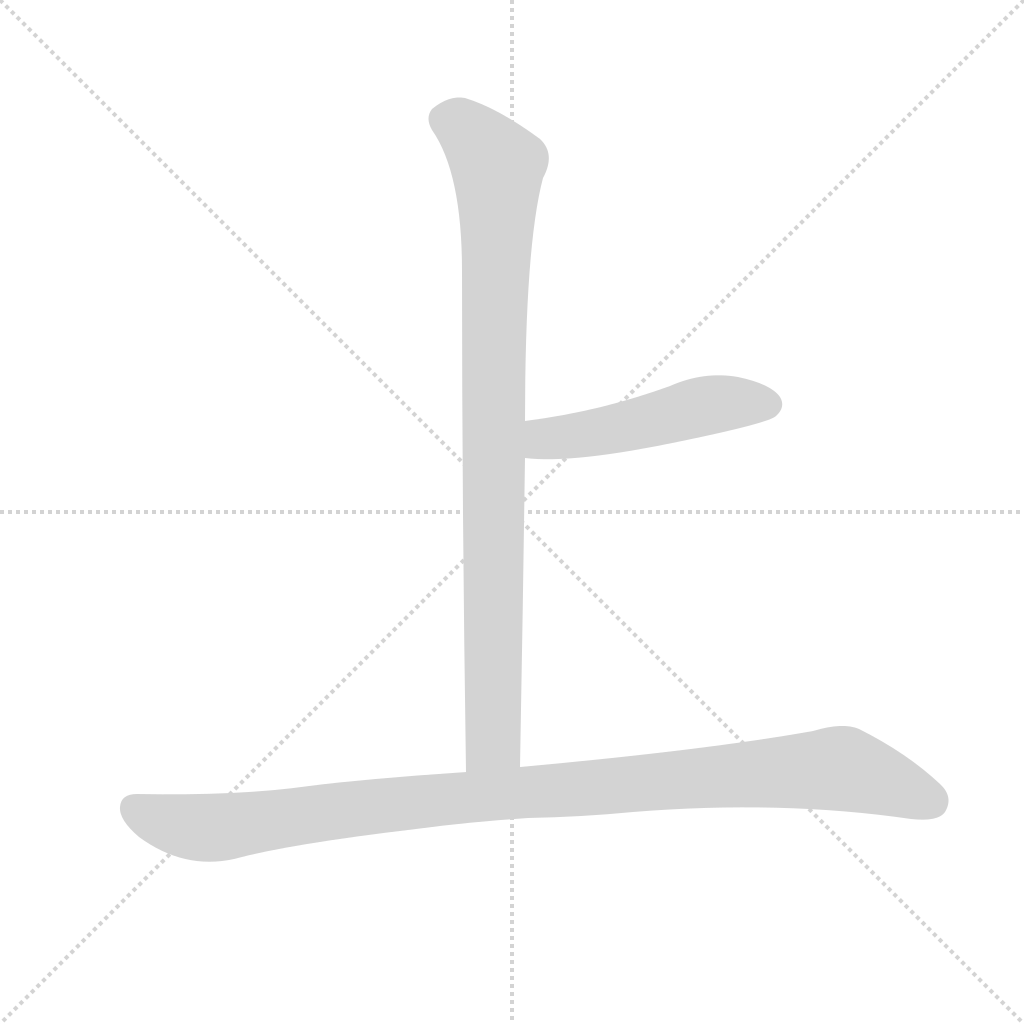
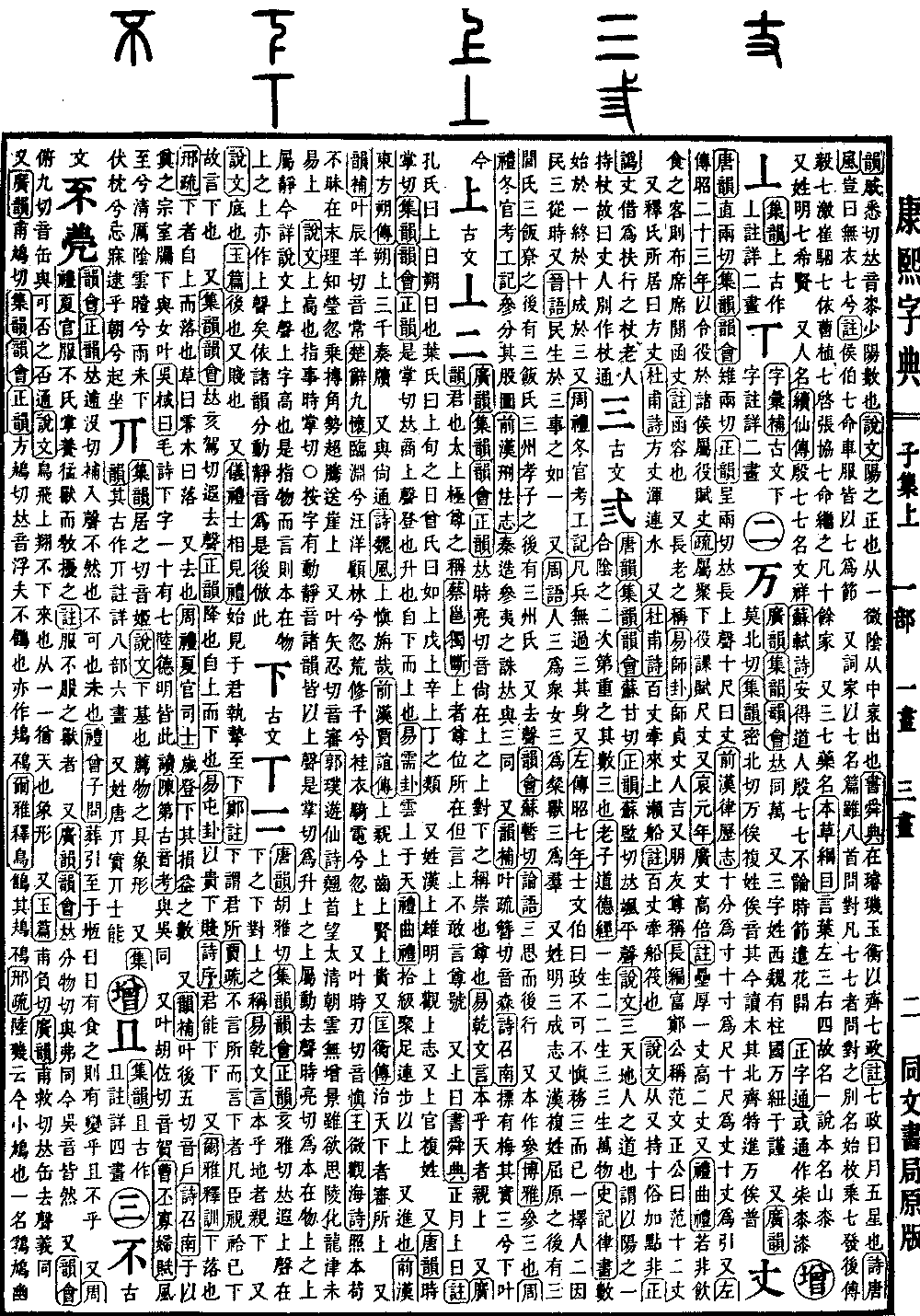
Zi Collection, Page Position: Upper. Radical: One (yi). Shang. Kangxi Stroke Count: 3. Page 76, Number 07.
In ancient script, it was written as 丄.
The Broad Rimes (Guangyun), Collected Rimes (Jiyun), Collected Rhymes (Yunhui), and Correct Rimes (Zhengyun) provide the phonetic notation shi-liang, pronounced the same as shang (to esteem). It indicates a high position, the opposite of "down." It carries the meaning of loftiness and nobility. The Commentary on the Words of the Text in the Book of Changes (Yijing) states: Those rooted in heaven are close to what is above.
The Broad Rimes also defines it as the monarch. Taishang is an extremely noble title. Cai Yong says in his work Solitary Decisions (Duiduan): Shang refers to the location of the noble position. One says shang to avoid direct mention of the formal title.
It also refers to shangri. The Canon of Shun in the Book of Documents (Shangshu) mentions the shangri of the first month. In the commentaries, Master Kong says shangri refers to the first day of the lunar month. Master Ye says it refers to the days of the first ten-day period. Master Zeng says it is a term like shangwu, shangxin, or shangding, referring to specific days in the sexagenary cycle.
It is also a surname. In the Han dynasty there was Shang Xiong, and in the Ming dynasty there were Shang Guan and Shang Zhi. There is also the compound surname Shangguan.
The Tang Rimes (Tangyun) provides the phonetic notation shi-zhang, while the Collected Rimes, Collected Rhymes, and Correct Rimes provide shi-zhang, read in the rising tone as shang. It means to climb or rise, moving from a low place to a high place. The Waiting Hexagram in the Book of Changes states: Clouds rise to the heavens. The Summary of Ceremonies in the Book of Rites (Liji) states: Ascend the steps, bringing the feet together, and continue upward step by step.
It also means to present to a superior. The Biography of Dongfang Shuo in the Book of Han (Hanshu) states: Shuo presented three thousand memorial tablets.
It is also interchangeable with shang (to esteem). The Odes of Wei in the Book of Odes (Shijing) states: May you be careful there. The Biography of Jia Yi in the Book of Han mentions honoring relatives, honoring the elderly, honoring the worthy, and honoring the noble. The Biography of Kuang Heng states: He who rules the world examines what is esteemed.
The Rhyme Supplements (Yunbu) provides a rhyming pronunciation like chang. The Nine Regrets in the Songs of Chu (Chuci) states: Overlooking the abyss, vast and deep; looking back at the forest, sudden and wild. I trim my robes and ride the rainbow southward and upward.
It also has a rhyming pronunciation like shen. Wang Wei says in his Poem on Viewing the Sea: If the root is not darkened, the branches will naturally be bright. Suddenly taking advantage of the rising wind, I soar above the cliffs.
It also has a rhyming pronunciation like shen. Guo Pu says in his Poem on Wandering Immortals: Raising my head to gaze at the Great Clarity, the morning clouds offer no more scenery. Though I wish to transform and ascend, the Dragon Ford is not easily climbed.
The Explaining Graphs and Analyzing Characters (Shuowen Jiezi) explains: Shang means high. It is an ideographic character. It is pronounced in the rising tone as shang.
Note: This character has two pronunciations, one for its use as a verb and one as a noun or adjective. Rhyme dictionaries use the rising tone to represent the verb "to ascend" and the departing tone to represent the static position "above." However, a detailed study of the Shuowen Jiezi shows that the rising tone version means "high" in reference to objects, so the static "above" can also be read in the rising tone. It is appropriate to follow the rhyme dictionaries in distinguishing between the active and static pronunciations. This pattern is followed hereafter.
Textual Research: In the Nine Regrets of the Songs of Chu, the phrase "riding lightning and suddenly ascending" is corrected to "riding the rainbow southward and upward" according to the original text.