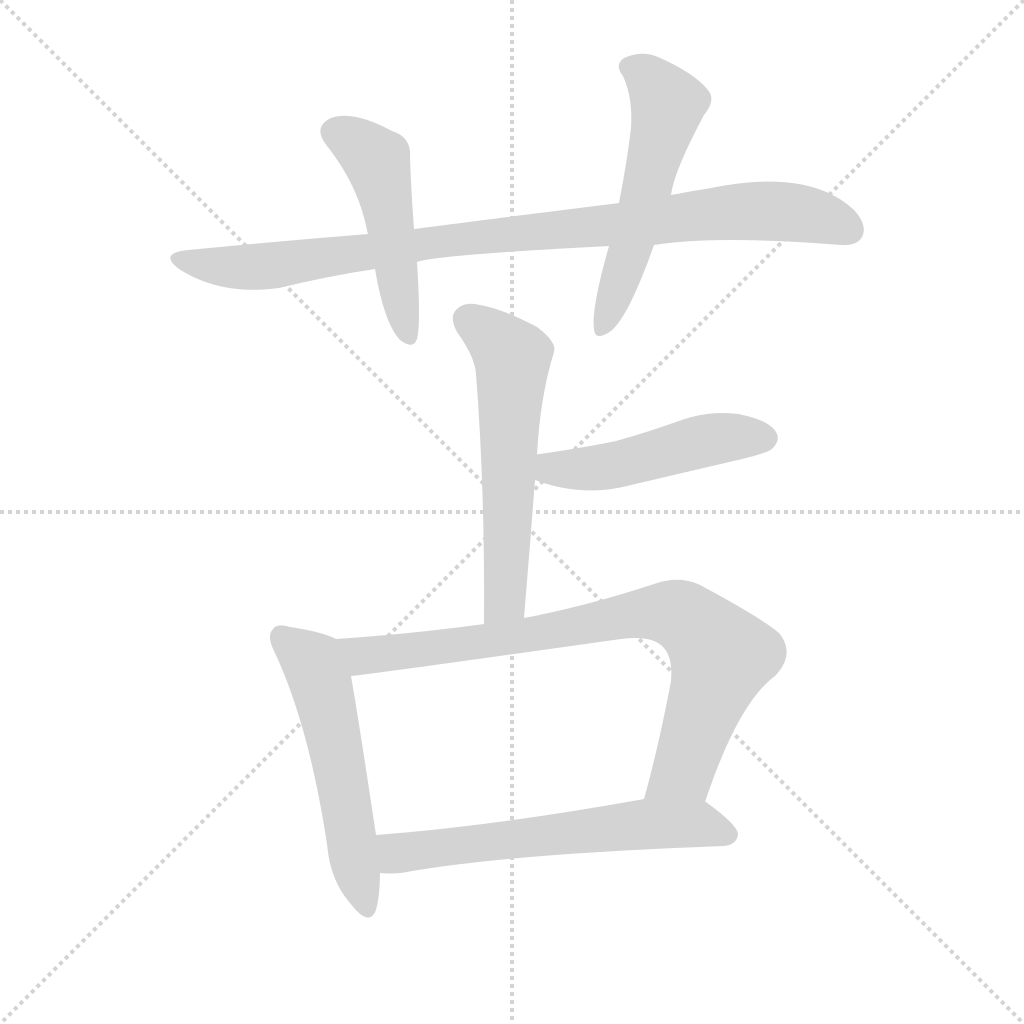
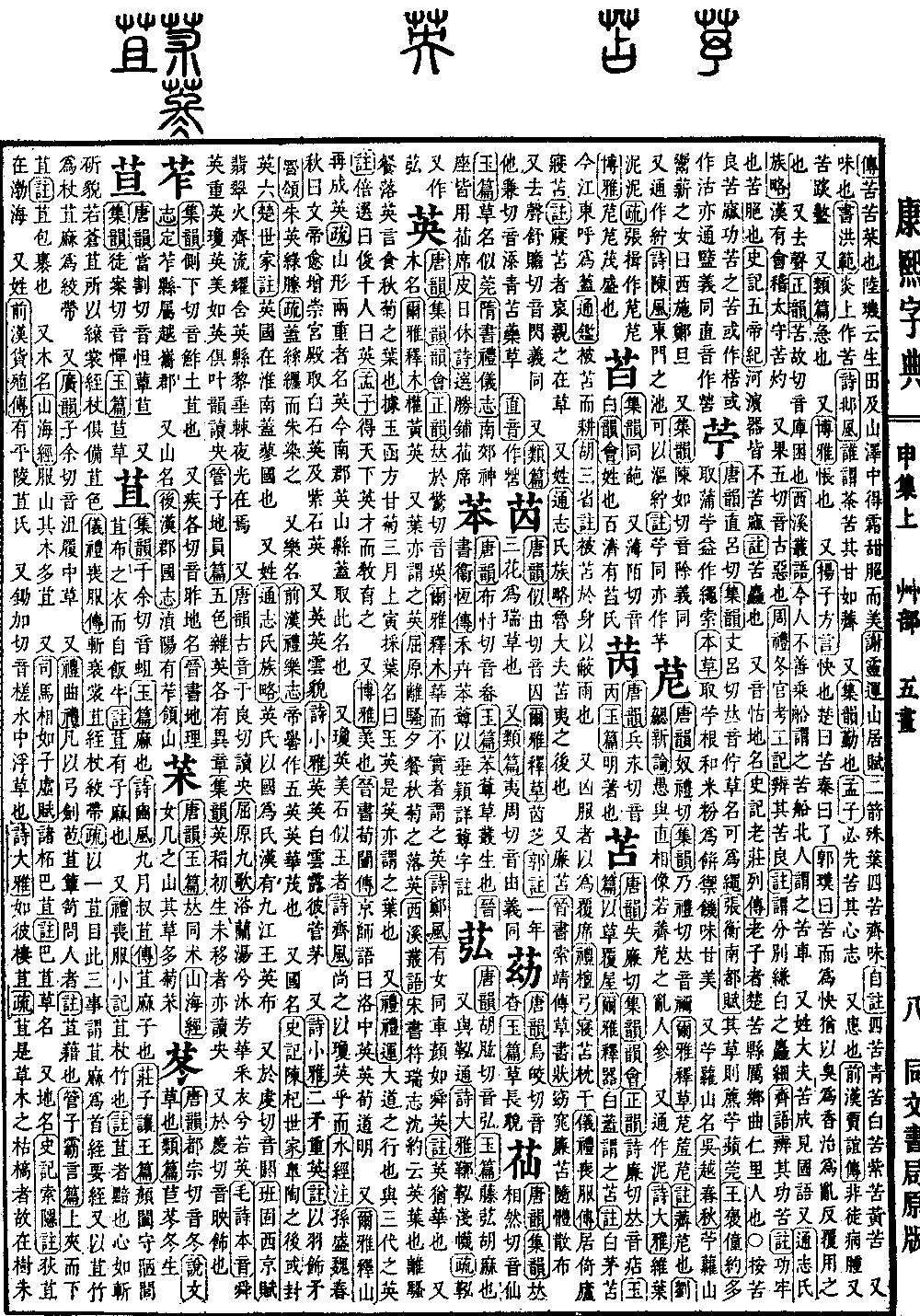
Shen Collection, Upper Volume
Radical: Grass (cǎo)
Kangxi Strokes: 11
Page 1024, Entry 05
Pronounced shān.
According to the Tang Rhyme (Tangyun), the Collected Rhymes (Jiyun), the Rhyme Dictionary (Yunhui), and the Correct Rhymes (Zhengyun), it is pronounced shān.
In the Jade Chapters (Yupian), it refers to covering a roof with grass.
In the Erya, Explanations of Implements (Erya Shiqi), a white covering is called a shan.
Commentary: A white cogon grass covering is what is known today in the Jiangdong region as a gài.
In the Comprehensive Mirror for Aid in Government (Tongjian), it mentions wearing a shan while farming.
Hu Sansheng commentary: Wearing a shan over the shoulders as a rain cloak. Additionally, those in mourning use it as a sleeping mat.
In the Book of Rites, Tan Gong (Liji Tangong), it says to sleep on a grass mat and use a shield as a pillow.
In the Book of Etiquette and Ceremonial, Commentary on Mourning Dress (Yili Sangfu Zhuan), it says to live in a makeshift shed and sleep on a grass mat.
Commentary: Sleeping on a grass mat is an expression of grief for a relative buried in the wild.
It is also a surname.
In the Comprehensive Records, Treatise on Clans (Tongzhi Shizulu), it mentions it is the surname of the descendants of Shanyi, a senior official of the state of Lu. There is also the name Lianshan.
In the Book of Jin, Biography of Suo Jing (Jinshu Suojing Zhuan), in his treatise on cursive script, it describes the forms as graceful and refined.
Also pronounced in the departing tone, read as shǎn. The meaning is the same.
Additionally, according to the Classified Chapters (Leipian), it is pronounced tiān. Qing-shan is a type of medicinal herb.
In the Direct Pronunciation (Zhiyin), it is written as shan. The character is formed with the grass radical.