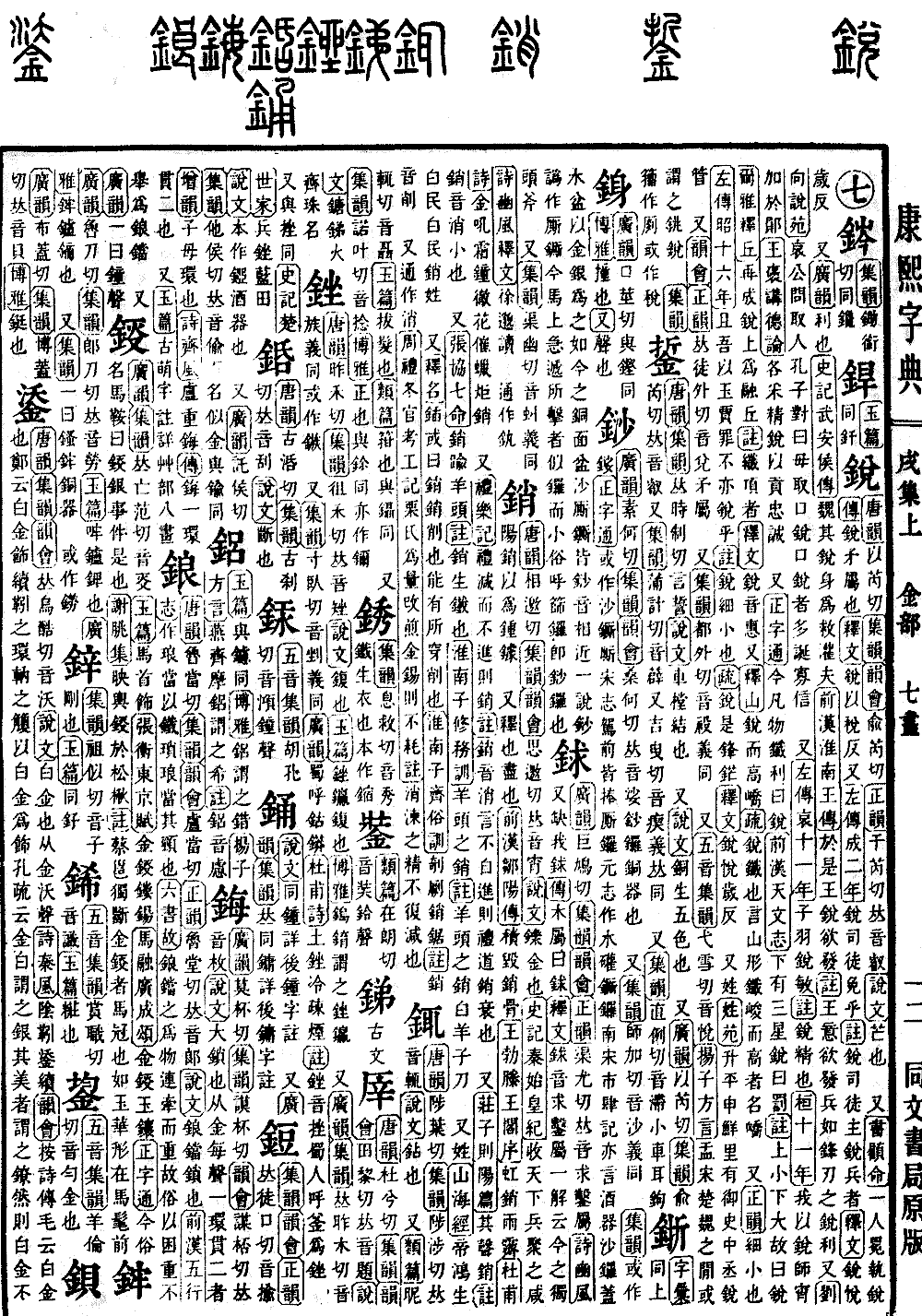
Xu Collection, Upper Volume
Radical: Metal (jīn)
Kangxi Strokes: 15
Page 1306, Entry 03
Pronounced rui (falling tone).
In the dictionary titled Tang Yun (Tang rhymes), it is defined as a point or tip.
In the Book of Documents (Shujing), under the chapter "Guming," it is written: "One man wearing a ceremonial cap holds a weapon." The commentary states that the character refers to a type of spear.
In the Zuo Commentary (Zuo Zhuan), under the second year of Duke Cheng, it mentions the commander of the spear-wielding troops.
Also defined as sharp or keen. In the Records of the Grand Historian (Shiji), it is used to describe a person's intense eagerness to save someone. In the History of the Former Han (Qian Hanshu), it describes a desire to mobilize troops, comparing the intensity to the sharpness of a blade.
In Liu Xiang's Garden of Stories (Shuoyuan), Duke Ai asks about selecting men, and Confucius replies: "Do not select those with sharp tongues; sharp tongues indicate much deception and little trustworthiness."
In the Zuo Commentary, under the eleventh year of Duke Ai, it is used to describe sharpness or agility.
In the Correct Character Guide (Zhengzitong), it is noted that anything pointed or sharp is called rui.
In the History of the Former Han, under the treatise on astronomy, it refers to a group of three stars that are narrow or pointed.
In the Erya (Approaching Nearness), it describes a hill with a sharp top.
In the Book of Mountains (Shishan), it refers to a mountain that is sharp and high.
Also defined as thin or small. In the Zuo Commentary, under the sixteenth year of Duke Zhao, it is used to mean small or petty.
Also a surname, as recorded in the Surname Garden (Xingyuan).
Pronounced dui (falling tone). Refers to a type of spear.
Pronounced dui (falling tone). Same definition as above.
Pronounced yue (entering tone). In the Fangyan (Regional Languages) by Yang Xiong, it refers to a type of basin or vessel.
Also written in a variant form. Sometimes also written in a variant form (shui).