Zi Collection, Page Position: Lower
Radical: Open Box (fāng)
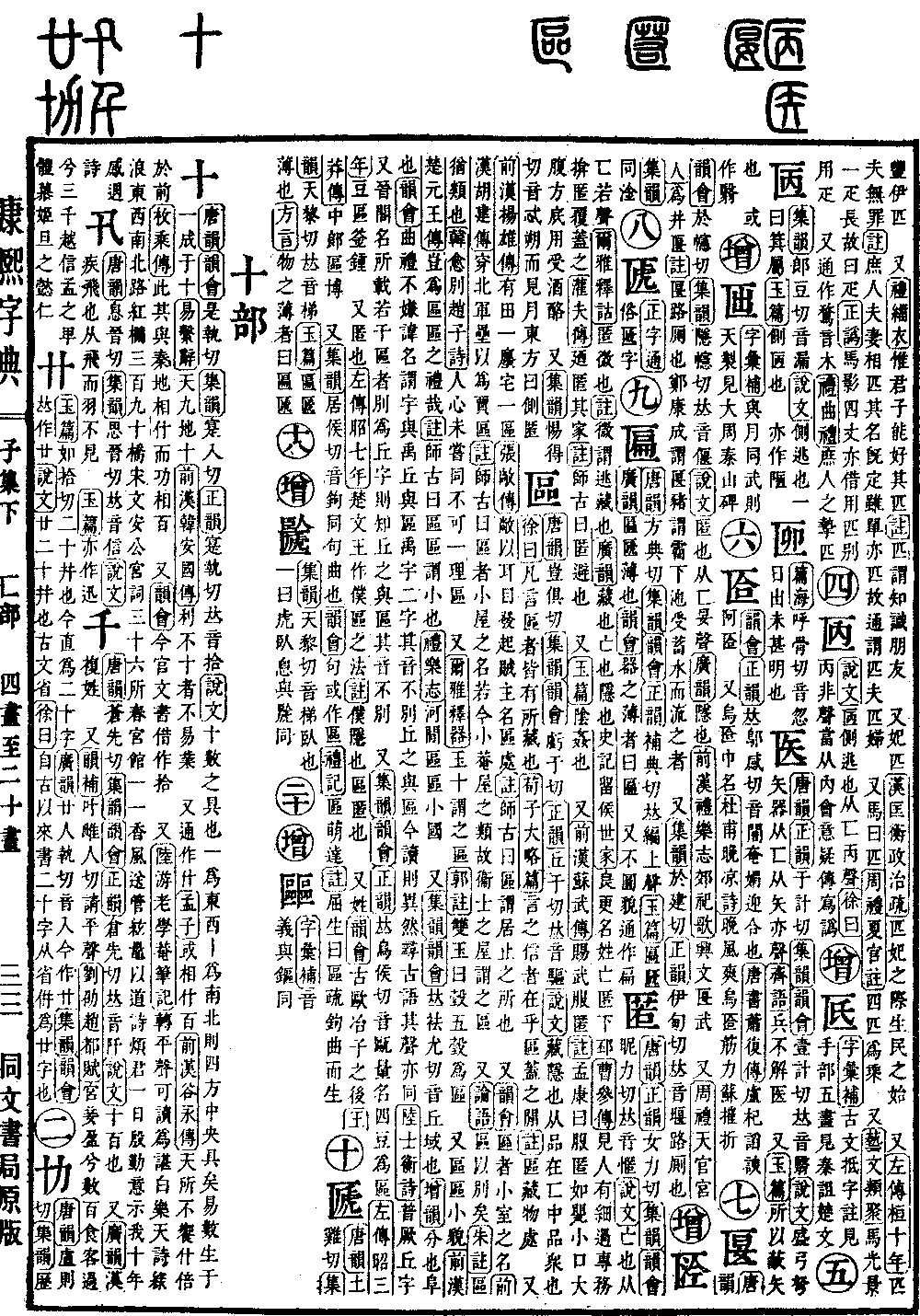
Meaning: District; Kangxi Stroke Count: 11; Page: 155, Entry: 13
Pronunciation: qǐ jù qiè (Qie Ju tone) in Tang Yun; kuī yú qiè (Kui Yu tone) in Ji Yun and Yun Hui; qiū yú qiè (Qiu Yu tone) in Zheng Yun, pronounced qū.
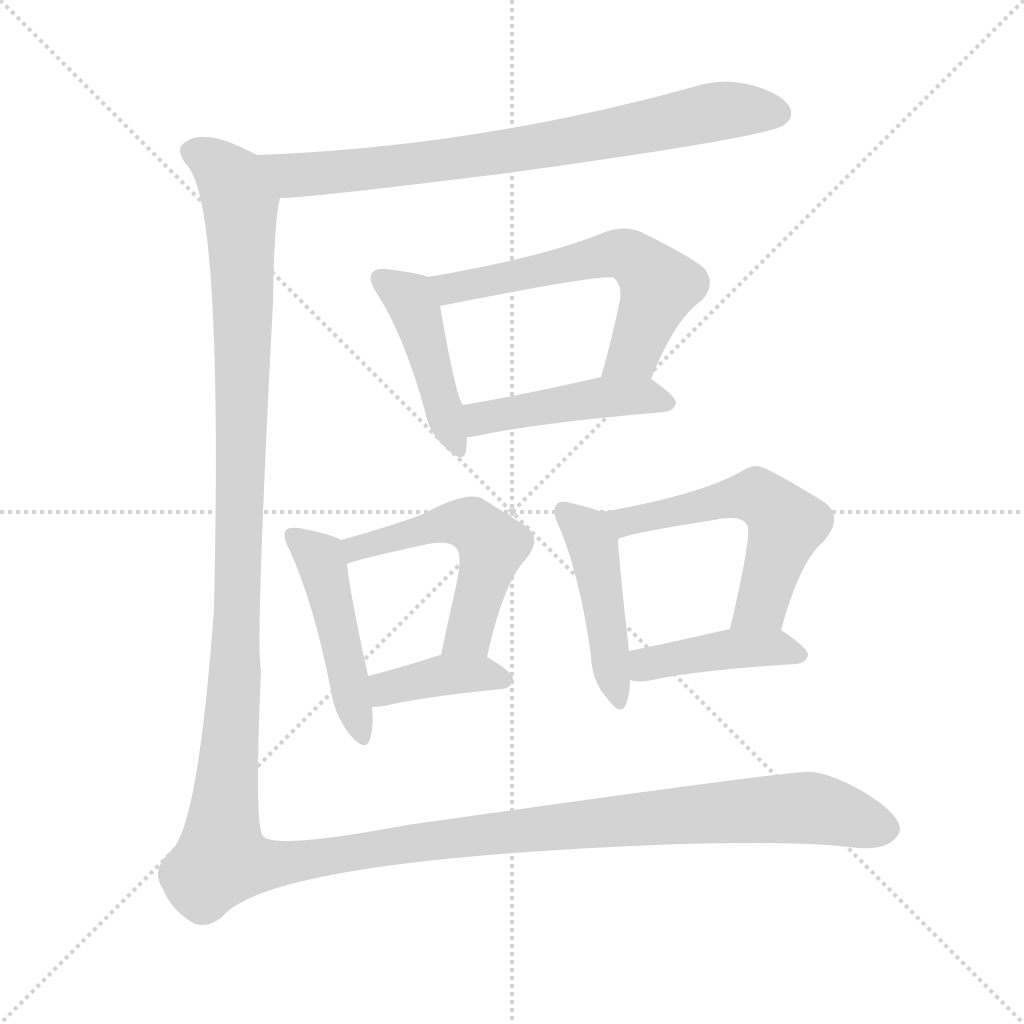
Shuowen Jiezi explains it as "to hide and conceal." The character is formed by placing "品" inside "匸". "品" represents many items.
Xu Kai's note: Whenever "区" is mentioned, it implies the meaning of hiding things.
Xunzi, Chapter "Da Lue": Those whose words are trustworthy, their speech often lies between concealment and revelation. Note: "区" is a place for hiding things.
Also in Qian Han Shu, Biography of Yang Xiong: There was one plot of land, one residential area.
Biography of Zhang Chang: Zhang Chang investigated through his informants and discovered the names and residences of the bandit leaders. Note: Yan Shigu said: "区" refers to a place of residence.
Also in Yun Hui: "区" is also the name of a small room.
Qian Han Shu, Biography of Hu Jian: They dug through the northern army camp and made it into a small room for trading goods. Note: Yan Shigu said: "区" is the name of a small room, similar to the small huts of today. Therefore, the rooms where guards live are also called "区".
Also in The Analects: Differentiate them according to their categories. Zhu Xi's note: "区" is like category.
Han Yu's poem "Farewell to Zhao Zi": People's minds are inherently different, and cannot be divided by the same principle.
Also in Er Ya, "Shi Qi": Ten pieces of jade are called one "区". Guo Pu's note: A pair of jade is called "瑴", and five "瑴" make one "区".
Also "区区" describes something as small.
Qian Han Shu, Biography of Prince Yuan of Chu: Is it for that insignificant gesture of courtesy? Note: Yan Shigu said: "区区" means small.
"Li Yue Zhi": Hejian was a small feudal state.
Also in Ji Yun, Yun Hui: qū yóu qiè (Qu You tone), pronounced qiū. Meaning region.
Zeng Yun: Meaning to divide, to distinguish.
Yun Hui: "Qu Li" says not to avoid homophones, such as "宇" (yǔ) and "禹" (yǔ), "丘" (qiū) and "区" (qū). The characters "禹" and "宇" have no distinction in ancient pronunciation. "丘" and "区" are pronounced differently now, but if we investigate ancient language, their pronunciations are the same. Lu Ji's poem: "Reaching all the hills and regions." Also, in the records of Jin Dynasty pavilions, several "区" are written as "丘", indicating that "丘" and "区" have no distinction in ancient pronunciation.
Also in Ji Yun, Yun Hui, Zheng Yun: wū hóu qiè (Wu Hou tone), pronounced ōu. A unit of capacity. Four dou make one "区".
Zuo Zhuan, Year 3 of Duke Zhao: (Measuring vessels) included dou, "区", fu, and zhong.
Also meaning to hide.
Zuo Zhuan, Year 7 of Duke Zhao: King Wen of Chu established laws regarding the hiding of fugitives (the law of "仆区"). Note: "仆" means to hide; "区" means to conceal.
Also a surname.
Yun Hui: According to legend, it is a descendant of Ou Yezi, an ancient craftsman.
Biography of Wang Mang: Records the official Ou Bo.
Also in Ji Yun: jū hóu qiè (Ju Hou tone), pronounced gōu. Same as "句". Meaning to bend.
Yun Hui: "句" is sometimes written as "区".
Book of Rites: Curved sprouts grow from the earth. Note: Growing in a curved manner is called "区". Shu: It grows curved like a hook.