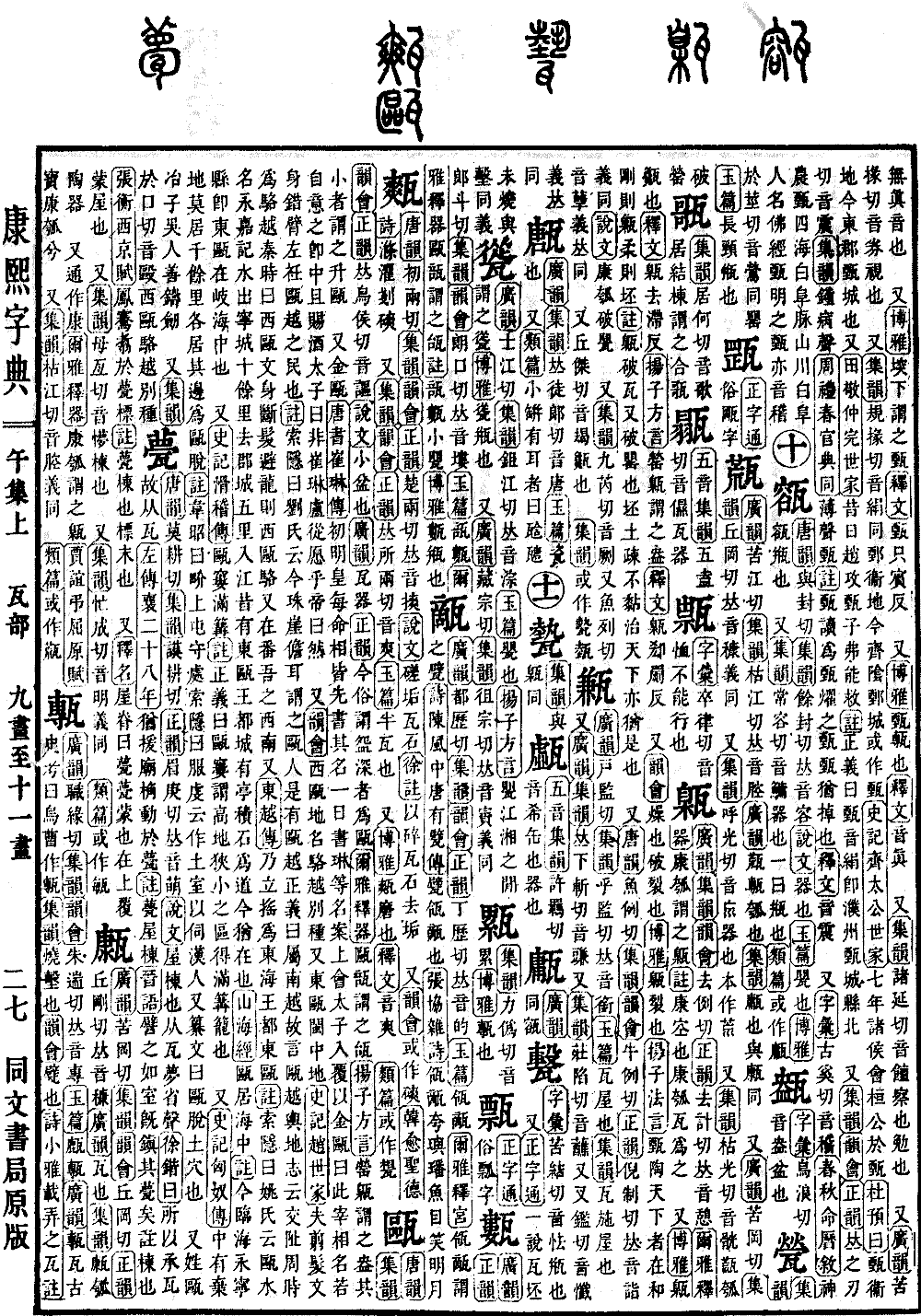
Wu Collection, Upper Volume
Radical: Tile (wǎ)
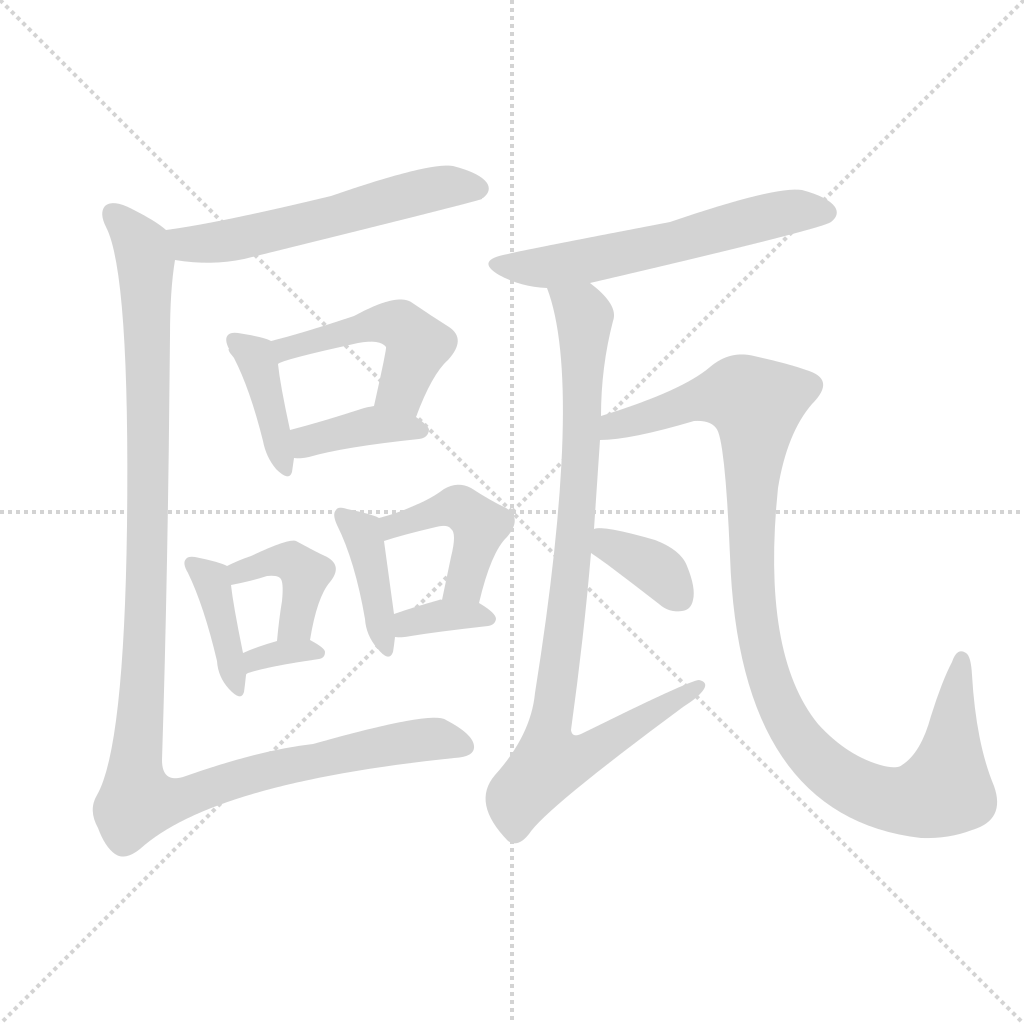
Ou
Kangxi Stroke Count: 16
Page 751, Entry 22
Tang Rhymes (Tangyun), Collected Rhymes (Jiyun), Rhyme Meetings (Yunhui), and Orthodox Rhymes (Zhengyun) all pronounce this as ou (flat tone), which is the same as the pronunciation of the character meaning to sing (ou).
Explaining Characters and Phrases (Shuowen Jiezi) defines it as a small basin.
Extended Rhymes (Guangyun) states it is a ceramic vessel.
Orthodox Rhymes (Zhengyun) states that currently, common usage refers to a deep bowl as an ou.
Literary Expositor (Erya), section on implements, states that an ou and a bu are both called a yi.
Yang Xiong's Regional Dialects (Fangyan) states that an ying and a qi are called an ang, and the smaller ones are called a sheng ou.
There is also the allusion of the golden ou.
Book of Tang (Tangshu), Biography of Cui Lin, records: Initially, whenever Emperor Xuanzong of Tang appointed a chancellor, he would first write down the name. One day, he wrote the names of Cui Lin and others and placed them on the desk. The crown prince happened to enter, so he covered them with a gold basin and said: These are the names of the chancellors; if you can guess them, I will appoint them immediately and bestow wine upon you. The crown prince said: Are they not Cui Lin and Lu Congyuan? The emperor said: Yes.
Rhyme Meetings (Yunhui) records: Xi’ou is a place name. It is a branch of the Luoyue.
There is also Dong’ou, which is in the region of Central Min.
Records of the Grand Historian (Shiji), Hereditary House of Zhao, records: Those who cut their hair, tattoo their bodies, cross their arms, and wear their lapels to the left are the people of Ouyue.
Annotation: Suoyin says: Mr. Liu believes: People in the current areas of Zhuyai and Dan’er are called the Ou people, hence the name Ouyue. Zhengyi says: They belong to Nanyue, hence the name Ouyue. Gazetteer of Geography (Yudizhi) says: Jiaozhi was Luoyue during the Zhou Dynasty and was called Xi’ou during the Qin Dynasty. They tattoo their bodies and cut their hair to avoid flood dragons; thus, Xi’ou and Luoyue are located southwest of Fanwu.
Biography of the Eastern Yue (Dongyue Zhuan) records: Thereupon, Yao was established as the King of the Eastern Sea, with his capital in Dong’ou.
Annotation: Suoyin says: Mr. Yao believes: Ou is the name of a body of water. Record of Yongjia (Yongjiaji) records: The source of the water originates more than ten li from Ningcheng and flows into the river five li from the county seat. Formerly, there was the capital of the King of Dong’ou, with a pavilion and stone-paved roads; the ruins still exist today.
Classic of Mountains and Seas (Shanhaijing) states: Ou is located in the middle of the great sea.
Annotation: The current Yongning County in Linhai is Dong’ou, located in the middle of the Qihai Sea.
Records of the Grand Historian (Shiji), Biographies of Masters of Wit (Huaji Zhuan), contains the phrase ou lou man gou.
Annotation: Zhengyi says: Ou lou refers to narrow, high-altitude plots of land; the hope is to harvest a full basket of grain.
Records of the Grand Historian (Shiji), Biography of the Xiongnu (Xiongnu Zhuan), records: Between them lay abandoned land, uninhabited for over a thousand li in every direction; both sides established outuo at their borders.
Annotation: Wei Zhao says: This refers to places where troops were stationed for defense at the borders. Suoyin says: Fu Qian believes: (The Xiongnu) built earthen huts to spy on the Han people. Additionally, Collection of Writings (Zuanwen) says: Outuo is simply an earth cave.
There is also a surname. Ouyezi was a man of the State of Wu, skilled in casting precious swords.
Collected Rhymes (Jiyun) pronounces this as ou (rising tone), which is the same as the pronunciation of the character meaning to strike (ou). Xi’ou is a branch of the Luoyue.