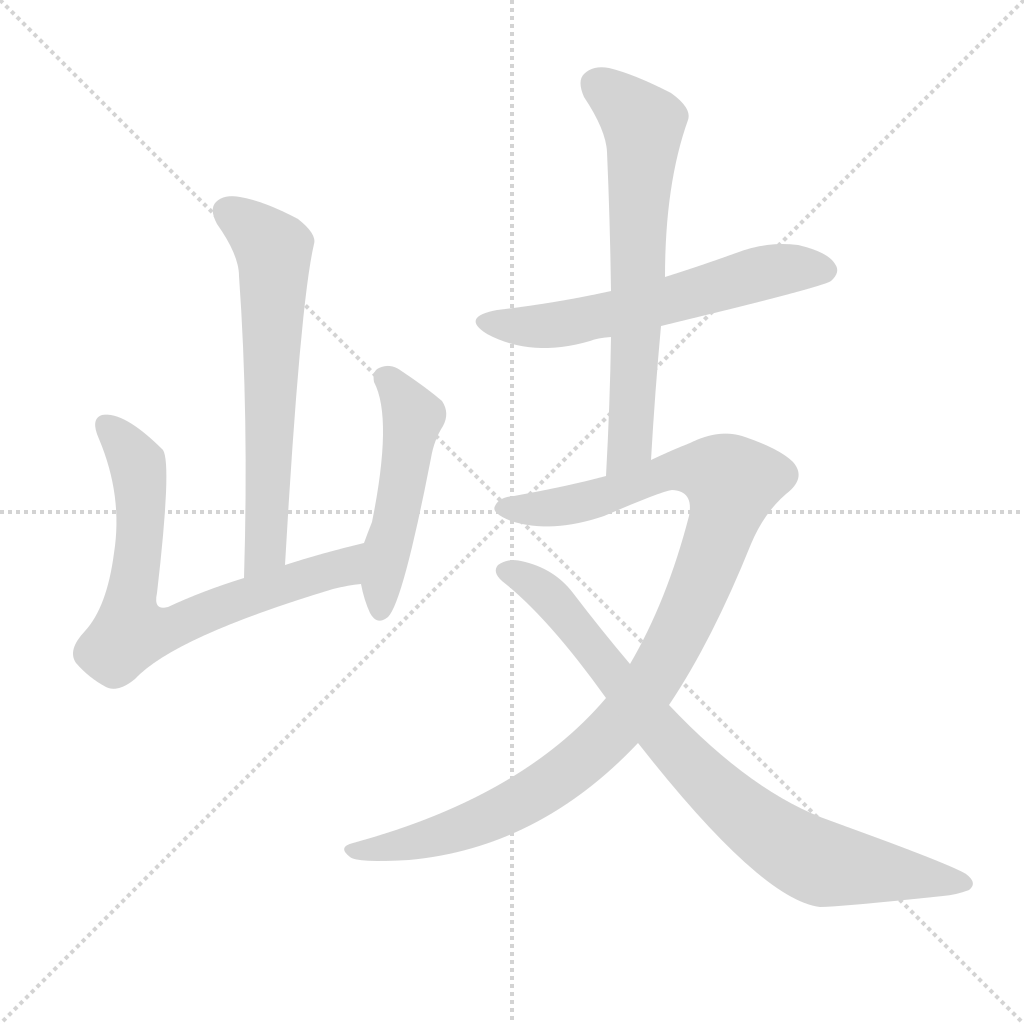
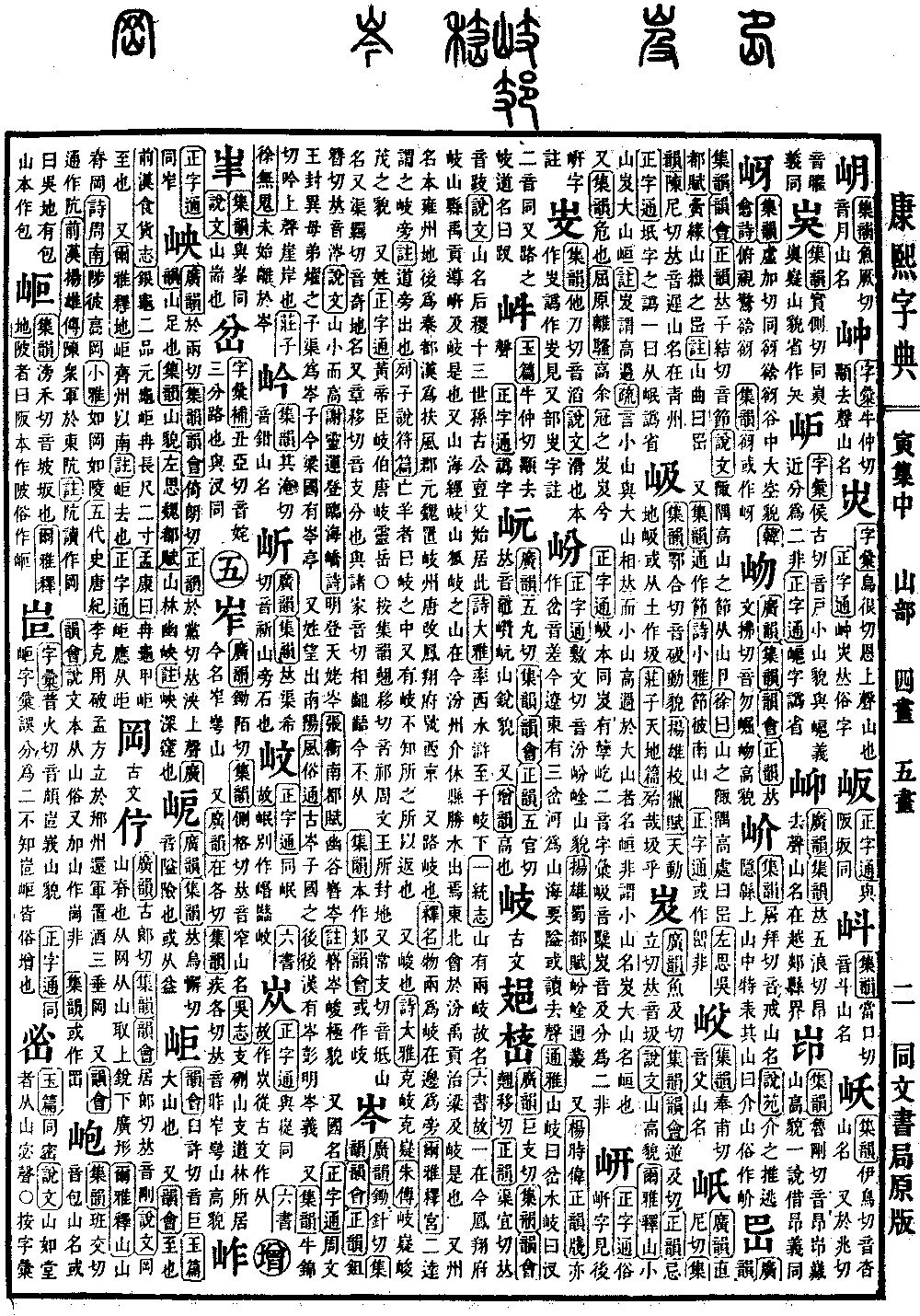
Yin Collection, Middle Volume. Radical: Mountain (shān). Kangxi stroke count: 7. Page 308, Entry 24.
Ancient textual records: According to Broad Rhymes (Guangyun), pronounced qi. According to Collected Rhymes (Jiyun) and Rhymes Collected (Yunhui), pronounced qi. According to Correct Rhymes (Zhengyun), pronounced qi. The pronunciation is the same as the character for 'to stand on tiptoe'. Explanations of Graphs and Analysis of Characters (Shuowen Jiezi) states it is the name of a mountain. The thirteen-generation descendant of Houji, Gugong Danfu, first resided here. The Book of Odes (Shijing), Greater Odes (Daya) states: Following the western riverbank, one arrives at the foot of Mount Qi. The Comprehensive Gazetteer (Yitongzhi) states that this mountain divides into two branches, hence its name. The Origin of the Six Scripts (Liushu Gu) states that this is a mountain in the present-day Fengxiang Prefecture, Qishan County. The Tribute of Yu (Yu Gong) records the draining of Mount Qian and Mount Qi, which refers to this place. Additionally, the Classic of Mountains and Seas (Shanhai Jing) records that Mount Qi, also known as Mount Huqi, is in the present-day Fenzhou, Jiexiu County. The Sheng River originates here and flows northeast into the Fen River. The Tribute of Yu (Yu Gong) record of managing Mount Liang and Mount Qi refers to this location.
It is also the name of a prefecture. Originally the territory of Yongzhou, it later became the capital of the State of Qin. During the Han dynasty, it was Fufeng Commandery. During the Northern Wei period, Qi Prefecture was established. During the Tang dynasty, it was renamed Fengxiang Prefecture and designated as the Western Capital.
It also refers to a fork in the road. Explanations of Names (Shiming) states: An object that divides into two parts is called qi; the portion on the side is called pang. Er Ya, Explanation of Palaces (Shigong) states: A road that divides into two is called qipang. The commentary notes: This refers to a road branching off from the side. Liezi, Discussion on Symbols (Shufu pian) states: The man who lost his sheep said: Amidst the fork in the road, there are further forks; not knowing which way they went, he returned.
It also refers to being high and steep. The Book of Odes (Shijing), Greater Odes (Daya) states: Able to be high, able to be towering. Zhu Xi's Commentary (Zhu Zhuan) states: Qiyi describes an appearance that is high, steep, and lush.
It is also a surname. Orthodox Guide to Characters (Zhengzitong) mentions Qibo, a minister of the Yellow Emperor, and Qi Lingyue of the Tang dynasty. Note: According to Collected Rhymes (Jiyun), pronounced qi. This was the territory enfeoffed to King Wen of Zhou. There is also a pronunciation of di. This refers to the mountain name. There is also a pronunciation of qi. This refers to the place name. There is also a pronunciation of zhi. It means to divide. These conflict with various other annotations, and are not followed here. Collected Rhymes (Jiyun) states the original form of the character is written differently. Rhymes Collected (Yunhui) notes it is sometimes written as a variant form.