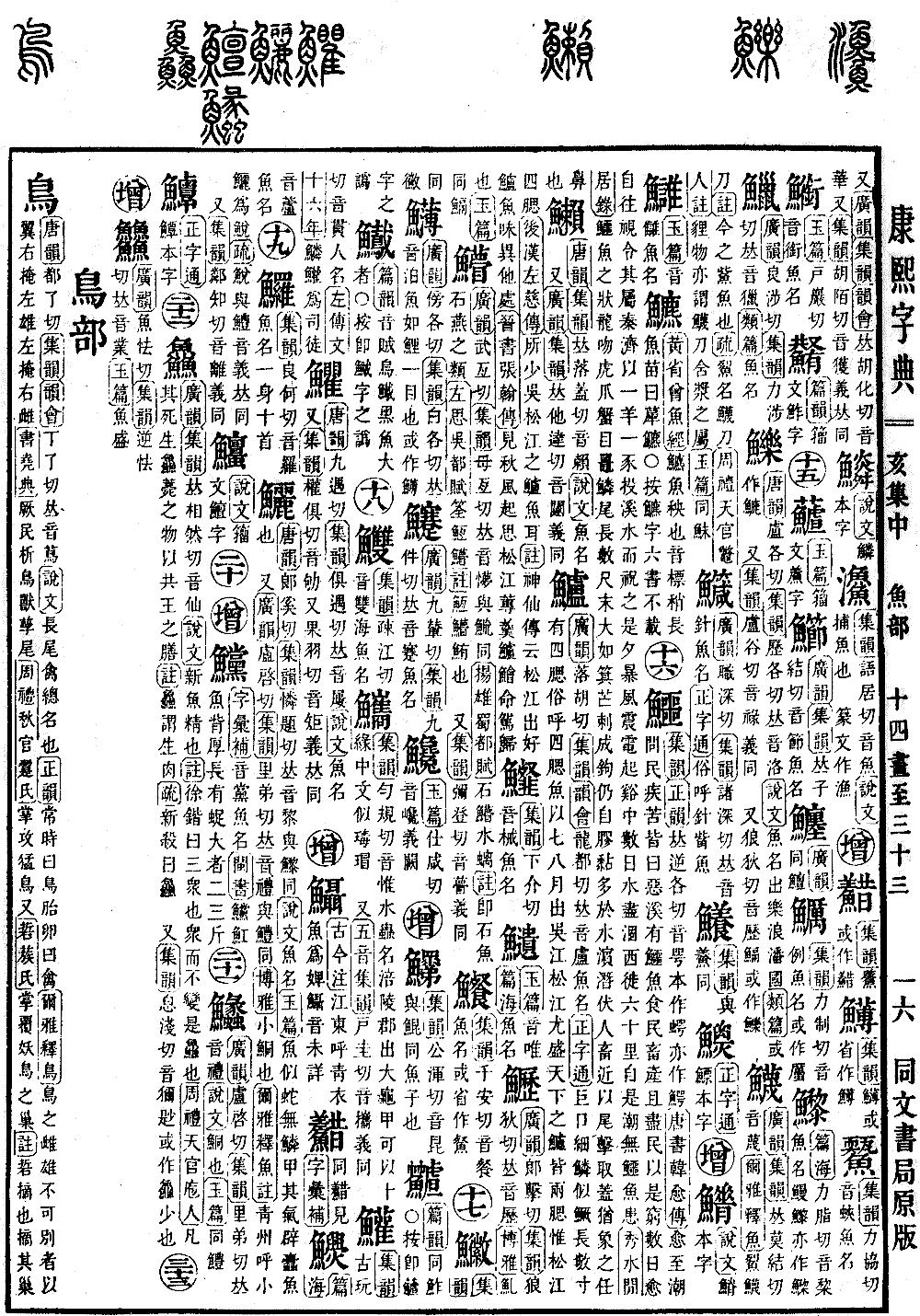
Hai Collection, Middle Volume
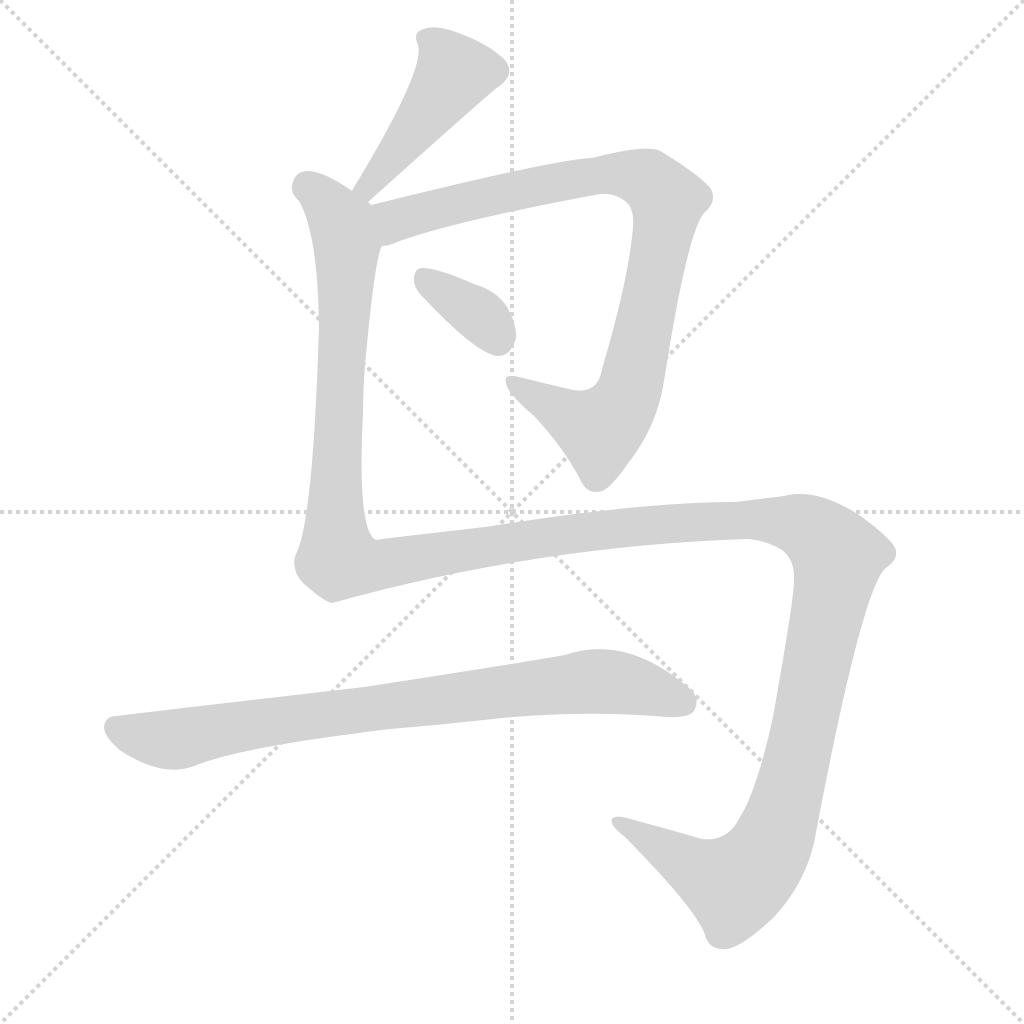
Radical: Bird (niǎo)
Kangxi Strokes: 11
Page 1480, Entry 01
Pronounced niǎo (rising tone).
According to the Explaining and Analyzing Characters (Shuowen Jiezi), it is the general term for long-tailed feathered creatures.
According to the Correct Rhymes (Zhengyun), those with constant behavior are called birds (niǎo), and those born from eggs are called fowls (qín).
According to the Literary Expositor (Erya), in the context of interpreting birds, those whose male and female cannot be distinguished are identified by their wings; if the right wing covers the left, it is male; if the left covers the right, it is female.
Book of Documents (Shangshu), Canon of Yao: The people dispersed while birds and beasts paired and bred.
Rites of Zhou (Zhouli), Autumn Official: The officer in charge of attacking birds of prey.
Also, the officer in charge of destroying the nests of ominous birds. Note: The character (zhé) means to pick or remove; to remove their nests and discard them.
According to the Investigation of Characters (Zhengzitong), those with two feet and feathers are called fowls (qín). Alternatively, it is said that a bird's beak is called (zhòu) or (huì), its talons are called (jù), its tail is called (cuì) and is also written as (pì), and it is also called (wěiyīng). Its gizzard is called (ào), its throat is called (kàng) or (yuánguān), the place where it stores food in its neck is called (sù), its wings are called (hé) or (líng), and the feathers on its neck are called (wēng). Those with short legs mostly stay prone, those with long legs mostly stand, those with legs close to the tail are good at walking, and those with legs close to the chest are good at hopping.
According to the Classic of Fowls (Qin Jing) by Shi Kuang, there are three hundred and sixty feathered creatures; their feathers correspond to the four seasons, and their colors correspond to the five directions.
Also, a star name. The Vermilion Bird is the name of the seven constellations of the south.
Book of Documents (Shangshu), Canon of Yao: The star Bird culminates at dusk.
Also, a country name. According to the Classic of Mountains and Seas (Shanhaijing), in the country of Yanchang, there are people with human bodies and bird heads, known as the Bird clan.
Also, a mountain name. According to the Geographical Records (Dizhi), it is located southwest of Shouyang County in Longxi Commandery; the Tribute of Yu (Yu Gong) mentions Mount Zhongnan and Dunwu extending as far as the Bird mountain.
Also, according to the Classic of Mountains and Seas (Shanhaijing), there is Mount Niaowei, from which the Niaowei River flows.
Also, an official title. Rites of Zhou (Zhouli), Summer Official: The officer in charge of shooting birds.
Zuo Tradition (Zuo Zhuan), 17th Year of Duke Zhao: When Shaohao Zhi ascended the throne, he recorded events using birds, established bird-themed official posts, and assigned bird names.
Also, the ancestors of the Qin state included the Niaosu clan. Records of the Grand Historian (Shiji), Annals of Qin: Da Fei had two sons; one was Da Lian, who was the ancestor of the Niaosu clan. Commentary notes: Because Zhong Yan had a bird's body and spoke human language, he was called the Niaosu clan.
Also, the red bird and white bird are both names for insects. According to the Xia Xiaozheng (Calendar of the Xia), the red bird refers to the red ladybug, and the white bird refers to the gnat or mosquito.
Also, the Kalavinka (a bird of marvelous sound). According to the Lotus Sutra (Fahuajing) verses: The holy lord, king among heaven, has the voice of a Kalavinka. Commentary notes: Kalavinka is a bird with a marvelous voice. Before the bird even begins to sing, it emits a subtle and marvelous sound that no celestial or human voice can equal; only the voice of the Buddha is comparable, hence it is used as a metaphor.
Pronounced niǎo (rising tone). Meaning is the same as above.
Also, according to the Rhyme Compilation (Jiyun) and the Classified Dictionary (Leipian), it is the same as the character for island (dǎo).
Book of Documents (Shangshu), Tribute of Yu (Yu Gong): The island tribes wore skin garments.
Records of the Grand Historian (Shiji), Annals of Xia, and Former Han Geographical Records write this as Bird (niǎo) tribes. Kong Anguo reads Bird as Island.
Also, according to the Supplement to the Dictionary (Zihuibu), pronounced jué. Former Han Geographical Records: Luan-niao County in Wuwei Commandery. Later Han (Hou Hanshu), Biography of Duan Jiong: Intending to attack Wuwei, Jiong pursued them to Luanniao. Commentary: Bird is pronounced jué.
Also, rhyming with (lǚ), pronounced nǚ. Records of the Grand Historian (Shiji), Autobiographical Preface: Duke Mu cherished righteousness and mourned the tragedy at Xiao. He used people for human sacrifice, and the poem Yellow Bird (Huangniao) was composed.
Also, rhyming with (dǒu), pronounced dǒu. Former Han (Qian Hanshu), Biographical Preface: Bathing in the home of the deceased, facing north to offer one's head. The traveler mourns the sacrifice, its righteousness exceeding that of the Yellow Bird.