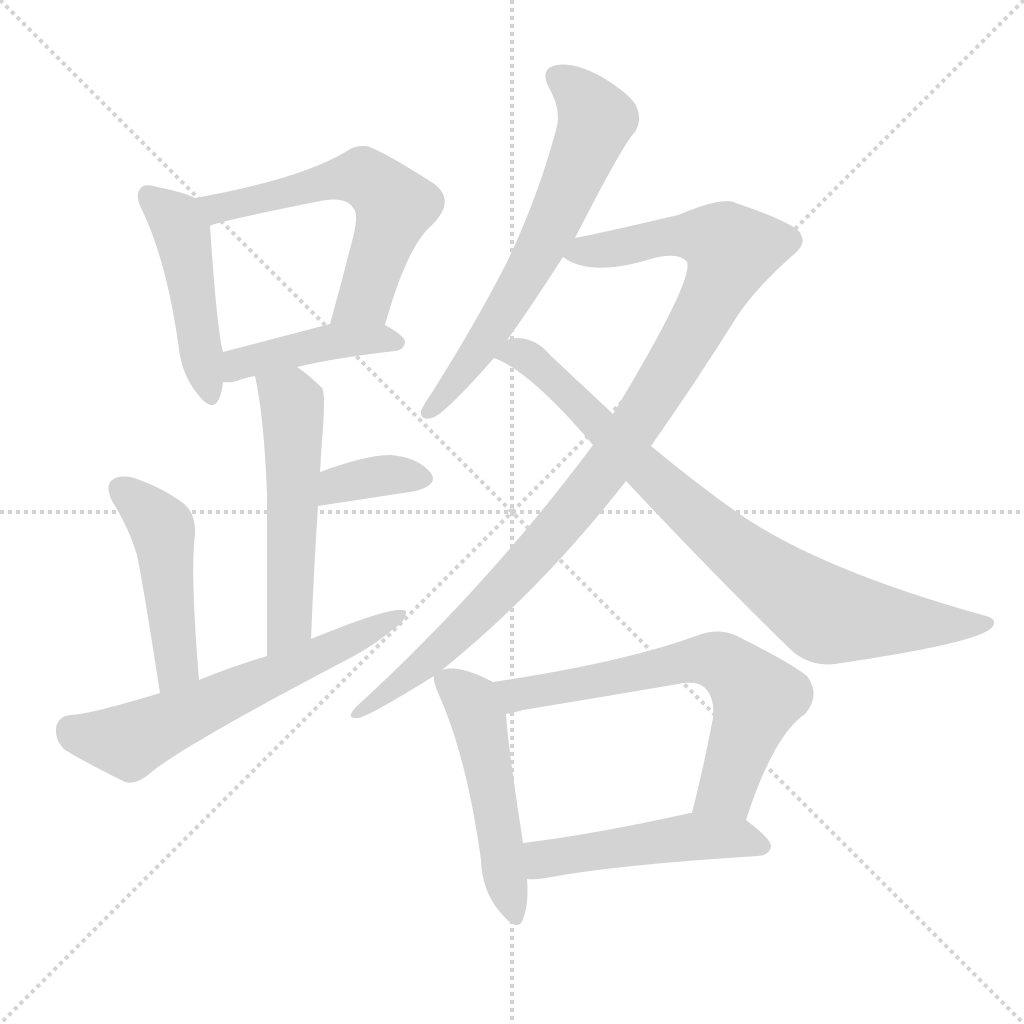
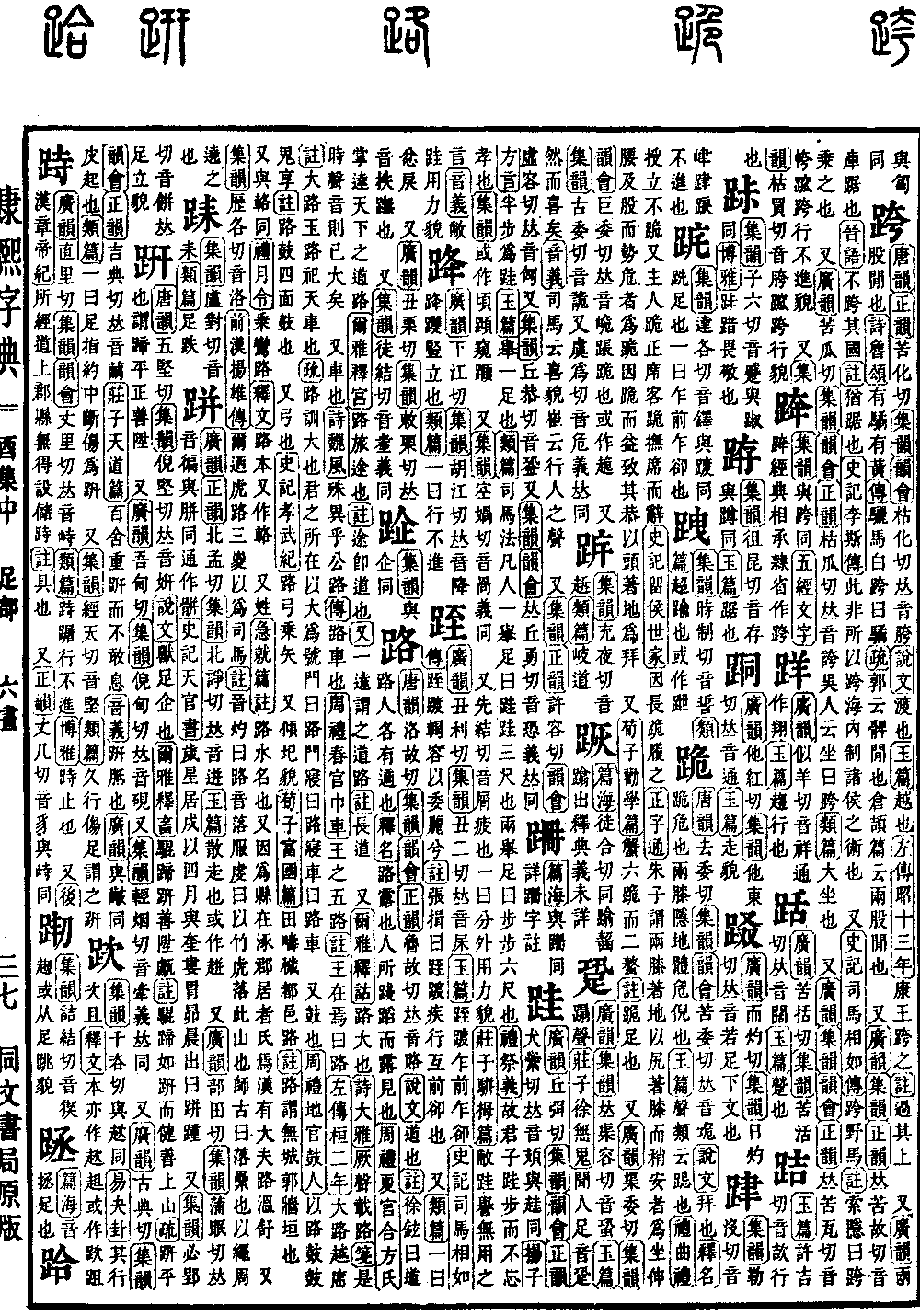
You Collection, Middle Volume
Radical: Foot (zú)
Kangxi stroke count: 13
Page 1225, Entry 22
Tang Rhymes (Tangyun) pronounces it luo. Collected Rhymes (Jiyun), Rhyme Meetings (Yunhui), and Correct Rhymes (Zhengyun) pronounce it lu, with a sound identical to lu.
Explanation of Graphs and Analysis of Characters (Shuowen Jiezi) defines it as a road.
Commentary: Xu Xuan states that a road is a place where people individually intend to go.
Explanation of Names (Shiming) explains: Road means to be revealed. It is a place that becomes revealed because people walk upon it and trample it.
Rites of Zhou (Zhouli), Summer Offices, He Fang Shi: In charge of the unobstructed flow of roads throughout the world.
Erya, Explanation of Palaces: Road means a journey.
Commentary: A path is a road.
Also: A place that connects through is called a road.
Commentary: Refers to a long way.
Also, Erya, Explanation of Words: Road has the meaning of great.
Book of Odes (Shijing), Greater Odes: His voice fills the road.
Annotation: At this point, the sound was already very great.
Also refers to a carriage.
Book of Odes (Shijing), Odes of Wei: Quite different from those officials who manage public carriages.
Commentary: Road refers to a carriage.
Rites of Zhou (Zhouli), Spring Offices, Jin Che: Records the five types of carriages of the king.
Commentary: The carriage where the king is located is called a road.
Zuo Tradition (Zuozhuan), Year 2 of Duke Huan: The great road carriage was spread with cattail mats.
Commentary: A great road is a jade road, which is a carriage used when offering sacrifices to Heaven.
Sub-commentary: Road is explained as having the meaning of great. Where the monarch is located is referred to with the term great; the gate is called the road gate, the sleeping palace is called the road chamber, and the carriage is called the road carriage.
Also refers to a drum.
Rites of Zhou (Zhouli), Earth Offices, Drummer: Use the road drum to beat in order to offer sacrifices to ghosts and spirits.
Commentary: A road drum is a drum with four faces.
Also refers to a bow.
Records of the Grand Historian (Shiji), Basic Annals of Emperor Wu: Road bows and Sheng arrows.
Also describes a ruined appearance.
Xunzi, Chapter on Enriching the State: The fields are wasteland, and the cities and towns are dilapidated.
Commentary: Road signifies having no city walls or ramparts.
Also the same as the character lu (vehicle).
Book of Rites (Liji), Monthly Ordinances: Riding in a luan road carriage.
Explication of Texts: Some versions of the road character are written as lu.
Also a surname.
Commentary to Urgent Lessons (Jijiupian): Lu is the name of a river. It also became the name of a county in Zhuo Commandery; those who resided there adopted it as their surname. In the Han Dynasty, there was the Grand Master Lu Wenshu.
Also, Collected Rhymes (Jiyun) pronounces it luo, with a sound identical to luo.
History of the Former Han (Qian Hanshu), Biography of Yang Xiong: Thereupon, bamboo fences were used to surround the Sanzong Mountains to serve as the area for the Sima (official office).
Commentary: Jin Zhuo says: Road is pronounced luo. Fu Qian says: A hu-luo (bamboo woven fence) was used to surround this mountain. Shigu says: Luo means to accumulate or surround. Use rope to encircle it.