Wu Collection, Lower Volume
Radical: Spirit (shì)
Kangxi Strokes: 13
Page 844, Entry 17
Pronounced lu.
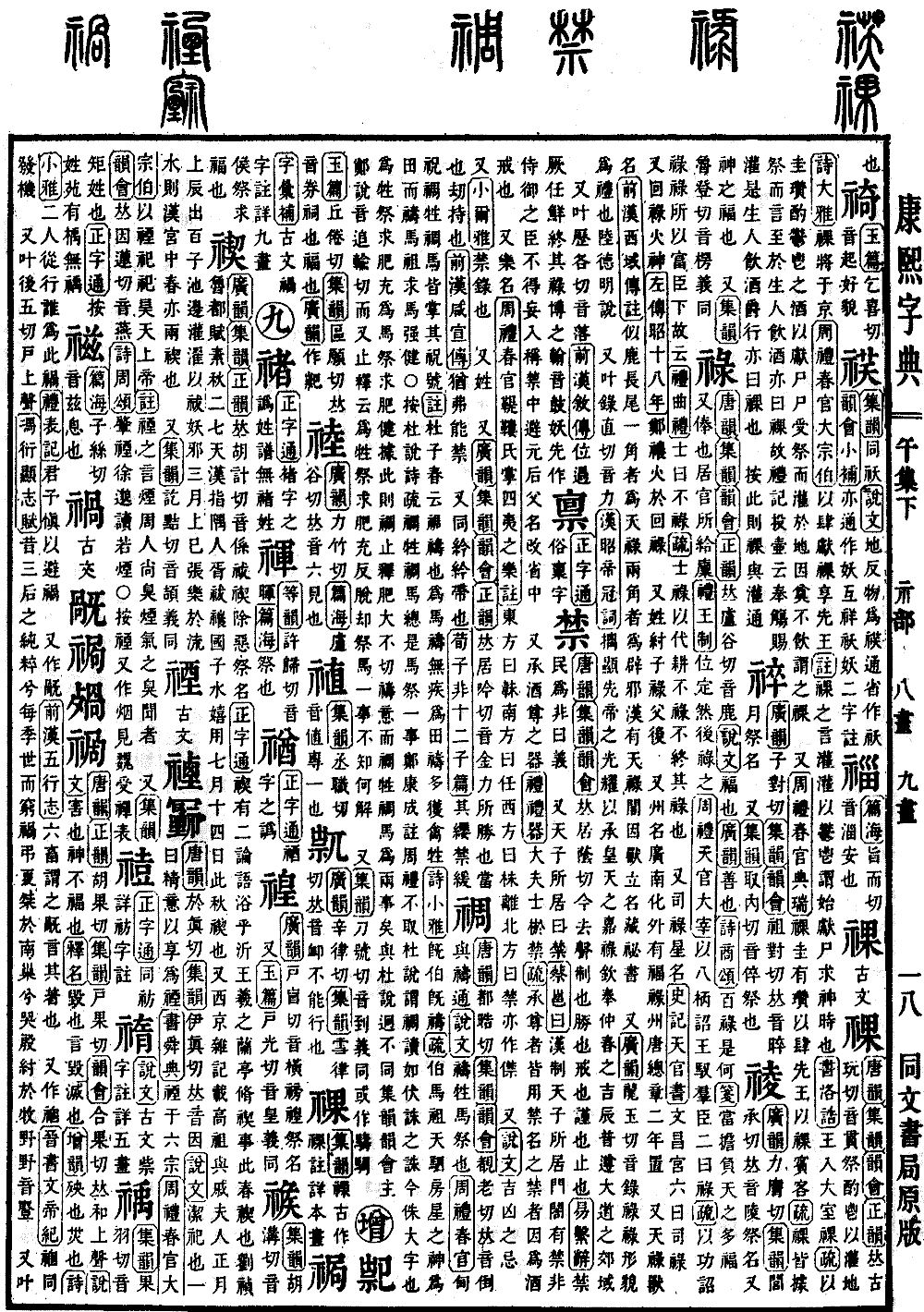
According to the Explaining Graphs and Analyzing Characters (Shuowen Jiezi), it refers to good fortune. According to the Extensive Rhymes (Guangyun), it refers to goodness. In the Book of Odes (Shijing), Shang Eulogies section, it states: "To bear the burden of a hundred blessings." The commentary notes that this refers to the duty of bearing and receiving the many blessings bestowed by Heaven.
It also refers to salary, the provisions received by officials for their service. The Book of Rites (Liji), Royal Regulations section, states: "Once the position is determined, the salary is then provided." The Rites of Zhou (Zhouli), Offices of Heaven, Grand Administrator section, states: "Utilizing eight types of authority to assist the ruler in governing the ministers, the second of which is salary." The sub-commentary states: "Salaries are bestowed according to merit. Salary is that which is used to provide sufficiency for the subordinates."
The Book of Rites (Liji), Qu Li section, states: "The death of a scholar is called 'no salary'." The sub-commentary explains that the scholar's salary is meant to substitute for farming; "no salary" means they can no longer continue to enjoy their salary.
It is also the name of a star, Si Lu. The Records of the Grand Historian (Shiji), Treatise on the Celestial Offices, states: "The sixth star of the Wen Chang palace is called Si Lu."
It also refers to Hui Lu, the god of fire. The Commentary of Zuo (Zuozhuan), Year 18 of Duke Zhao, mentions the State of Zheng offering prayers to Hui Lu to avert fires.
It is also used as a surname, being the descendants of Lu Fu, the son of King Zhou of Shang.
It is also the name of a prefecture. In the remote regions of Guangnan, there was Fu Lu Prefecture, established in the second year of the Zongzhang reign period of the Tang Dynasty.
It is also the name of a mythical beast, Tian Lu. The Commentary on the Book of the Western Regions in the History of the Former Han (Qianhan Shu) states: "An animal resembling a deer with a long tail and one horn is called Tian Lu, while those with two horns are called Bi Xie." The Han Dynasty had the Tian Lu Pavilion, named after this creature, used to store secret books and records.
Pronounced lu. Lu Lu describes a respectful demeanor when performing rites. This is the view of Lu Deming.
Also pronounced li. In the Odes on the Capping of Emperor Zhao of Han (Han Zhaodi Guan Ci), it is written: "To manifest the brilliant glory of the former emperor, and to receive the beautiful blessings of August Heaven. Respectfully observing the auspicious day of the second month of spring, universally following the frontier of the great suburban sacrifice."
Also pronounced luo. In the History of the Former Han (Qianhan Shu), Memoir section, it is written: "If a position exceeds one's capabilities, it is rare to have a good outcome and maintain one's salary. To be widely learned but shallow like a crowing cock, the drum spirit of ominous signs will manifest first."