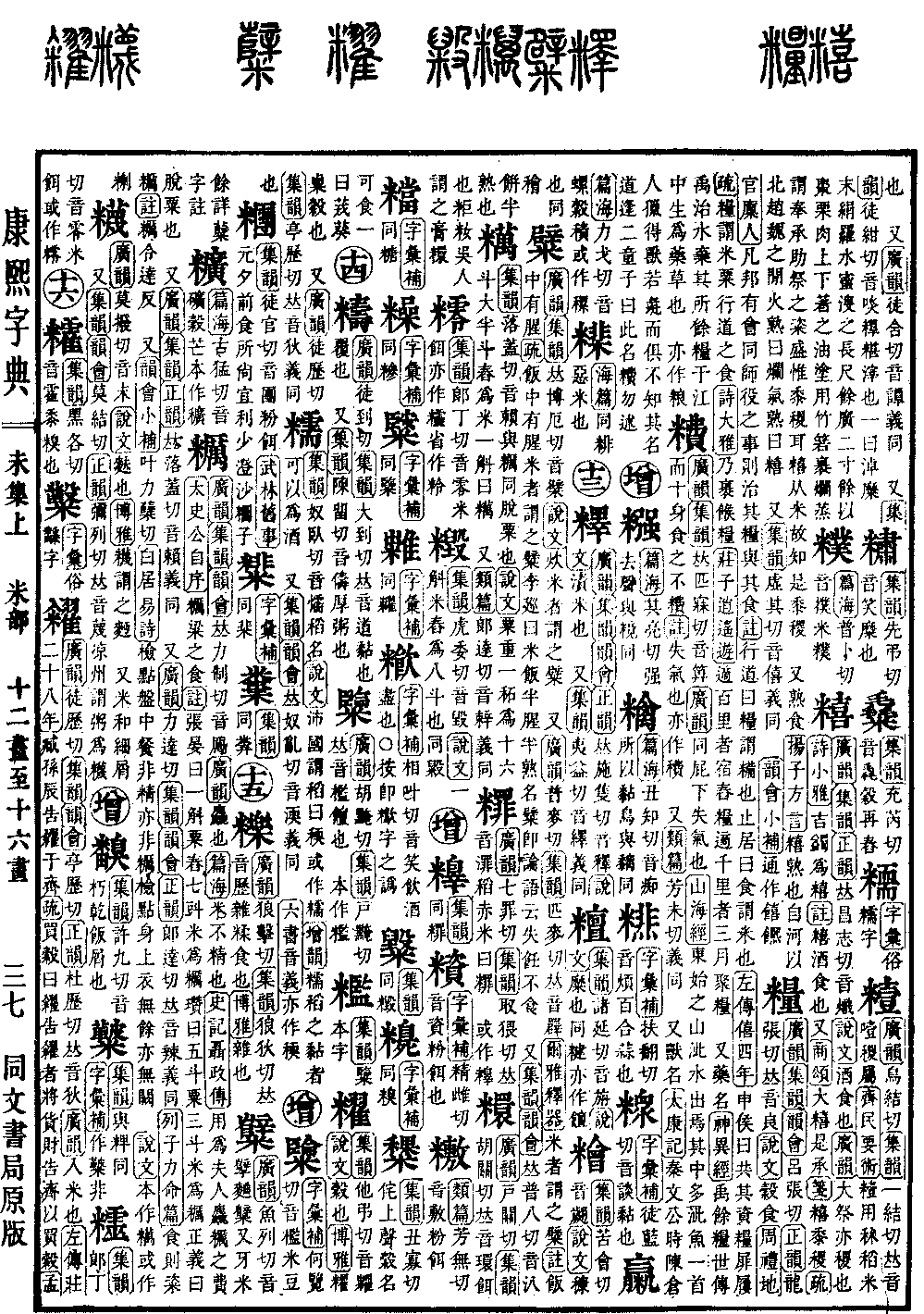
Wei Collection, Upper Volume
Radical: Rice (mǐ)
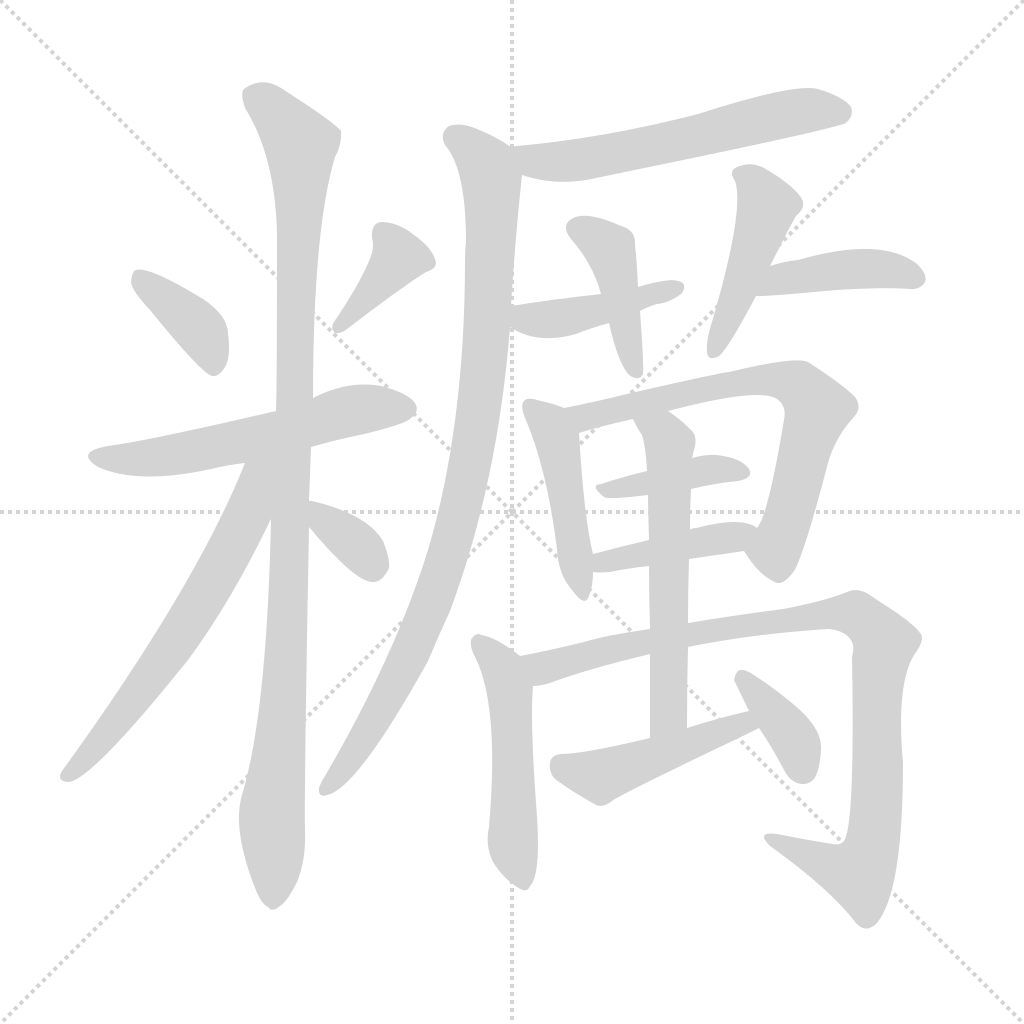
Li
Kangxi stroke count: 21
Page 913, Entry 47
Broad Rhymes (Guangyun), Collected Rhymes (Jiyun), and Rhyme Compendium (Yunhui) define it as pronounced li (falling-rising tone).
Broad Rhymes: Coarse.
Sea of Writings (Pianhai): Rice that is not refined.
Records of the Grand Historian (Shiji), Biography of Nie Zheng: Used for the expenses of the lady's coarse food.
Authorial Preface of the Grand Historian: Coarse rice and coarse grains for food.
Commentary: Zhang Yan states: One hu of millet pounded into seven dou of rice is li. Zan states: Five dou of millet yielding three dou of rice is li. Correct Meaning (Zhengyi): It refers to husked coarse rice.
Also, according to Broad Rhymes (Guangyun), Collected Rhymes (Jiyun), and Correct Rhymes (Zhengyun), it is pronounced lai (falling tone). The meaning is the same.
Also, according to Broad Rhymes (Guangyun), it is pronounced la (entering tone). According to Collected Rhymes (Jiyun), Rhyme Compendium (Yunhui), and Correct Rhymes (Zhengyun), it is pronounced la (entering tone). The meaning is the same.
Book of Liezi, Chapter on Strength and Destiny: What one eats is coarse rice.
Commentary: Li is pronounced as ling da.
Also, according to Small Supplement to the Rhyme Compendium (Yunhui Xiaobu), it rhymes as lie (entering tone).
Poem by Bai Juyi: Examine the food on the platter, it is neither refined nor coarse. Examine the clothing on the body, there is nothing surplus and nothing lacking.
Explication of Written Characters (Shuowen): Originally written as a variant form. Or written as another variant form.