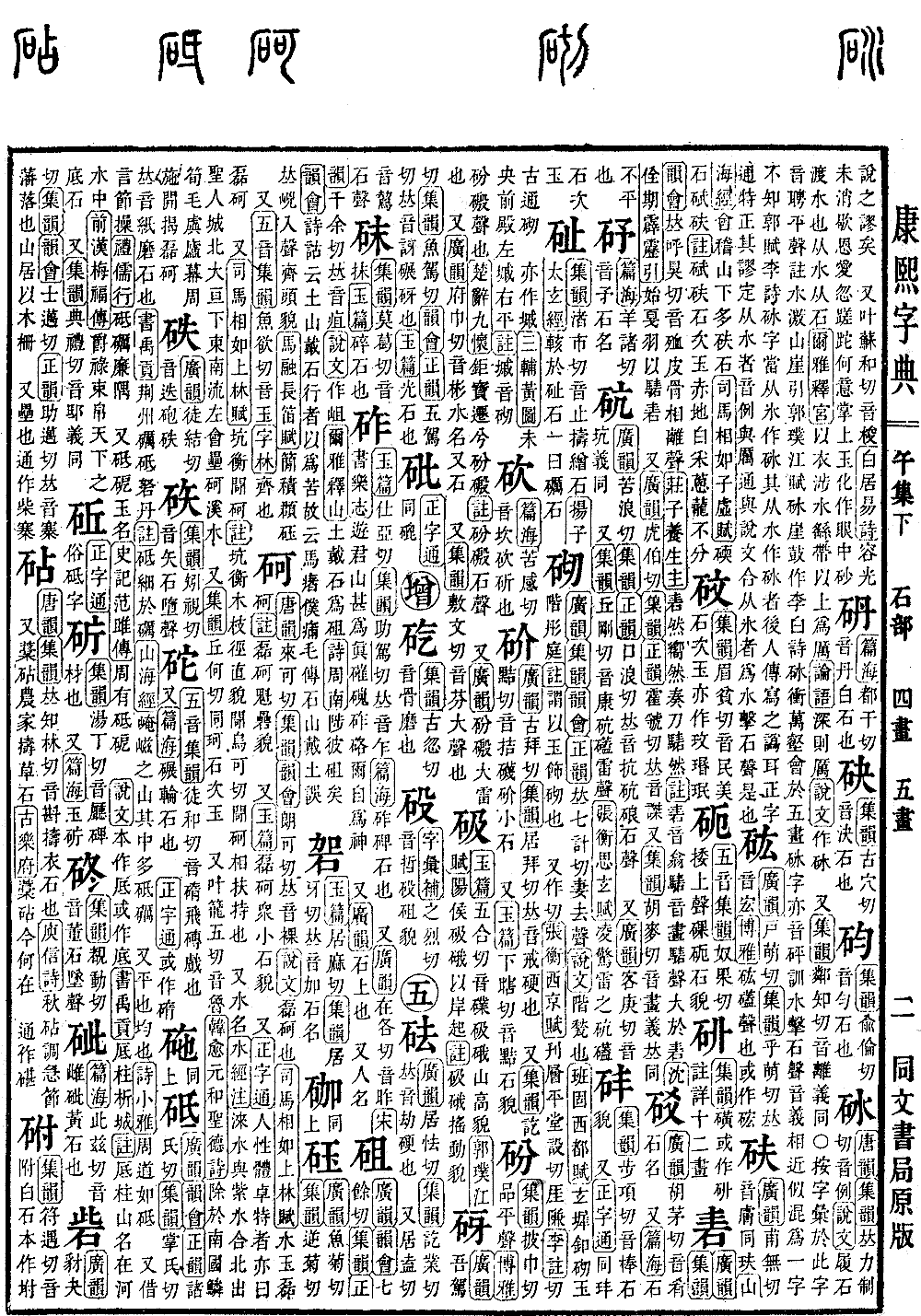
Wu Collection, Lower Volume
Radical: Stone (shí)
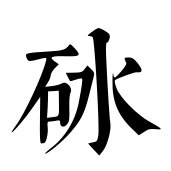
Character: 砅
Kangxi strokes: 9
Page 828, Entry 04
Tang Rhymes (Tangyun) and Collected Rhymes (Jiyun): Pronounced li (falling tone).
Explanation of Characters (Shuowen): To cross a river by stepping on stones. The character form is composed of water and stone.
Approaching Elegance (Erya), Explanation of Palaces: Carrying one's clothes while crossing a river, when the water reaches above the belt, is called li (falling tone).
Analects (Lunyu): If the water is deep, then use the method of li (falling tone).
Explanation of Characters (Shuowen): Written as 砅.
Also, Collected Rhymes (Jiyun): Pronounced li (level tone). The meaning is the same.
According to the Collection of Characters (Zihui), for this character, the pronunciation is indicated as pin (level tone). Note: The impact of a water current against a mountain cliff.
Citing Guo Pu, Rhapsody on the Yangtze River (Jiang Fu): The water strikes the cliff and surges. Li Bai poetry: The water strikes and rushes through ten thousand ravines.
In the five-stroke character ping, it is also pronounced peng, explained as the sound of water striking stone. The pronunciation and meaning are similar, and they appear to have been conflated into one character. It is unclear whether the character 砅 in Guo Pu’s rhapsody or Li Bai’s poem should be written with the ice radical as ping. Those written with the water radical as 砅 are errors in later transcriptions.
Correct Meaning (Zhengzitong) specifically corrects this error, confirming that the form with the water radical is pronounced li (falling tone) and is interchangeable with li (falling tone). This conforms to the Explanation of Characters (Shuowen). The form with the ice radical represents the sound of water striking stone, which is correct.