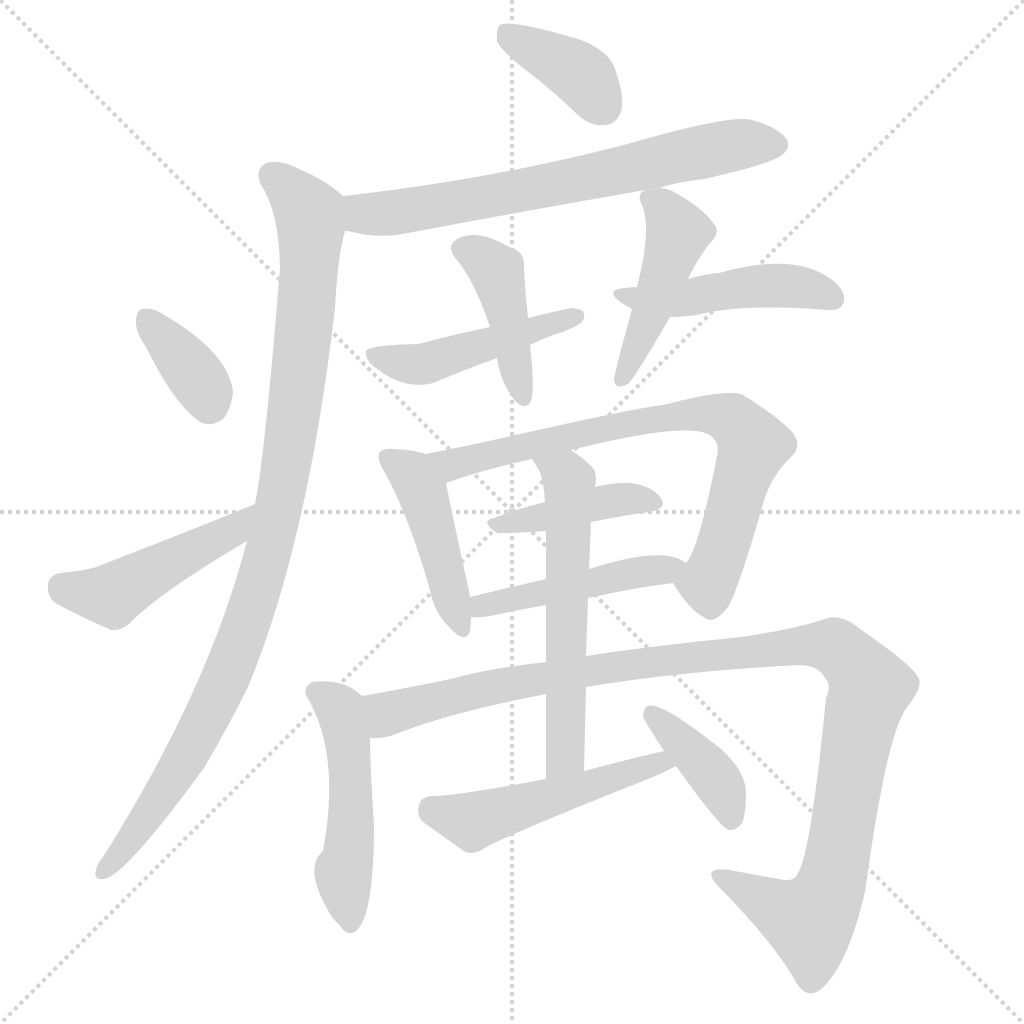
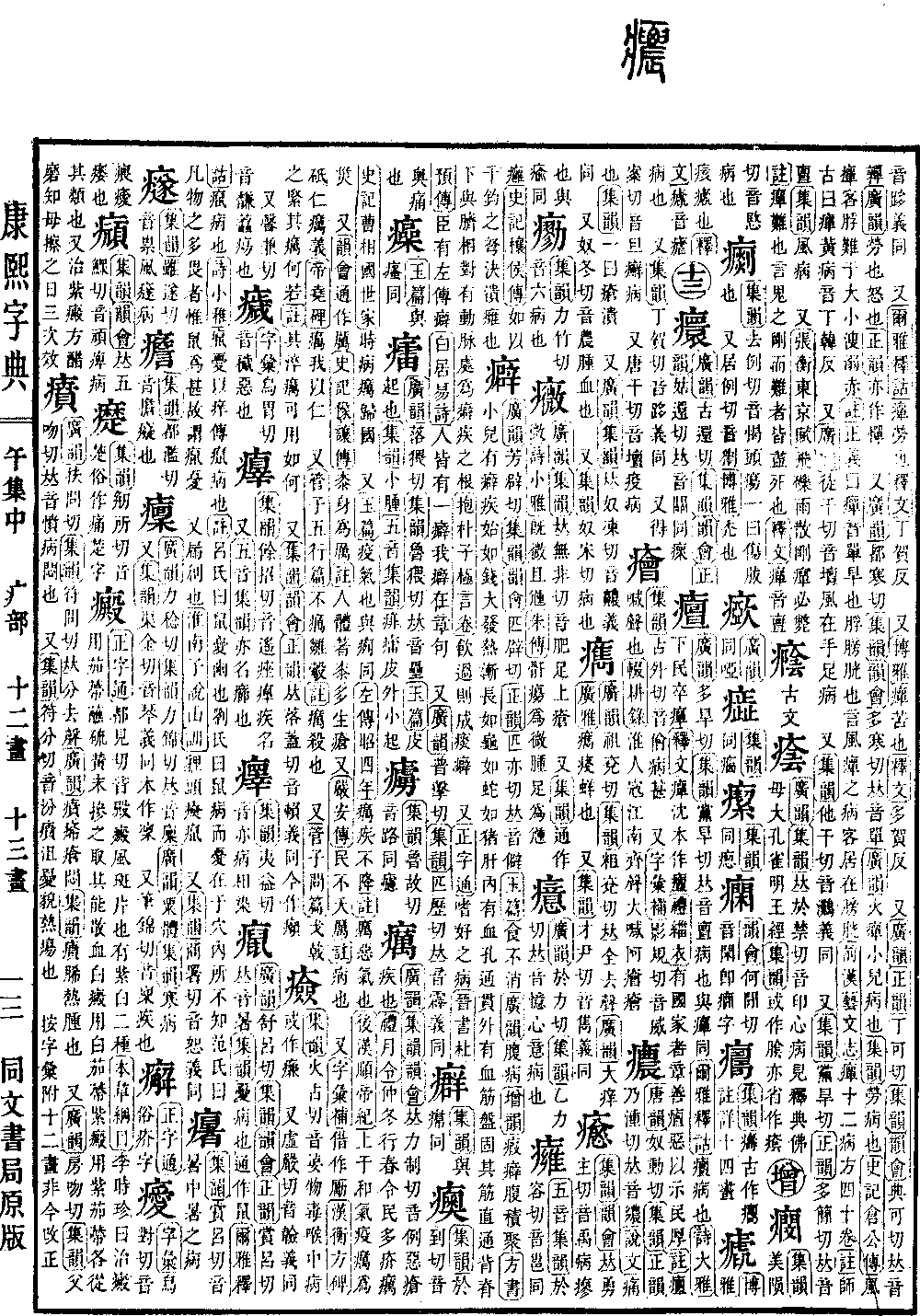
Wu Collection, Middle Volume
Radical: Sickness (bìng)
Li
Kangxi stroke count: 18
Page 781, Entry 27
Guangyun (Guangyun), Jiyun (Jiyun), and Yunhui (Yunhui) define this as having the pronunciation li (falling tone). It refers to malignant sores and diseases.
Book of Rites (Liji): In the middle month of winter, if one follows the ordinances of spring, the people will suffer from scabies and pestilence.
Records of the Grand Historian (Shiji): At that time, suffering from a pestilence, he returned to his state.
Yupian (Yupian): It also refers to epidemic vapors. It is the same as the variant form (li).
Zuo Zhuan (Zuo Zhuan): Pestilential diseases do not descend. Commentary: Li refers to malignant vapors.
Book of the Later Han (Hou Hanshu): It affects the harmony above, causing epidemics and pestilence to become disasters.
Yunhui (Yunhui): It is also commonly written as the variant form (li).
Records of the Grand Historian (Shiji): He lacquered his body to cause sores. Commentary: When the human body is coated with lacquer, it often produces sores.
Records of the Grand Historian (Shiji): The people did not die young from pestilence. Commentary: It means disease.
Zihuibu (Zihuibu): It is borrowed as the variant form (li).
Han Heng Fang Inscription: Sharpen benevolence and exert righteousness.
Emperor Yao: Exert me through benevolence.
Guanzi (Guanzi): Do not kill the chicks and grains. Commentary: Li means to kill.
Guanzi (Guanzi): Regarding the tightness of the daggers and halberds, how is their sharpness? Commentary: It asks how their grinding and sharpening can be utilized.
Jiyun (Jiyun), Yunhui (Yunhui), and Zhengyun (Zhengyun) define this as having the pronunciation lai (falling tone). The meaning is the same. It is now written as the variant form (lai).