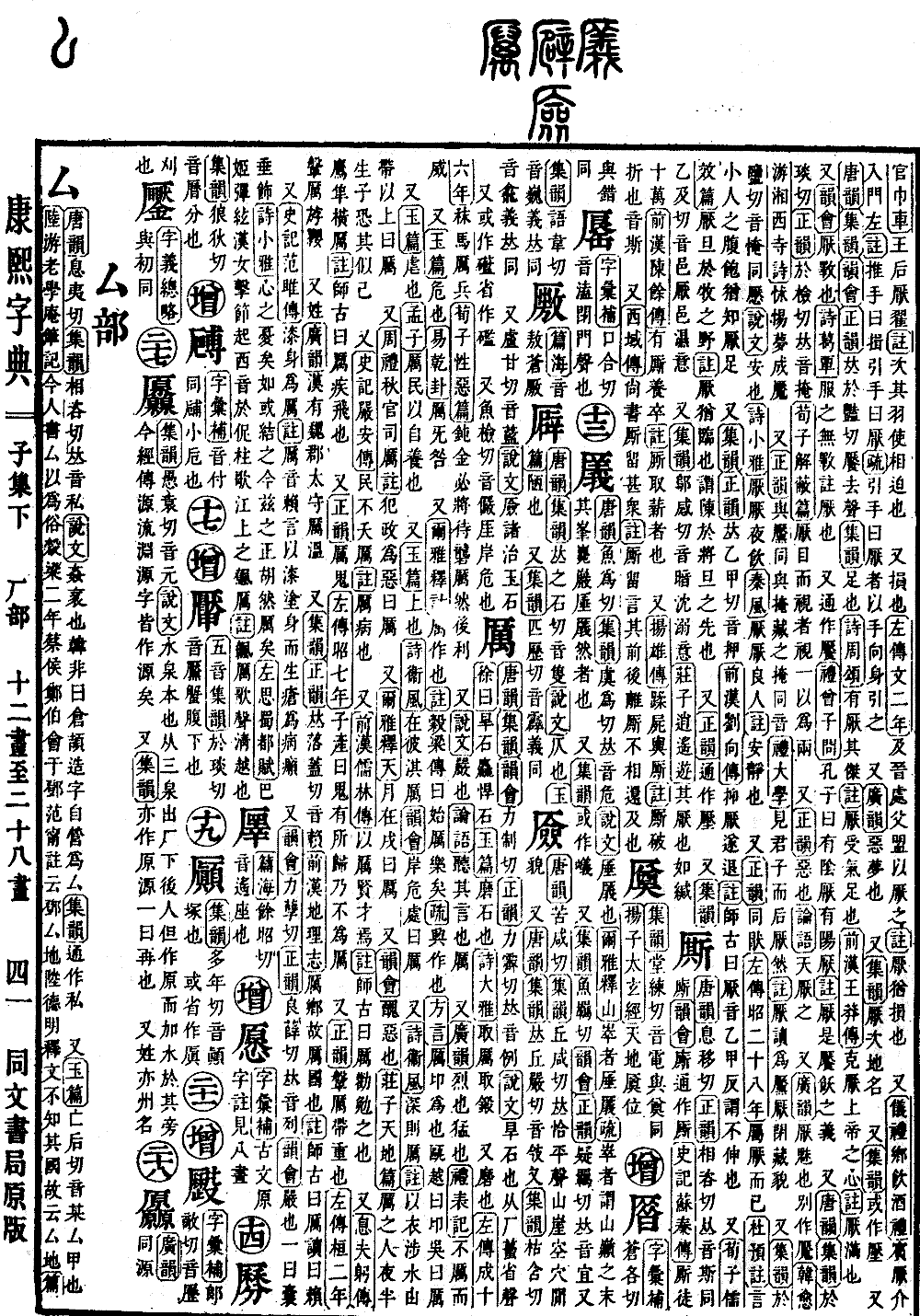
Zi Collection, Page Position: Lower
Radical: Cliff (chǎng)
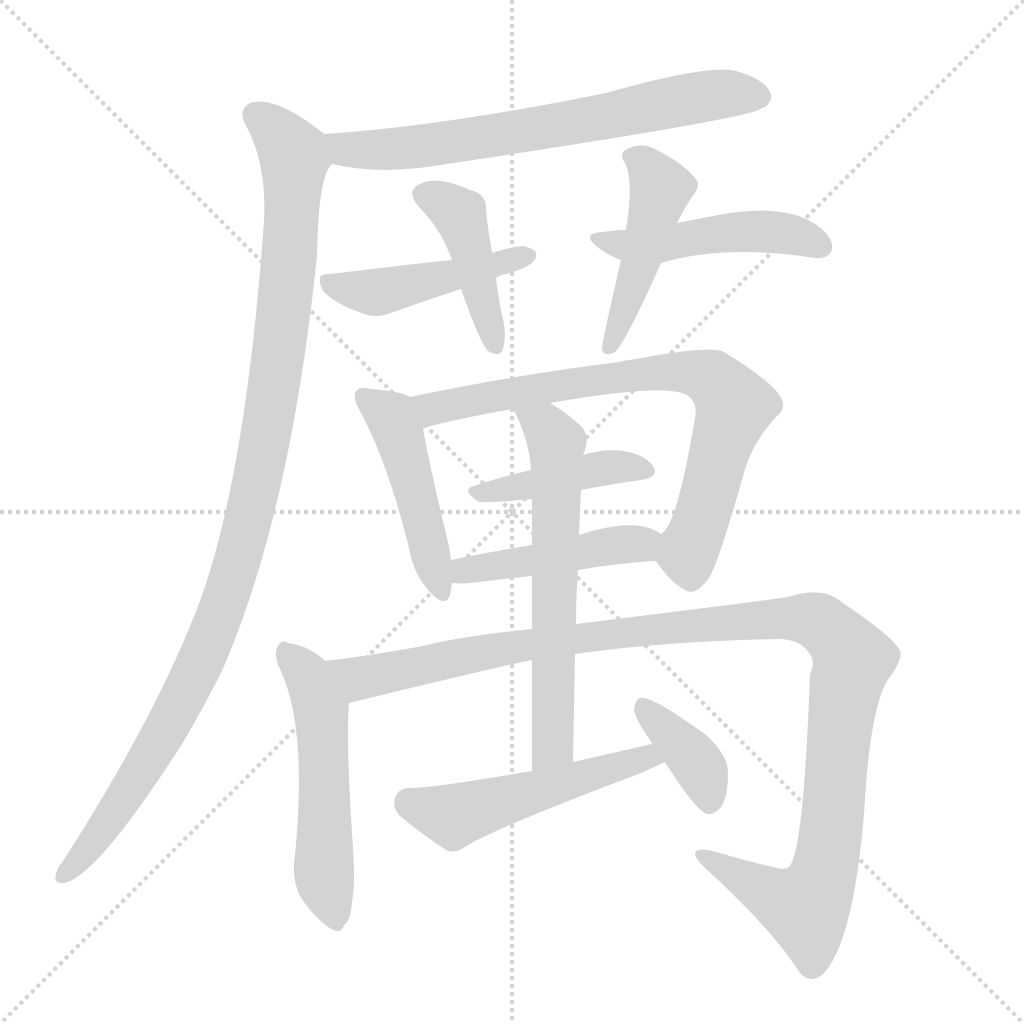
Character: lì
Kangxi Stroke Count: 15
Page Number: Page 163, Number 09
Tang Dictionary (Tangyun), Collected Rhymes (Jiyun), and Consonant Rhymes (Yunhui) indicate the pronunciation is a combination of the sounds lì and zhì. Correct Rhymes (Zhengyun) indicates the pronunciation is a combination of the sounds lì and jì. The sound is the same as lì.
Explaining Graphs and Analyzing Characters (Shuowen Jiezi) defines this as a coarse stone. It is derived from the radical Cliff (chǎng), with the abbreviated phonetic component chài. Xu says it is a coarse, hard stone. Jade Chapters (Yupian) defines it as a whetstone. Taking the whetstone and the forge — Book of Odes (Shijing).
Also means to sharpen or grind. Feeding the horses and sharpening the weapons — Zuo Commentary (Zuozhuan). Dull metal must await grinding and sharpening to become sharp — Xunzi (Xunzi).
Also defined in Shuowen Jiezi as severe. To hear their words is to find them stern — Analects (Lunyu).
Expanded Rhymes (Guangyun) defines it as intense or fierce. Majestic without being fierce — Book of Rites (Liji).
Yupian defines it as dangerous. Danger, but no blame — Book of Changes (Yijing).
Erya (Erya) defines it as to act or set in motion. The Guliang Commentary (Guliang Zhuan) notes that the music began to be performed. The sub-commentary states it means to arise and act. Dialects (Fangyan) defines it as to do. People of the Ou-Yue and Wu regions use the term lì.
Yupian defines it as oppressive. Oppressing the people to support oneself — Mencius (Mengzi).
Yupian defines it as the top or edge. Upon the bank of the Qi River — Shijing. Yunhui notes that a steep place on a riverbank is called lì.
Shijing says if the water is deep, one wades. The commentary notes that to cross water with clothes on, where the water is above the belt, is called lì.
Rites of Zhou (Zhouli) commentary states that to violate government policy and commit evil is called lì.
Erya defines the moon in the position of xu as lì.
Yunhui defines it as ugly or loathsome. An ugly person who bears a child at midnight fears the child will resemble them — Zhuangzi (Zhuangzi).
Records of the Grand Historian (Shiji) states that the people suffer no premature death or disease. The commentary defines lì as illness.
Book of Han (Hanshu) mentions using it to encourage talented people. Yan Shigu says lì means to encourage and exhort.
In the biography of Xi Fugong in the Hanshu, it describes hawks and falcons flying across swiftly. Yan Shigu says lì means to fly fast.
Zhengyun defines it as an evil spirit. Zichan said that when a ghost has a place to return to, it does not become an evil spirit — Zuozhuan.
Zhengyun defines panli as the weight of a sash. Sashes and tassels — Zuozhuan.
Also a surname. Guangyun mentions that in the Han Dynasty, there was Li Wen, the Governor of Wei Commandery.
Jiyun and Zhengyun give an alternative pronunciation as lài. Hanshu mentions Li Village, which was formerly the State of Li. Yan Shigu says lì is read here as lài. Shiji mentions coating the body in lacquer to become lì. The commentary says the pronunciation is lài, meaning to coat the body in lacquer and produce sores, becoming afflicted with leprosy (làni).
Yunhui and Zhengyun give an alternative pronunciation as liè. Yunhui defines it as severe. Another definition is an ornament hanging from a bag. My heart is grieved as if bound; why is the current government so severe — Shijing. In the Rhapsody on the Capital of Shu (Shudu Fu) by Zuo Si, it describes singing the lì upon the river. The commentary says the sound of the singing is clear and piercing.
Verification: In the Yijing, the phrase danger, but no blame originally used a variant form for the word no, which is corrected to the standard form according to the original text.