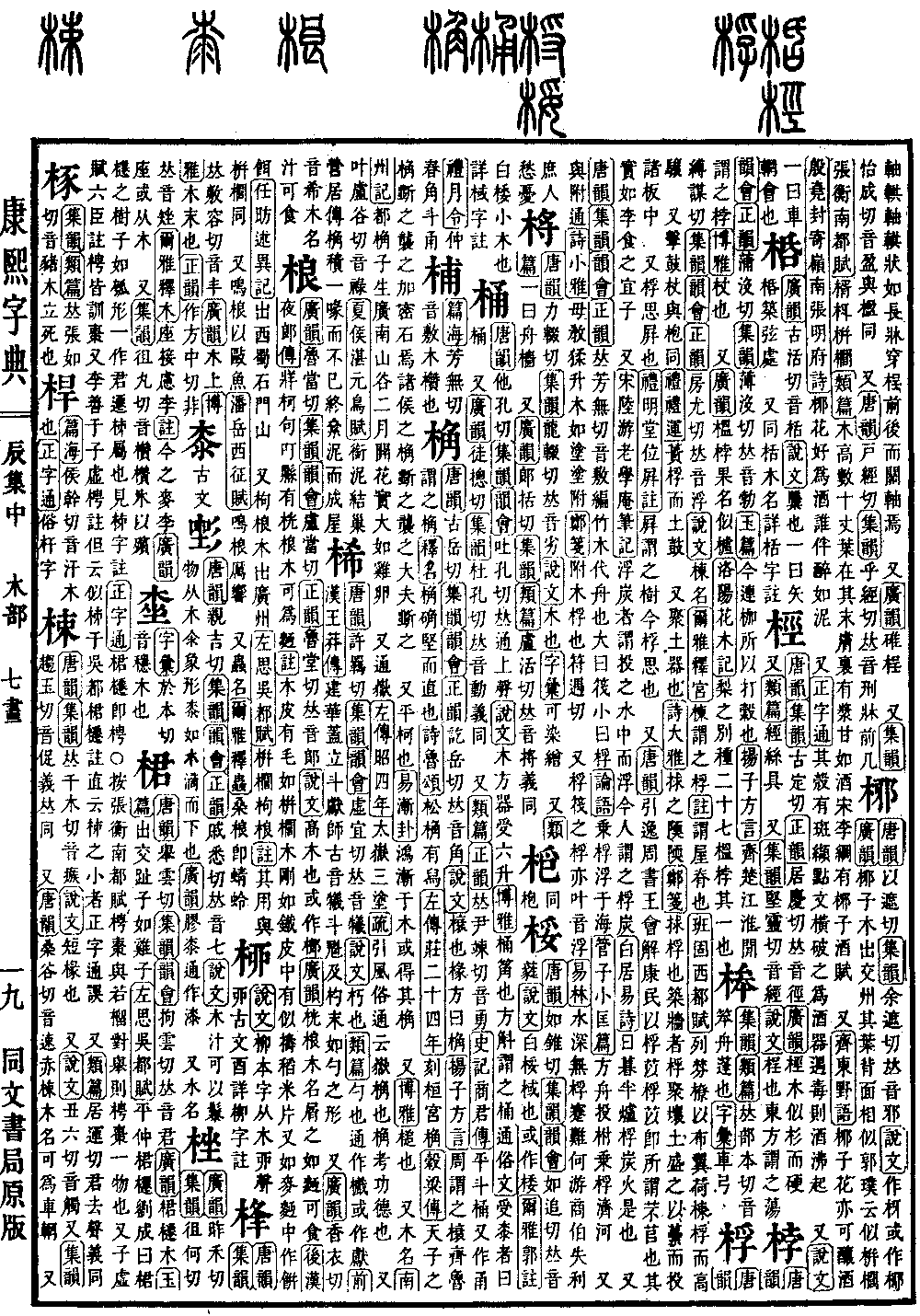
Chen Collection, Middle Volume
Radical: Tree (mù)
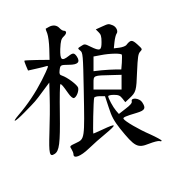
Character: Lang
Kangxi Stroke Count: 11
Page 527, Entry 14
Pronounced lang.
According to the Explaining Graphs and Analyzing Characters (Shuowen Jiezi), it refers to a tall tree. Sometimes also written in a variant form (lang).
According to the Extensive Dictionary of Rhymes (Guangyun), there is a tree called guanglang, which can be ground into a flour-like substance that is edible.
According to the History of the Later Han (Houhan Shu), Account of Yelang, in Junding County of Zangke, there exists the guanglang tree, which can be made into flour. The commentary notes that the bark of this tree is hairy like a palm tree, the wood is as hard as iron, and the inner part contains something resembling pounded rice flakes. It is similar to wheat flour and can be made into cakes and dumplings.
According to Ren Fang's Record of Strange Things (Shuyi Ji), it is found in the Stone Gate Mountains of western Shu.
There is also the goulang tree, which grows in Guangzhou. According to Zuo Si's Rhapsody on the Capital of Wu (Wudu Fu), it is grouped with the palm tree and the goulang. The commentary notes that its usage is the same as the palm tree.
It also refers to the minglang, used to drive fish. According to Pan Yue's Rhapsody on the Western Expedition (Xizheng Fu), the minglang sounds sharply.
It is also the name of an insect. According to the Literary Expositor (Erya), Interpretation of Insects, the sanglang is the dragonfly.
Textual research: In the History of the Later Han, Account of Yelang, the text mentions Junding County. In accordance with the original text, Ding has been corrected to Ting.