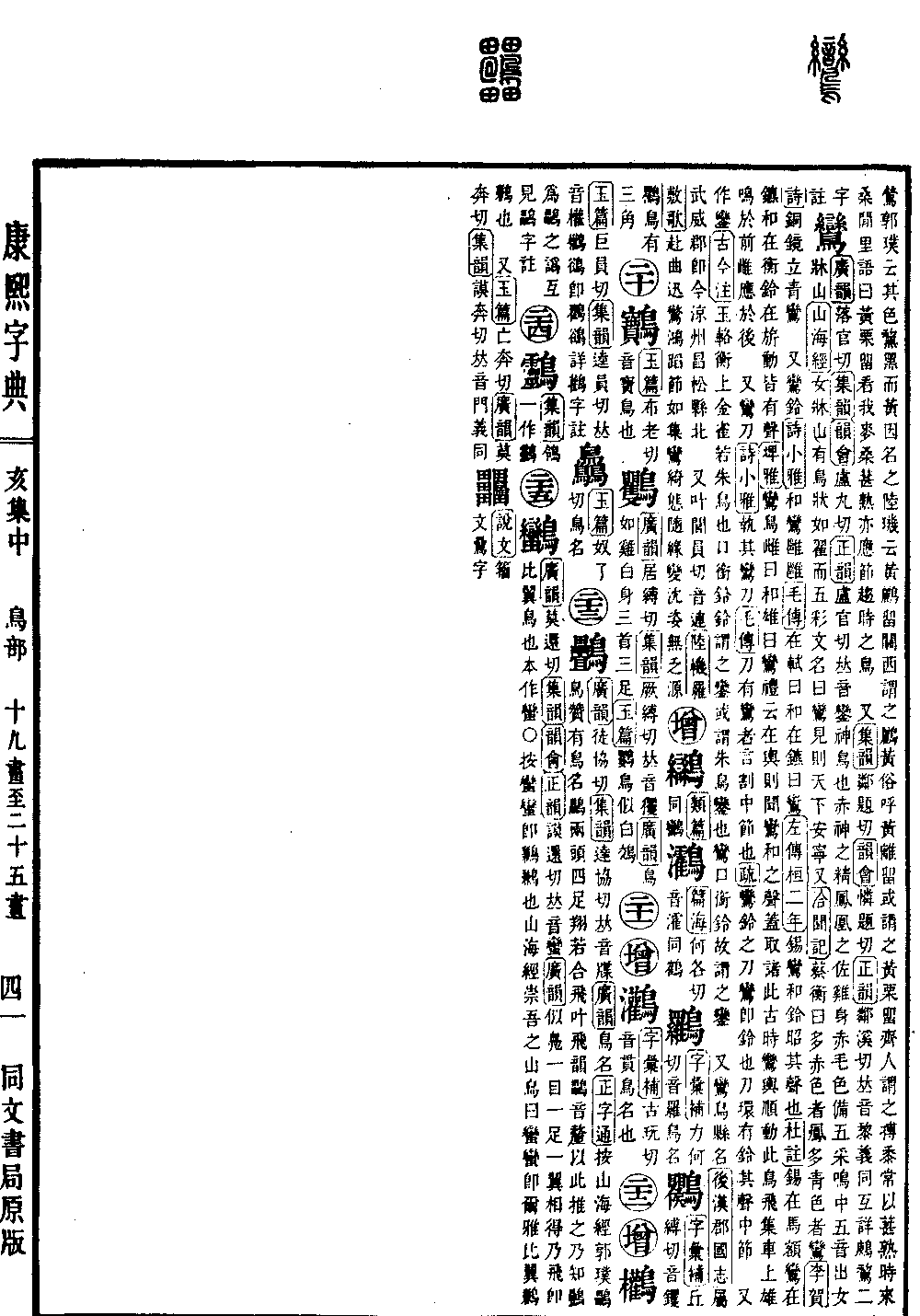
Hai Collection, Middle Volume. Radical: Bird (niǎo). Kangxi strokes: 30. Page 1505, Entry 01.
Pronounced luán. In the Extensive Rhymes (Guangyun), it is pronounced luánguan. In the Collected Rhymes (Jiyun) and the Rhyme Collection (Yunhui), it is pronounced lúan. In the Correct Rhymes (Zhengyun), it is pronounced luánguan. The pronunciation is the same as lúan. It is a mythical bird, the quintessence of red spiritual energy, an attendant to the phoenix. Its body resembles a chicken, covered in red feathers with all five colors present. Its cry aligns with the five musical tones, and it originates from Mount Nüchuang. According to the Classic of Mountains and Seas (Shanhaijing), Mount Nüchuang has a bird shaped like a pheasant with a long tail and five-colored patterns, named luan. When it appears, the world enjoys peace. Additionally, the Qiawenji records Cai Heng as saying that those with mostly red feathers are phoenixes, while those with mostly blue feathers are luan. A line in the poems of Li He mentions a blue luan standing before a bronze mirror. There is also the term luanling (luan bell). The Book of Odes (Shijing), Lesser Odes of the Kingdom section, writes that the he bell and the luan bell ring in harmony. The Mao Commentary explains that the bell hanging on the crossbar of a carriage is called he, and the bell hanging on the bit of a horse is called luan. The Zuo Tradition (Zuo Zhuan), second year of Duke Huan, records that the tin ornaments on a horse's forehead, the luan bells on the bit, the he bells on the crossbar, and the bells on the banners were all used to broadcast sound. The Du Commentary explains that the tin ornaments are on the forehead, the luan bells on the bit, the he bells on the crossbar, and the bells on the banners; when they move, they produce sound. The Piya states that for the luan bird, the female is called he and the male is called luan. The Book of Rites (Liji) states that hearing the sounds of the luan and he on a carriage is likely derived from this meaning. In ancient times, when the emperor traveled in his carriage, these birds would fly and gather on the carriage, with the males calling in front and the females responding from behind. There is also the term luandao (luan knife). The Book of Odes (Shijing), Lesser Odes of the Kingdom section, writes of holding that luan knife. The Mao Commentary explains that there is a luan bell on the knife, implying that cutting can be done in rhythm. The Sub-commentary explains that for a knife with a luan bell, luan refers to the bell. There is a bell on the knife ring, and its sound conforms to rhythm. It is sometimes written in the variant form luan. The Records of Ancient and Modern (Gujinzhu) states that the gold bird ornament on the crossbar of the emperor's jade carriage resembles a red bird. It holds a bell in its mouth, and this bell is called luan. Some say it is a luan in the shape of a red bird. Because the luan bird holds a bell in its mouth, it is called luan. There is also Luanniao, which is the name of a county. The Book of the Later Han: Treatises on Administrative Geography (Houhan Junuozhi) records it as belonging to Wuwei Commandery, which is the northern part of the present-day Changsong County in Liangzhou. It is also pronounced in a rhyming sense as lüanyuan, sounding like lian. The Luofu Song by Lu Ji sings: Responding to the melody more swiftly than a startled wild goose, stepping to the rhythm like a flock of luan gathering, beautiful postures changing with the occasion, the profound expression having no source of depletion.