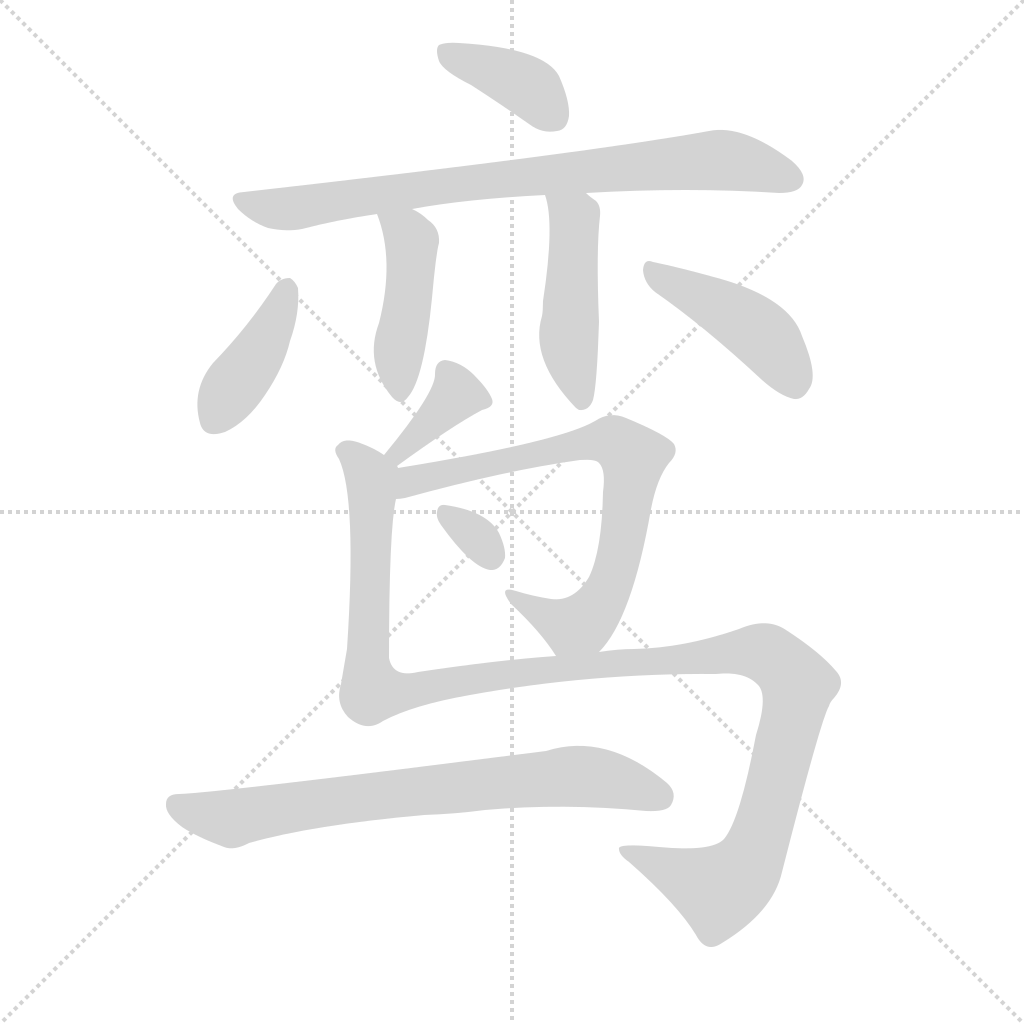
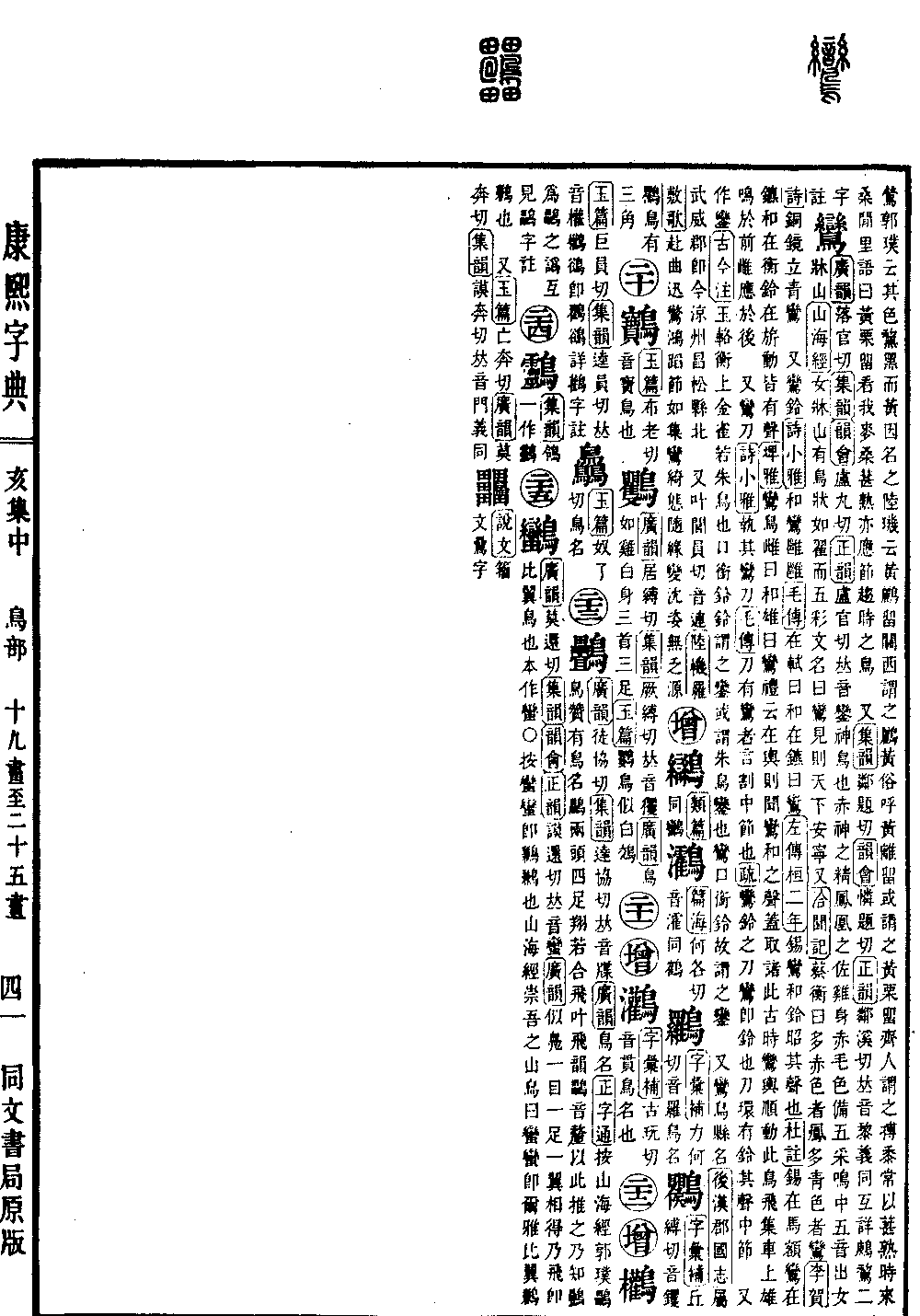
Hai Collection, Middle Volume. Radical: Bird (niǎo).
Kangxi strokes: 30. Page 1505, Entry 14.
Pronounced luán. A divine bird. It is the refined essence of red-colored divinity and acts as an assistant to the phoenix. Its body shape resembles a chicken, and it is covered in red feathers that possess five distinct colors. Its call corresponds to the five musical tones. It originates from Nüchuang Mountain. Classic of Mountains and Seas (Shanhaijing): On Nüchuang Mountain, there is a bird shaped like a long-tailed pheasant with five-colored patterns, named the luan. When it appears, the world attains peace.
Also, Qiawenji (Records of Extensive Inquiry) quotes Cai Heng saying: A bird with a predominance of red is a feng, and a bird with a predominance of cyan is a luan.
Li He poem: A bronze mirror holds a green luan.
Also refers to luan bells. Book of Odes (Shijing), Minor Odes (Xiaoya): The he and luan bells chime harmoniously.
Mao Commentary: The bell on the front rail of a carriage is called he, and the bell on the horse’s bit is called luan.
Zuo Commentary (Zuozhuan), Second Year of Duke Huan: Bestowing luan and he bells is to manifest the sound of the carriage and horses.
Du Commentary: The xi bell is on the horse’s forehead, the luan is on the bit, the he is on the rail, and the ling is on the banner; each moves and makes a sound.
Piya (Explication of Terms): Of the bird known as the luan, the female is called he and the male is called luan. The Book of Rites (Liji) says: That one can hear the sounds of the luan and he on a carriage originates from this meaning. In ancient times, when the emperor’s carriage traveled, this bird would fly and land on the carriage; the male would call from the front, and the female would respond from behind.
Also refers to luan knives. Book of Odes (Shijing), Minor Odes (Xiaoya): Holding those luan knives.
Mao Commentary: The knife has a luan ornament, meaning the cutting and slicing accords with the rhythm.
Sub-commentary: A knife with luan bells; the luan is a bell. The ring on the knife has a bell, and its sound matches the rhythm.
Also written as lúan.
Gujin Zhu (Commentary on Past and Present): The golden bird on the crossbar of the imperial carriage is shaped like a red bird. It holds a bell in its beak, and this bell is called lúan. Some say it is a red bird-shaped lúan ornament. The luan bird holds a bell in its beak, hence it is called lúan.
Also refers to Luan, which is a county name. History of the Later Han (Hou Hanshu), Treatise on Geography: Belonged to Wuwei Commandery; it is located north of present-day Changsong County in Liangzhou.
Also rhymes with lian (pronounced lián).
Lu Ji, Luofu Ge (Song of Luofu): Responding to the melody as swiftly as startled wild geese, treading the beat like gathered luan birds; the beautiful posture changes with the melody, the profound demeanor has no exhausted source.