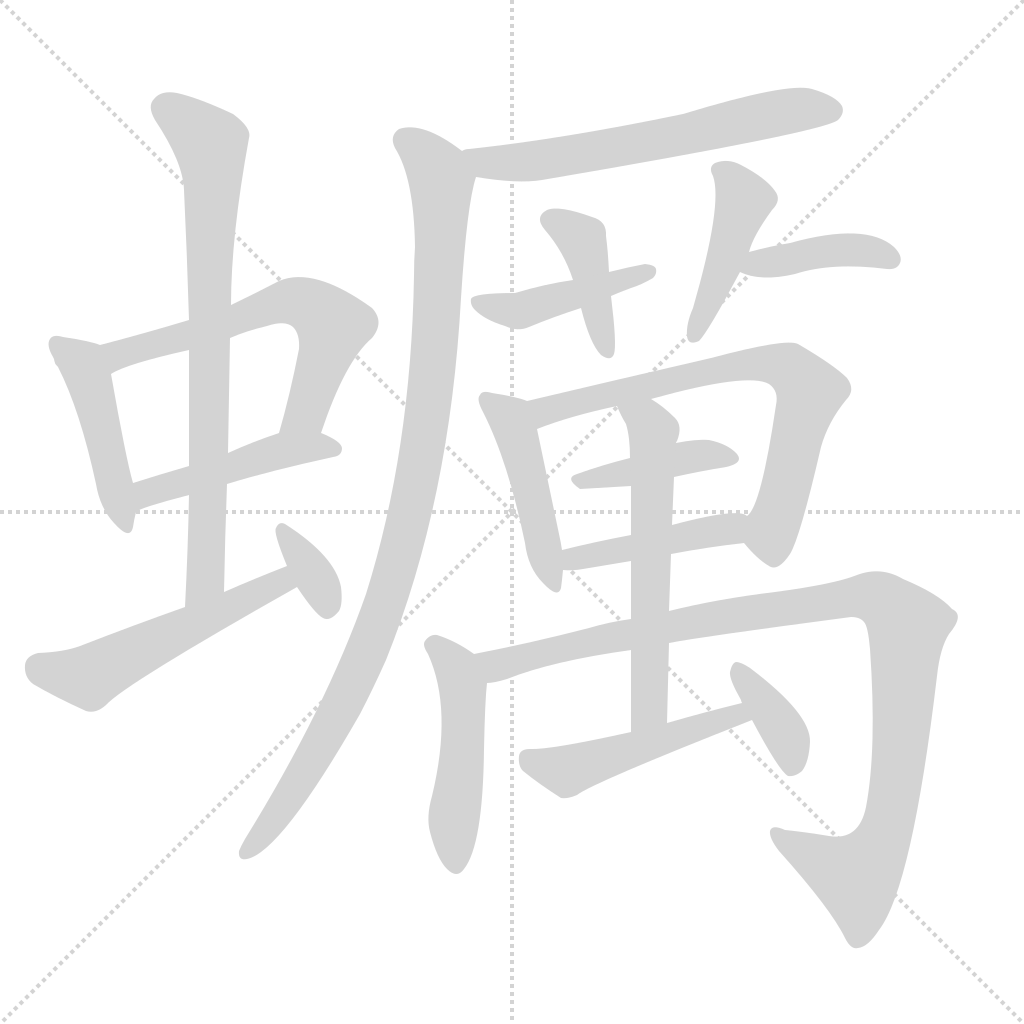
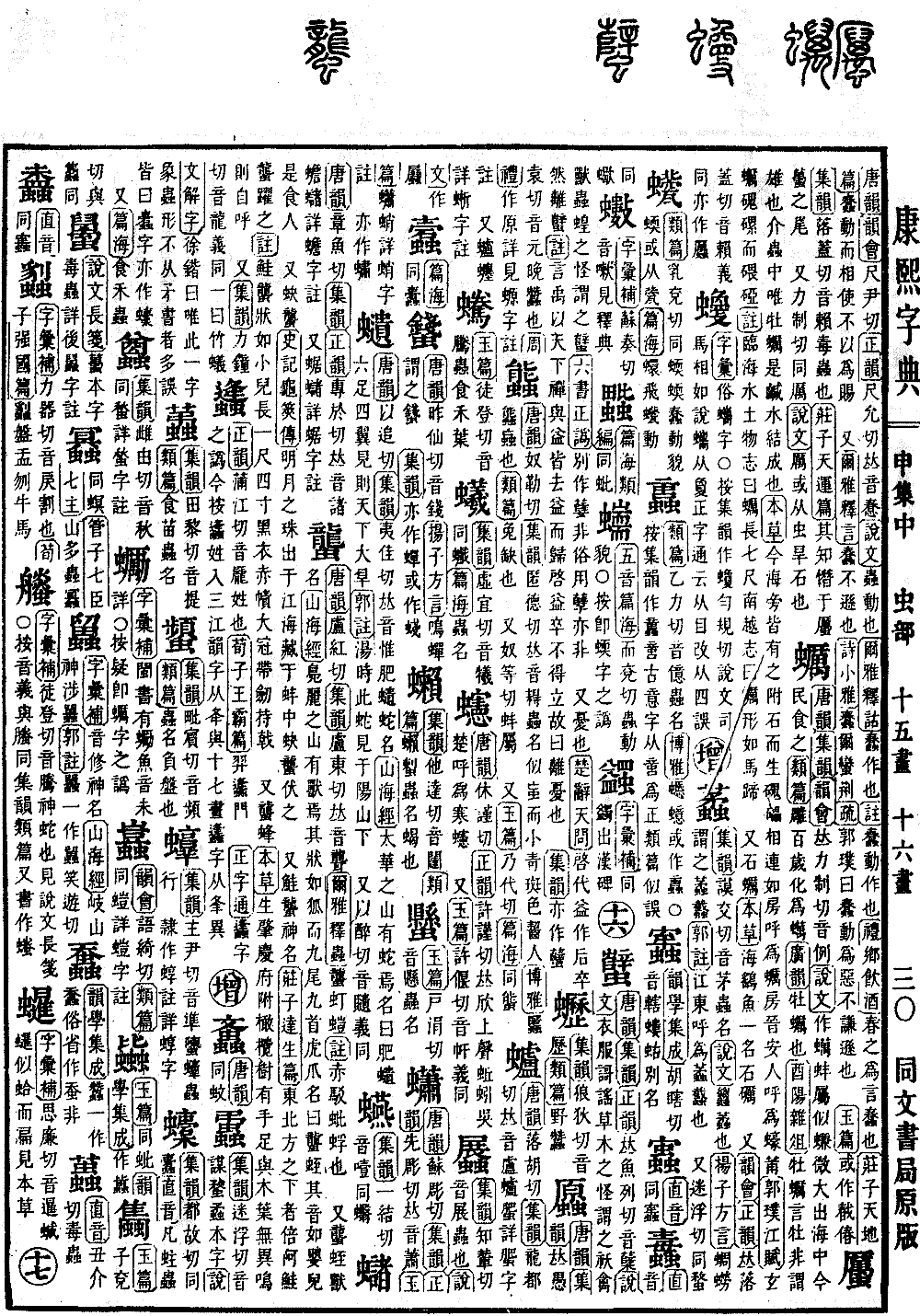
Shen Collection, Middle Volume. Radical: Insect (chóng). Kangxi stroke count: 21. Page 1102, Entry 02.
Pronounced li (falling tone), same pronunciation as li (falling tone).
In the Shuowen Jiezi (Explaining Graphs and Analyzing Characters), it is written as li. It belongs to the clam family. It resembles a small clam but is slightly larger, found in the sea, and is currently eaten by the common people.
The Leipian (Classified Dictionary) records: When the eagle reaches one hundred years of age, it transforms into a li.
The Guangyun (Expanded Dictionary of Rhymes) refers to it as the oyster.
The Youyang Zazu (Miscellaneous Morsels from Youyang) states that it is called the mu (male) oyster, not because it is male, but because among the shellfish, only the oyster is formed by the congealing of salt water.
The Bencao (Compendium of Materia Medica) records: They are currently found along all seashores, growing attached to rocks. Their outer shells are bumpy and joined together like houses, known as li-fang (oyster houses). The people of Jin'an call it hao-pu.
Guo Pu, in his Jiang Fu (Rhapsody on the River), writes: The oysters are rugged and uneven.
Note: The Linhai Shuitu Wuzhi (Treatise on the Soil and Products of Linhai) says: The oyster grows to seven feet long. The Nanyue Zhi (Record of Southern Yue) says: The shape of the oyster resembles a horse hoof.
There is also the stone oyster.
The Bencao (Compendium of Materia Medica) records: The sea kite fish has another name, stone li.
Additionally, the Yunhui (Collection of Rhymes) and Zhengyun (Correct Rhymes) state the pronunciation is lai (falling tone), with the same meaning. It is also written in a variant form.