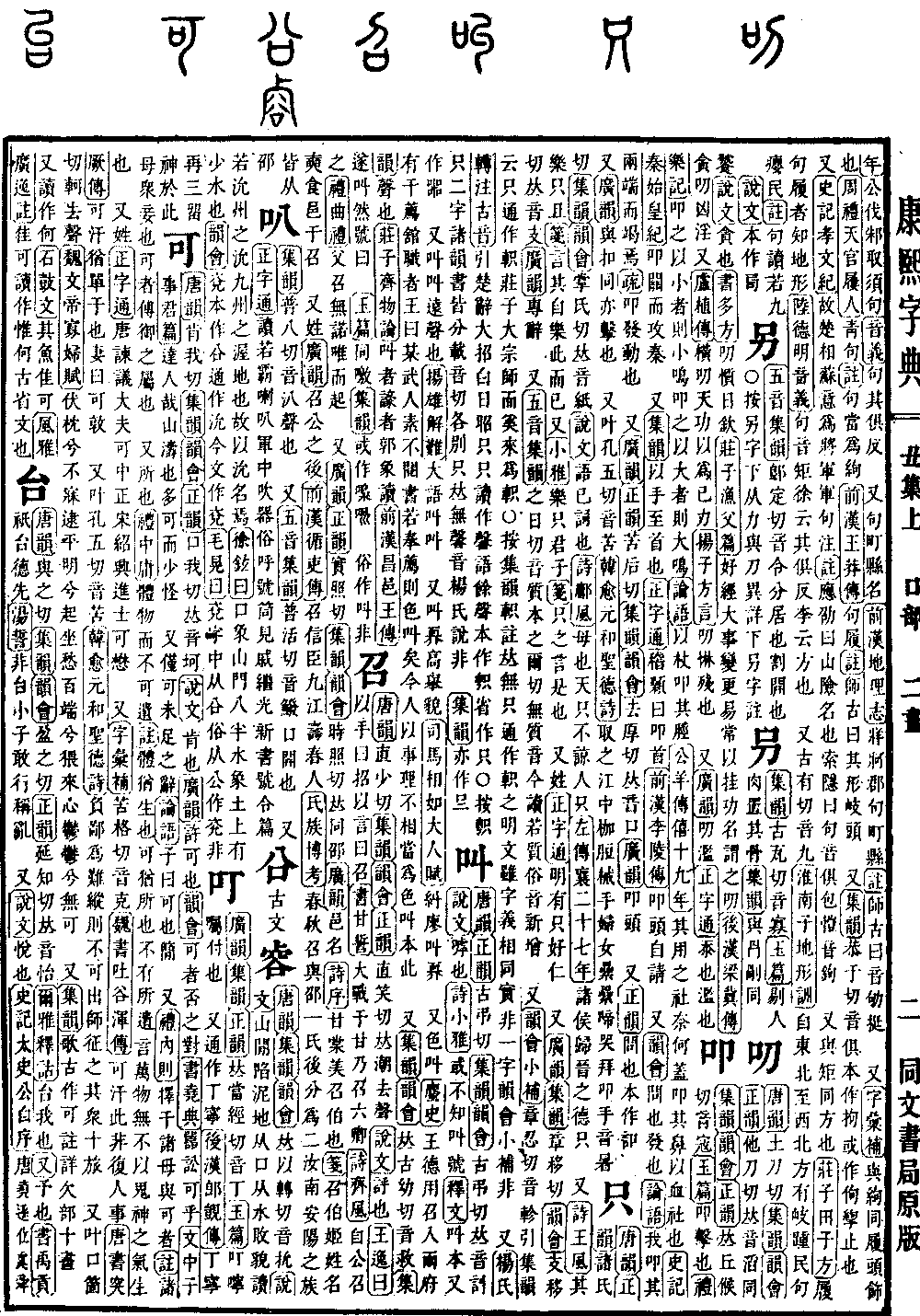
Chou Collection, Upper Volume
Radical: Mouth (kǒu)
Kangxi stroke count: 5
Page 172, Entry 04
Pronounced qiu.
Yupian: To strike.
Book of Rites (Liji): When one strikes a small object, it produces a small sound; when one strikes a large object, it produces a large sound.
Analects (Lunyu): To strike his shins with a staff.
Gongyang Commentary (Gongyang Zhuan): How was the sacrifice to the soil deity performed? It was likely done by striking its nose and using the blood to offer to the deity.
Records of the Grand Historian (Shiji): To strike at the Hangu Pass to attack the Qin state.
Also, according to Jiyun: To bring the hand to the forehead.
Zhengzitong: To knock the head is called koutou (kowtow).
Book of Han (Hanshu): To kowtow and make a personal plea.
Also, according to Yunhui: To inquire or to elicit.
Analects (Lunyu): I inquire into both sides of the question for him and provide a full answer.
Sub-commentary (Shu): Kou means to elicit.
Also, pronounced kou.
Guangyun: To kowtow.
Zhengzitong: To inquire. Originally written as the variant form (kou).
Also, according to Guangyun: The same as the variant form (kou), which also means to strike.
Also, following the rhyme pattern for kong and wu, pronounced ku.
Han Yu, Poem on the Holy Virtues of the Yuanhe Era (Yuanhe Shengde Shi): Captured from the river, with shackles around their necks and bound hands. Women gather in groups, weeping and kneeling to kowtow. Shou is pronounced shu.
Correction: In the citation from Book of Rites (Liji), the original text indicated Music Record (Yueji), which has been corrected to Record of Learning (Xueji) to match the original dictionary entry.